


Shadi Tabibian: When Patients Bleed but Standard Testing Is Normal
Shadi Tabibian, Deputy of research at Blood Diseases Research Centers in Iran University of Medical Sciences, shared a post on LinkedIn:
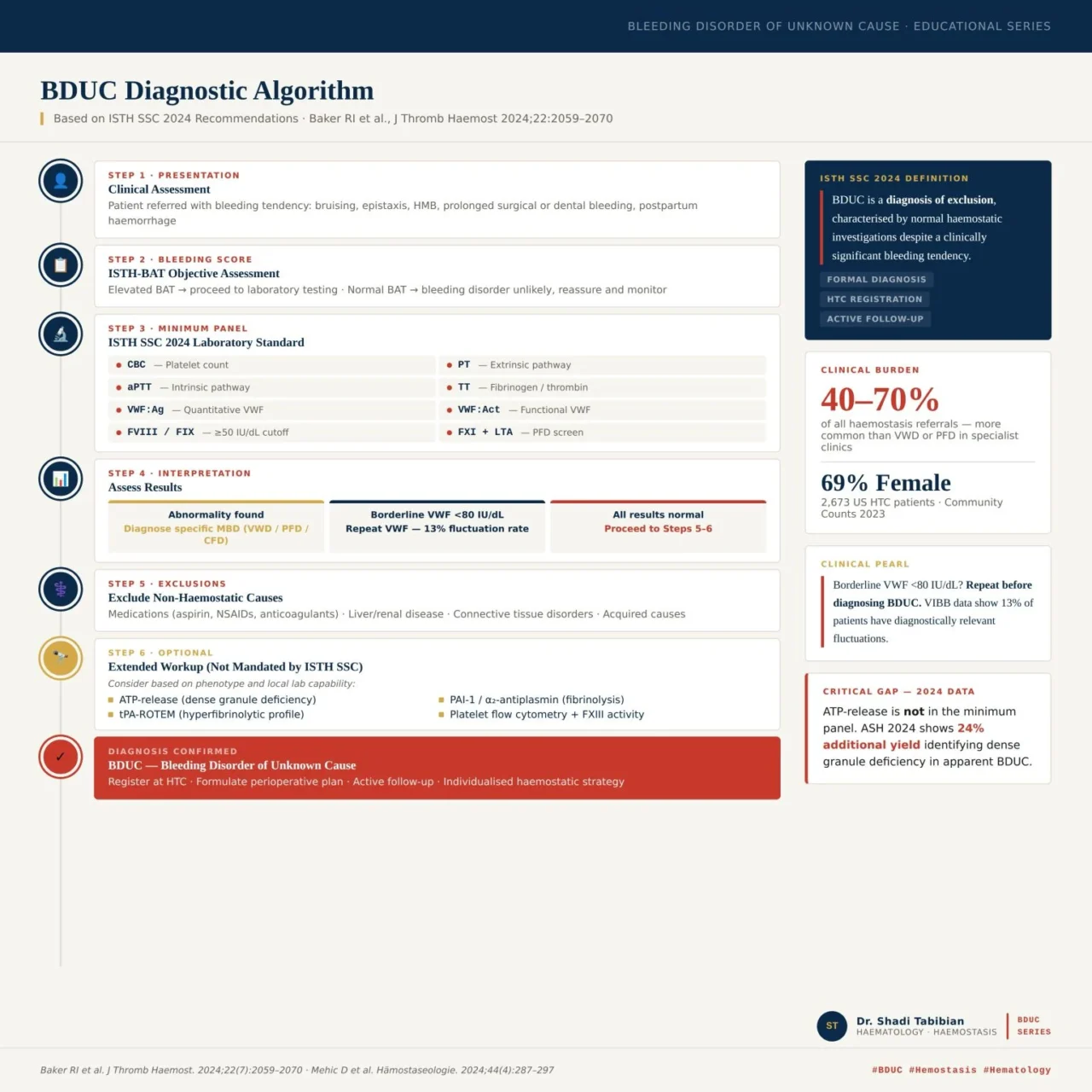
“In 40–70% of patients referred for a bleeding tendency, every standard test comes back normal.
No platelet defect. No coagulation factor deficiency. No von Willebrand disease.
Just a patient who bleeds — and a diagnosis we cannot make.
We call this Bleeding Disorder of Unknown Cause (BDUC). And for decades, what happened next depended entirely on which centre the patient walked into. Some were registered. Most were discharged. Almost none received a standardised workup.
That changed in 2024.
The Scientific and Standardization Committee of the ISTH published the first internationally endorsed definition, minimum diagnostic criteria, and management framework for BDUC. For the first time, there is a globally agreed answer to the question: what does a complete workup actually look like?
The minimum panel now requires:
- CBC, PT, aPTT, Thrombin time
- VWF antigen with VWF activity
- FVIII, FIX, FXI (cutoff greater than 50 IU/dL)
- Platelet light transmission aggregometry (LTA)
All normal. Confirmed BDUC. Register the patient. Plan their care.
But here is what the consensus did not resolve:
The minimum panel does not mandate ATP-release assays. Data presented at ASH 2024 show a 24% incremental diagnostic yield when ATP-release is added to LTA — identifying dense granule deficiency in patients previously labelled BDUC.
No randomised controlled trial exists for any treatment. The 77% postpartum haemorrhage rate in BDUC patients without prophylaxis is one of the most striking numbers in all of haemostasis. And we have no Level 1 evidence to guide what to do about it.
The 2024 ISTH SSC Communication is a landmark — the most important BDUC guideline development in a decade. But it is a starting line, not a finish line.
Figure 1 of my BDUC Educational Series maps the full diagnostic pathway — from the first clinical encounter to confirmed BDUC — with every decision node, every branch, and every critical pearl built in.
Are you registering your BDUC patients at your HTC?
Is your minimum panel aligned with the 2024 SSC recommendations?”
Stay updated with Hemostasis Today.
-
Jul 26, 2026, 12:20Advancing Sickle Cell Care Through Advocacy – American Society of Hematology
-
Jul 26, 2026, 12:04Paolo Zamboni: Marking 50 Years in Medicine
-
Jul 26, 2026, 11:55William Wallace: Muscle Aging Emerges as the Strongest Mortality Predictor
-
Jul 26, 2026, 08:51Dayita Banerjee: Presenting New Insights in Fibrinolysis Research at ISTH 2026
-
Jul 26, 2026, 08:39Roshni Kulkarni: The Human Face of Postpartum Hemorrhage
-
Jul 26, 2026, 08:14Atahar imam Hasan: Universal Artificial Blood and the Future of Trauma Care
-
Jul 26, 2026, 07:40Maha Othman: Leading Scientific Collaboration Across Hemostasis at ISTH 2026
-
Jul 26, 2026, 07:20Pablo Corral: Why Should Dyslipidemia Be Any Different?
-
Jul 26, 2026, 06:46Marios Georgakis: Largest GWAS of Transient Ischemic Attacks Reveals New Genetic Insights into Stroke Risk