


Tareq Abadl: Coombs Test – The Key to Detecting Immune-Mediated Hemolysis
Tareq Abadl, Medical Lab Specialist, shared a post on LinkedIn:
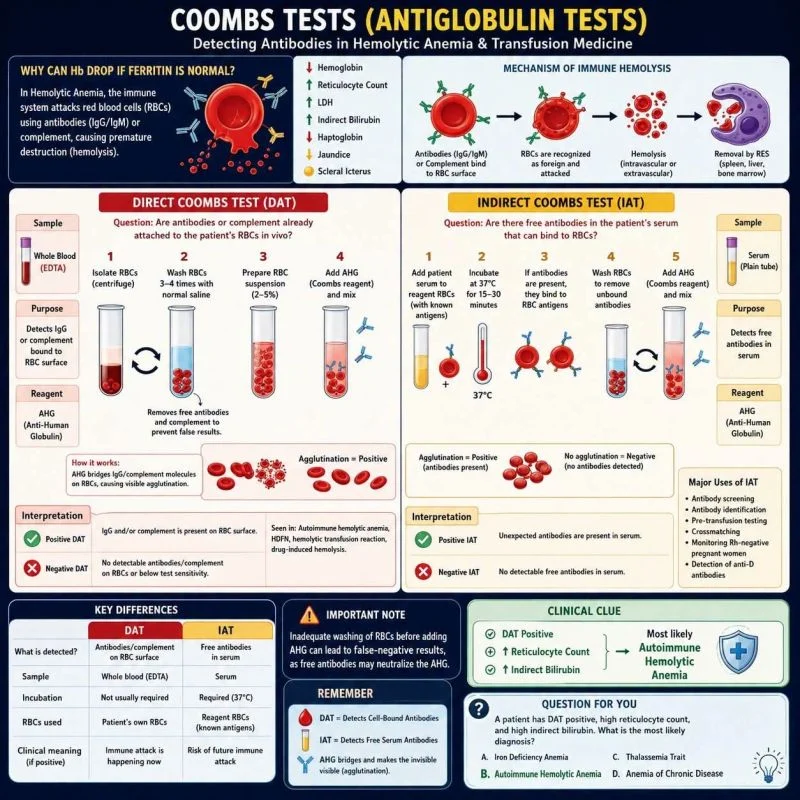
“Coombs Test (Antiglobulin Test): The Key to Detecting Immune-Mediated Hemolysis
How can a patient have normal iron stores and ferritin, yet their hemoglobin keeps falling?
Sometimes the problem isn’t iron deficiency—it’s the immune system attacking its own red blood cells (RBCs).
This immune destruction leads to Hemolytic Anemia, where antibodies or complement proteins target RBCs, causing premature hemolysis.
Common laboratory findings:
- Decreased Hemoglobin (Hb)
- Increased Reticulocyte Count
- Elevated LDH
- Elevated Indirect Bilirubin
- Decreased Haptoglobin
Patients may also develop:
- Jaundice
- Scleral Icterus
What is the Coombs Test?
Also known as the Antiglobulin Test, it uses Anti-Human Globulin (AHG) reagent to detect IgG antibodies and/or complement proteins.
The test answers two critical questions:
- Are antibodies already attached to RBCs?
- Or are they freely circulating in the serum, ready to attack?
Direct Coombs Test (DAT)
Purpose: Detect antibodies or complement already bound to RBCs in vivo.
Sample: EDTA Whole Blood
Principle:
RBCs are washed thoroughly to remove unbound antibodies, then AHG is added.
AHG acts as a bridge between sensitized RBCs, producing visible agglutination.
Positive DAT indicates:
- Autoimmune Hemolytic Anemia (AIHA)
- Hemolytic Transfusion Reactions
- Hemolytic Disease of the Fetus and Newborn (HDFN)
- Drug-Induced Hemolytic Anemia
Indirect Coombs Test (IAT)
Purpose: Detect free antibodies circulating in serum.
Sample: Serum
Principle:
Patient serum is mixed with reagent RBCs and incubated at 37°C.
If antibodies are present, they bind to the cells. After washing, AHG is added to detect sensitization.
Positive IAT indicates unexpected antibodies in the serum.
Common applications:
- Antibody Screening
- Antibody Identification
- Crossmatching
- Pre-Transfusion Testing
- Monitoring Rh-Negative Pregnancies
Why is IAT Important During Pregnancy?
An Rh-negative mother may develop antibodies against an Rh-positive fetus.
These antibodies can cross the placenta and cause Hemolytic Disease of the Fetus and Newborn (HDFN).
Early detection through IAT helps prevent serious complications.
Quick Memory Tip
DAT – Detects Cell-Bound Antibodies
IAT – Detects Free Serum Antibodies
High-Yield Point:
Improper washing before adding AHG may leave free antibodies in the tube, neutralizing AHG and causing a False Negative Result.
Golden Summary
DAT – Antibodies already attached to RBCs.
IAT – Antibodies circulating freely in serum.
AHG converts invisible sensitization into visible agglutination.
Incubation is essential in IAT.
Positive DAT – Active immune attack.
Positive IAT – Potential future risk from circulating antibodies.”
Other posts featuring Tareq Abadl on Hemostasis Today.
-
Sep 29, 2026, 19:00Caitlin Raymond: Can Artificial Blood Solve Blood Supply Shortages?
-
Sep 29, 2026, 18:51Chaza Alaji: Dyslipidemia, Thrombosis and the DIC Diagnostic Trap
-
Sep 29, 2026, 17:31Rajnikant Patel: Bridging Ayurvedic Concepts and Modern Toxin-Mediated Disease
-
Sep 29, 2026, 17:13Nicholas Lang։ A Meaningful Case of Immune Thrombocytopenia
-
Sep 29, 2026, 16:55Ayatullah Gamal Wahab: When the CBC Lies
-
Sep 29, 2026, 16:35Jonathan Douxfils: Navigating the VTE Risk Continuum in Reproductive Medicine
-
Sep 29, 2026, 16:35Chaima Rajeh: Types of Anemia and Their Laboratory Features
-
Sep 29, 2026, 16:27Scott Isaacs: How GLP-1 RAs Target Systemic Inflammation to Drive Cardio, Autoimmune, and Gut Health
-
Sep 29, 2026, 16:21Yitshak Kreiss: From Treating Patients to Defining the Standard of Knowledge