


Wolfgang Miesbach: How Clonal Hematopoiesis May Explain Age-Related Mitochondrial Mutations
Wolfgang Miesbach, Professor of Medicine at Frankfurt University Hospital, shared on LinkedIn about a recent article by Rahul Gupta et al, published in Nature, adding:
”Has the secret of aging been unlocked?
A groundbreaking Nature study analyzing 750,000 plus
genomes has revealed why our blood cells accumulate mitochondrial DNA mutations as we age—and the answer challenges decades of scientific thinking.
The two-step revelation:
Step 1: Mitochondrial DNA replication errors create low-level ‘cryptic’ mutations in our cells—think of them as hidden genetic typos that go unnoticed.
Step 2: Clonal hematopoiesis (CH) amplifies these mutations by expanding specific cell clones, making the previously invisible mutations detectable.
What makes this paradigm-shifting:
- NOT oxidative stress (the old theory) – Replication errors driving the process
- The mutations are neutral passengers, not drivers of disease—both functional and silent variants accumulate equally in CH carriers
- Clinical impact: Strong associations with myelodysplastic syndrome, leukemias, and chronic kidney disease
- Game-changer: mtDNA mutation burden could detect early CH before traditional screening identifies driver mutations
This elegant work connects three aging hallmarks—mitochondrial mutations, clonal hematopoiesis, and telomere biology—into one unified mechanism.
The implications for early detection and risk stratification in hematologic malignancies are profound.”
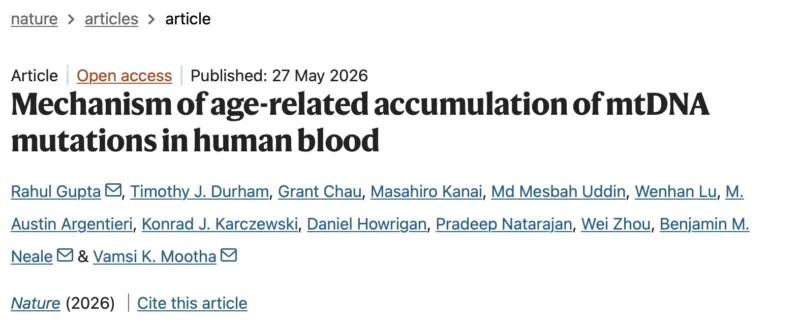
Title: Mechanism of age-related accumulation of mtDNA mutations in human blood
Authors: Rahul Gupta, Timothy J. Durham, Grant Chau, Masahiro Kanai, Md Mesbah Uddin, Wenhan Lu, M. Austin Argentieri, Konrad J. Karczewski, Daniel Howrigan, Pradeep Natarajan, Wei Zhou, Benjamin M. Neale, Vamsi K. Mootha
Stay updated on all scientific advances with Hemostasis Today.
-
Sep 29, 2026, 19:00Caitlin Raymond: Can Artificial Blood Solve Blood Supply Shortages?
-
Sep 29, 2026, 18:51Chaza Alaji: Dyslipidemia, Thrombosis and the DIC Diagnostic Trap
-
Sep 29, 2026, 17:31Rajnikant Patel: Bridging Ayurvedic Concepts and Modern Toxin-Mediated Disease
-
Sep 29, 2026, 17:13Nicholas Lang։ A Meaningful Case of Immune Thrombocytopenia
-
Sep 29, 2026, 16:55Ayatullah Gamal Wahab: When the CBC Lies
-
Sep 29, 2026, 16:35Jonathan Douxfils: Navigating the VTE Risk Continuum in Reproductive Medicine
-
Sep 29, 2026, 16:35Chaima Rajeh: Types of Anemia and Their Laboratory Features
-
Sep 29, 2026, 16:27Scott Isaacs: How GLP-1 RAs Target Systemic Inflammation to Drive Cardio, Autoimmune, and Gut Health
-
Sep 29, 2026, 16:21Yitshak Kreiss: From Treating Patients to Defining the Standard of Knowledge