


Ney Carter Borges: FAVOR III China Demonstrates a 37% Reduction in Myocardial Infarction with QFR Guidance
Ney Carter Borges, Member Cardiologist of Global Physician Association at Cleveland Clinic Florida, shared on LinkedIn about a recent article by Han Zhang et al, published in JACC, adding:
”QFR-Guided PCI Improves 5-Year Outcomes: The FAVOR III China Trial
The FAVOR III China trial provides the longest follow-up to date evaluating an angiography-derived physiological strategy for guiding percutaneous coronary intervention (PCI).
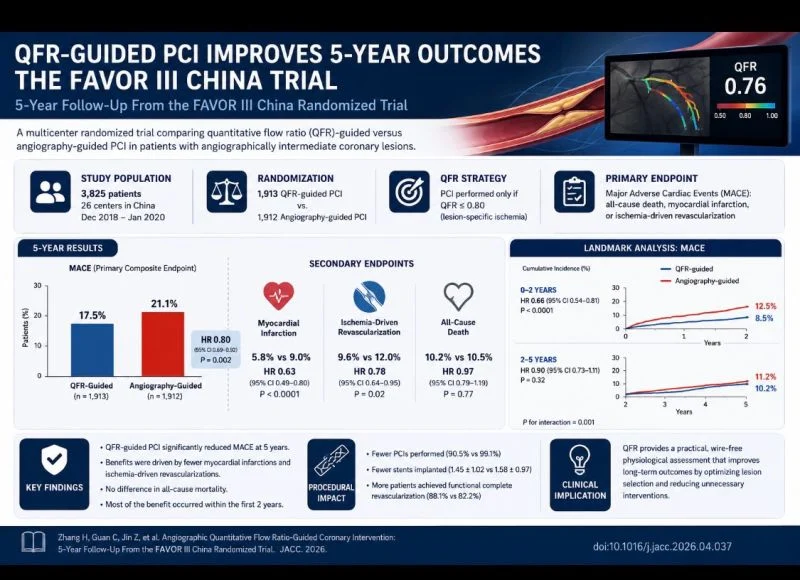
In this multicenter, randomized study involving 3,825 patients with intermediate coronary stenoses, participants were assigned to PCI guided either by Quantitative Flow Ratio (QFR) or by conventional angiography alone.
After 5 years, QFR guidance significantly reduced the incidence of major adverse cardiovascular events (MACE) compared with angiography-guided PCI (17.5% vs 21.1%; HR 0.80; 95% CI 0.69–0.92; p=0.002).
This benefit was primarily driven by a 37% reduction in myocardial infarction (5.8% vs 9.0%; HR 0.63; p<0.0001) and a 22% reduction in ischemia-driven repeat revascularization (9.6% vs 12.0%; HR 0.78; p=0.02).
Overall mortality was similar between groups, confirming that the physiological strategy improves ischemic outcomes without affecting long-term survival.
An important finding is that QFR-guided PCI resulted in fewer procedures and fewer implanted stents, while achieving greater functional completeness of revascularization.
By identifying lesions that truly produced ischemia, QFR avoided unnecessary interventions without compromising safety.
Landmark analysis demonstrated that most of the clinical advantage occurred during the first two years after PCI.
From years 2 to 5, event rates became similar, suggesting that the principal benefit of physiological guidance is the optimization of the initial revascularization strategy rather than continuous divergence over time.
Clinical message: QFR offers a practical, wire-free physiological alternative to FFR, allowing more precise lesion selection while reducing procedural complexity.
These 5-year results reinforce QFR as an effective strategy to improve long-term clinical outcomes, decrease unnecessary stenting, and reduce myocardial infarction and repeat revascularization in patients undergoing PCI.”
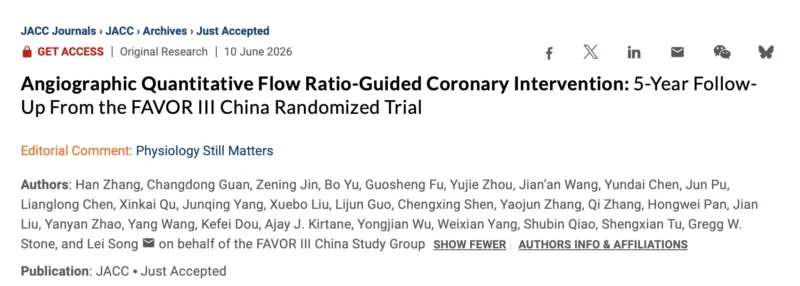
Title: Angiographic Quantitative Flow Ratio-Guided Coronary Intervention: 5-Year Follow-Up From the FAVOR III China Randomized Trial
Authors: Han Zhang, Changdong Guan, Zening Jin, Bo Yu, Guosheng Fu, Yujie Zhou, Jian’an Wang, Yundai Chen, Jun Pu, Lianglong Chen, Xinkai Qu, Junqing Yang, Xuebo Liu, Lijun Guo, Chengxing Shen, Yaojun Zhang, Qi Zhang, Hongwei Pan, Jian Liu, Yanyan Zhao, Yang Wang, Kefei Dou, Ajay J. Kirtane, Yongjian Wu, Weixian Yang, Shubin Qiao, Shengxian Tu, Gregg W. Stone, Lei Song
Stay updated on all scientific advances with Hemostasis Today.
-
Sep 29, 2026, 19:00Caitlin Raymond: Can Artificial Blood Solve Blood Supply Shortages?
-
Sep 29, 2026, 18:51Chaza Alaji: Dyslipidemia, Thrombosis and the DIC Diagnostic Trap
-
Sep 29, 2026, 17:31Rajnikant Patel: Bridging Ayurvedic Concepts and Modern Toxin-Mediated Disease
-
Sep 29, 2026, 17:13Nicholas Lang։ A Meaningful Case of Immune Thrombocytopenia
-
Sep 29, 2026, 16:55Ayatullah Gamal Wahab: When the CBC Lies
-
Sep 29, 2026, 16:35Jonathan Douxfils: Navigating the VTE Risk Continuum in Reproductive Medicine
-
Sep 29, 2026, 16:35Chaima Rajeh: Types of Anemia and Their Laboratory Features
-
Sep 29, 2026, 16:27Scott Isaacs: How GLP-1 RAs Target Systemic Inflammation to Drive Cardio, Autoimmune, and Gut Health
-
Sep 29, 2026, 16:21Yitshak Kreiss: From Treating Patients to Defining the Standard of Knowledge