


Ney Carter Borges: Is It Time to Personalize Antiplatelet Therapy?
Ney Carter Borges, Member Cardiologist of Global Physician Association at Cleveland Clinic Florida, shared on LinkedIn about a recent article by Dharam J. Kumbhani et al. published in JACC Journals, adding:
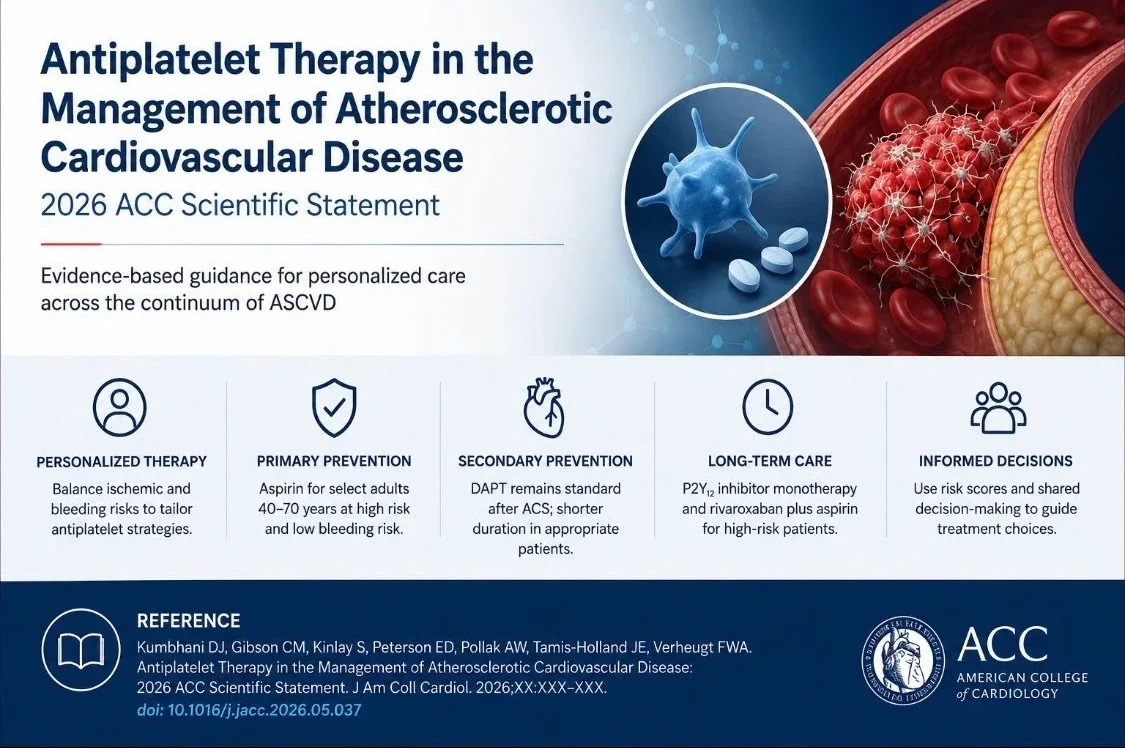
“Antiplatelet Therapy in Atherosclerotic Cardiovascular Disease: Toward a Personalized Strategy
The 2026 American College of Cardiology (ACC) Scientific Statement represents one of the most comprehensive updates on antiplatelet therapy in patients with atherosclerotic cardiovascular disease (ASCVD).
Rather than introducing a single new treatment paradigm, the document emphasizes individualized decision-making, recognizing that optimal therapy depends on balancing each patient’s ischemic and bleeding risks.
One of the statement’s most important messages is that routine aspirin for primary prevention is no longer appropriate for most individuals.
Contemporary preventive strategies—including intensive lipid lowering, blood pressure control, smoking cessation, and diabetes management—have substantially reduced aspirin’s incremental benefit while its bleeding risk remains unchanged.
Consequently, low-dose aspirin should be reserved for carefully selected adults aged 40–70 years with elevated cardiovascular risk and low bleeding risk, whereas routine use in adults older than 70 years is generally discouraged.
For secondary prevention, dual antiplatelet therapy (DAPT) remains the cornerstone following acute coronary syndrome (ACS).
Twelve months of aspirin combined with a potent P2Y12 inhibitor continues to be the standard approach, although shorter DAPT regimens followed by P2Y12 inhibitor monotherapy have emerged as effective strategies for reducing bleeding without compromising ischemic protection in appropriately selected patients.
The document also supports de-escalation from ticagrelor or prasugrel to clopidogrel after the first month in selected patients with increased bleeding risk.
The statement further highlights growing evidence supporting clopidogrel monotherapy beyond one year after ACS, suggesting that it may provide superior long-term ischemic protection with similar or even lower bleeding risk compared with aspirin alone.
In patients with stable coronary or peripheral artery disease who remain at high ischemic risk and have acceptable bleeding risk, the combination of low-dose rivaroxaban (2.5 mg twice daily) plus aspirin remains an important option for long-term secondary prevention.
Importantly, the ACC strongly advocates routine use of validated risk assessment tools—including DAPT, PRECISE-DAPT, and ARC-HBR—while emphasizing that these instruments should complement, rather than replace, individualized clinical judgment and shared decision-making.
The overarching message is clear: modern antiplatelet therapy is no longer defined by a fixed duration or universal regimen, but by precision medicine tailored to each patient’s evolving ischemic and bleeding profile.”
Title: Antiplatelet Therapy in the Management of Atherosclerotic Cardiovascular Disease: 2026 ACC Scientific Statement: A Report of the American College of Cardiology
Authors: Dharam J. Kumbhani, C. Michael Gibson, Scott Kinlay, Eric D. Peterson, Amy W. Pollak, Jacqueline E. Tamis-Holland, Freek W.A. Verheugt

Stay updated on all scientific advances with Hemostasis Today.
-
Oct 7, 2026, 16:44Amor Salah: 2026 NCS/SCCM Guidelines for Managing Antithrombotic-Associated ICH
-
Oct 7, 2026, 16:04NETs in Thrombosis: From Mechanism to Therapeutic Target
-
Oct 7, 2026, 15:28Amir Samimi: Prognostic Value of Platelet Count in Resected HNSCC
-
Oct 7, 2026, 15:21Eloïse Laouenan: Bridging Immunity and Thrombosis in MVTE
-
Oct 7, 2026, 15:10Uthra Sundaram: Honouring Donors During International Plasma Awareness Week
-
Oct 7, 2026, 15:04Daniel Victor Ortigoza: Should Frail Older Patients With AF Switch From VKA to DOACs?
-
Oct 7, 2026, 14:53Susan Noone: Donor Turned Recipient Shares Lifesaving Transfusion Story
-
Oct 7, 2026, 14:49Aimee Burtenshaw: The Impact of the Infected Blood Inquiry on Hospital Transfusion Laboratories
-
Oct 7, 2026, 14:41Vikash Jaiswal: Does Timing Matter for Calcium in Pre-Eclampsia Prevention?