


Nathan Connell: Is It Time to Rethink What We Tell Hemophilia B Carriers About Pregnancy?
Nathan Connell, Clinical Chief of Hematology at Brigham and Women’s Faulkner Hospital, shared on LinkedIn about a recent article by Claire Kelly et al, published in JTH, adding:
”Is it time to rethink what we tell hemophilia B carriers about pregnancy?
For years, guidelines have stated that factor IX levels do NOT rise during pregnancy in hemophilia B carriers, unlike factor VIII in hemophilia A carriers.
This has driven more conservative management, such as earlier planning for factor concentrate, and in some cases, ruling out neuraxial anesthesia.
But here’s the thing, that guidance was based on data from only around 30 carriers across 10 publications, many of which were isolated case reports.
A new Irish registry study by Kelly et al. in the Journal of Thrombosis and Haemostasis (JTH) examined 49 hemophilia B carriers across 87 pregnancies, the largest cohort to date, and noted:
- FIX levels DID rise significantly during pregnancy (mean 0.54 → 0.89 IU/mL, p < 0.0001)
- Even in women with mild hemophilia B (baseline <0.40), levels increased meaningfully (0.27 → 0.51 IU/mL)
- Every carrier with a baseline FIX between 0.30–0.49 reached levels >0.50, which may be enough for neuraxial anesthesia
Why does this matter?
We may have been overcorrecting. Some of these women were likely told they couldn’t have an epidural, or were given factor concentrate they may not have needed.
This study suggests that with proper third-trimester level monitoring, many hemophilia B carriers, especially those with mild disease, can be managed less conservatively than current guidelines recommend.
This doesn’t change the picture for carriers with very low baseline levels, where the rise may still be insufficient.
But for a meaningful proportion of carriers, it opens the door to safer, more patient-centered care.
Bottom line: Check the levels. Don’t assume they won’t rise. The data now say otherwise.”
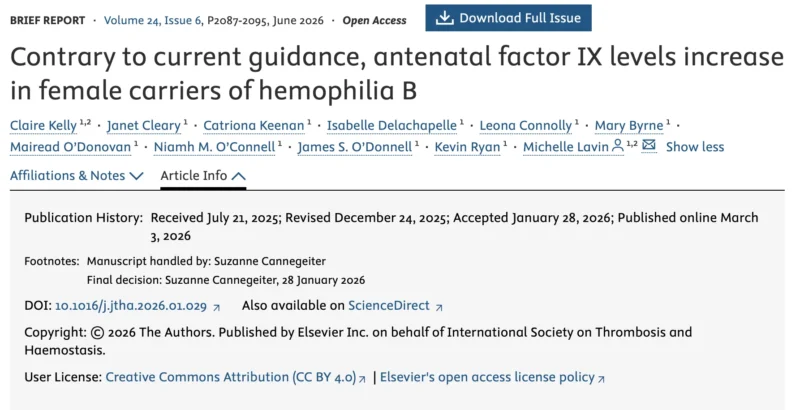
Title: Contrary to current guidance, antenatal factor IX levels increase in female carriers of hemophilia B
Authors: Claire Kelly, Janet Cleary, Catriona Keenan, Isabelle Delachapelle, Leona Connolly, Mary Byrne, Mairead O’Donovan, Niamh M. O’Connell, James S. O’Donnell, Kevin Ryan, Michelle Lavin
Stay updated on all scientific advances with Hemostasis Today.
-
Oct 9, 2026, 16:23David Boone: Distinguishing Stroke Prevention from Rhythm Control in Atrial Fibrillation
-
Oct 9, 2026, 15:27Mohamed Hegazi: Geostatistical Modelling Maps Global β-Thalassaemia Carrier Prevalence
-
Oct 9, 2026, 15:15Maha Othman: Uncovering the Consensus on TXA in TBI – Call for Collaboration on a Landmark Umbrella Review
-
Oct 9, 2026, 15:07Daniel D. Han: How Inhalation Product Exposure Impairs Cardiac and Platelet Recovery After MI
-
Oct 9, 2026, 14:58William Toole: How Ultrasound-Guided PRP Therapy Relieves Joint and Tendon Pain
-
Oct 9, 2026, 14:50Shayan Mohammadmoradi: In Corpus Christi for the 20th Midwest Platelet Conference
-
Oct 9, 2026, 14:37Tariq Tramboo: High Platelet Concentrate for Osteoarthritis Knee – Recent Meta-Analyses
-
Oct 9, 2026, 14:26Yousma Khan: Hematology Series – Beyond RBCs, WBCs and Platelets
-
Oct 9, 2026, 14:13Jesus Ardila Novoa: Why the WHO’s Historic Essential Medicines List Decision Is Just the Beginning