

Tim Patel: How Regular Movement Helps Keep Blood Flowing Throughout the Day
Tim Patel, Consultant Emergency Physician at St John of God Health Care, shared a post on LinkedIn:
“5 minutes of walking every hour matters more than most workouts.
Not because of calories.
Not because of fitness.
Because sitting quietly breaks part of your circulation.
After 30 years in medicine, I’ve realized something simple:
Most people think blood flow is handled entirely by the heart.
It isn’t.
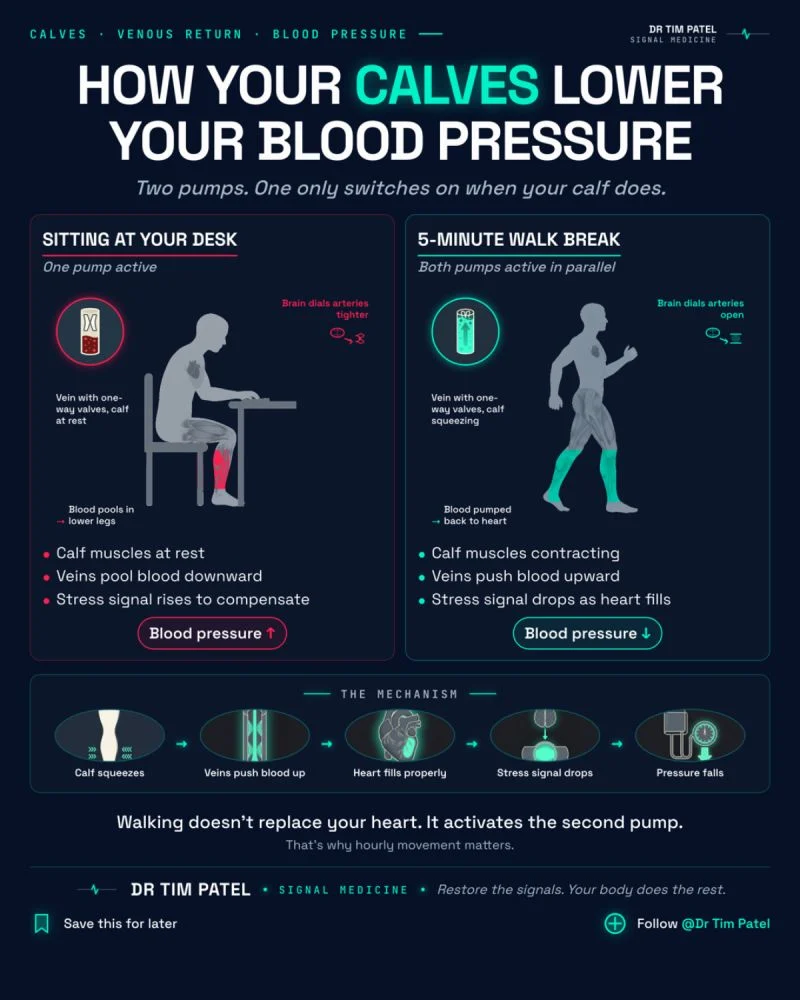
Your body actually relies on 2 pumps:
- Your heart
- Your calf muscles
The second one only works when you move.
That matters more than people realise.
When you sit for hours:
- Blood pools in the legs
- Pressure builds in the vessels
- The body compensates by tightening arteries
- Blood pressure slowly rises over time
You don’t feel this happening.
But your cardiovascular system does.
Walking changes it almost immediately.
Every step contracts the calf muscles and pushes blood back upward toward the heart.
That improves circulation without your heart working harder.
One 2026 hypertension study found:
- Short bouts of movement lowered blood pressure quickly
- The effect was strongest in people with elevated BP
- Hourly walks rivalled longer workouts for daily BP control
Which means:
Your body cares less about one perfect workout…
And more about whether you stay still all day.
The PUMP Framework I give patients:
P — Pause every hour. Stand up before opening another tab.
U — Use your calf muscles. Walk, climb stairs, or do calf raises.
M — Move for 5 minutes. Consistency matters more than intensity.
P — Persist daily. Not just on gym days.
8 hours of sitting compounds quietly.
So does movement.
Tomorrow morning:
Set a timer for every 55 minutes.
Then walk for 5.
Your calves are your second heart.
Use them every hour and they’ll quietly protect the first.
Save this for the next time you sit down at your desk and forget to stand back up.”
Stay updated with Hemostasis Today.
-
Oct 11, 2026, 22:40Bahram Alamdary Badlou: Platelets as First Responders in Hemostasis, Immunity, and Inflammation
-
Oct 11, 2026, 22:22Vipin Singh: New Publication on Hippo-YAP Signaling and Platelet Activation
-
Oct 11, 2026, 22:21Trygve Berge: New AFNOR Paper on AF-related Stroke in Norway
-
Oct 11, 2026, 22:09Omar Alomari: Our New Publication on Apixaban vs Rivaroxaban for VTE
-
Oct 11, 2026, 21:22Shayan Roshan: Happy to Share Two Research Milestones in Trauma Care and Pancreatic Cancer
-
Oct 11, 2026, 21:16Chokri Ben Lamine: Anemia in Myelofibrosis – Multiple Mechanisms, Limited Responses
-
Oct 11, 2026, 21:03Carmela Walker: Supporting Warriors Living With SCD Through Dental Care and Advocacy
-
Oct 11, 2026, 21:00Rishdha Roshad: Intraoperative Cell Salvage – Turning Blood Loss into an Opportunity for Recovery
-
Oct 11, 2026, 20:59Anthony R. Sloan: Honored to Share Our Work at the 20th Midwest Platelet Conference