


Omar Adwan: Are You Following Proper Phlebotomy Technique?
Omar Adwan, Medical Laboratory Technologist at Modawah Lab Center, shared a post on LinkedIn:
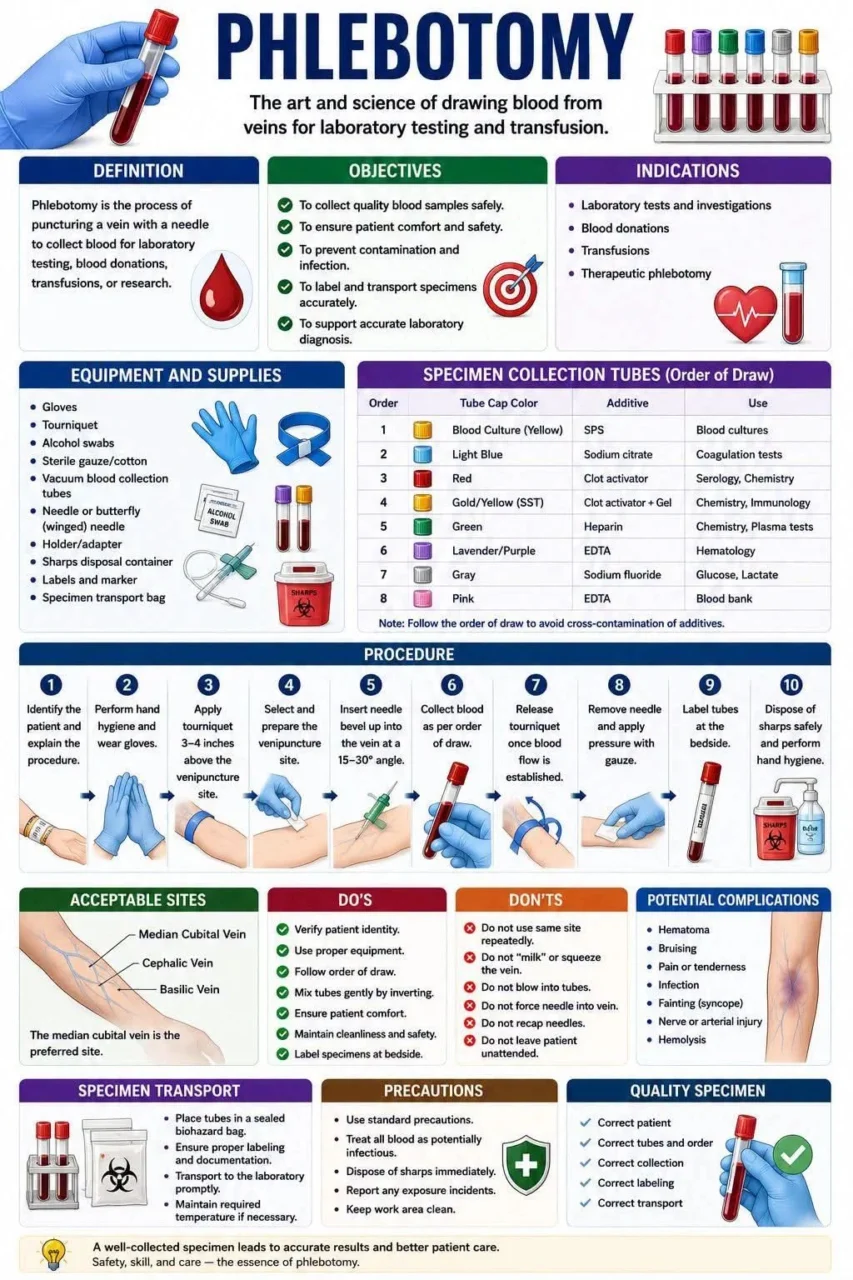
“Phlebotomy
Definition
Phlebotomy is the process of collecting blood from a vein using a sterile needle for laboratory testing, blood donation, transfusion, or therapeutic purposes.
It is a fundamental procedure performed by trained healthcare professionals to obtain high-quality blood specimens.
Principle
Phlebotomy is based on the safe venipuncture technique, where blood is withdrawn from a suitable vein under aseptic conditions.
Proper patient identification, specimen collection, and handling ensure accurate laboratory results and patient safety.
Objectives
- To collect blood samples for laboratory testing.
- To ensure patient safety and comfort during blood collection.
- To obtain high-quality specimens for accurate test results.
- To prevent contamination and specimen errors.
- To support diagnosis, treatment, and disease monitoring.
Materials required
- Sterile needles or butterfly needles
- Vacuum blood collection tubes (Vacutainer)
- Tourniquet
- Alcohol swabs (70% isopropyl alcohol)
- Sterile cotton or gauze
- Adhesive bandage
- Gloves and PPE
- Tube holder (Vacutainer holder)
- Sharps disposal container
- Specimen labels and laboratory request form
Procedure
- Verify the patient’s identity and explain the procedure.
- Perform hand hygiene and wear gloves.
- Apply the tourniquet 3–4 inches above the venipuncture site.
- Select a suitable vein and disinfect the site with an alcohol swab.
- Insert the needle into the vein at a 15–30° angle.
- Collect blood into the required tubes following the correct order of draw.
- Release the tourniquet once blood flow is established.
- Remove the needle and apply pressure with sterile gauze.
- Label the specimen tubes immediately at the bedside.
- Dispose of the needle safely in a sharps container and send the specimen to the laboratory.
Observation
Successful Collection: Blood flows smoothly into the collection tubes without complications.
Unsuccessful Collection: No blood flow, slow flow, hematoma formation, or patient discomfort may indicate improper technique or difficult venous access.
Advantages
- Provides high-quality blood specimens for laboratory testing.
- Simple, quick, and minimally invasive.
- Essential for disease diagnosis and patient monitoring.
- Supports blood donation and transfusion services.
- Safe when performed using proper techniques and infection control measures.
Limitations
- Improper technique may cause hemolysis, hematoma, or infection.
- Difficult venous access may require multiple attempts.
- Incorrect patient identification or labeling can lead to serious laboratory errors.
- Patient anxiety, fainting (vasovagal syncope), or movement may affect specimen collection.
- Proper training and adherence to standard precautions are essential for accurate and safe blood collection.
Other posts featuring Omar Adwan on Hemostasis Today.
-
Oct 10, 2026, 17:58Archo Farzana Batool: Exploring Medical Writing Through an Article on Iron Deficiency Anemia
-
Oct 10, 2026, 17:53Assessing Frailty in Adults With Hemophilia – JTH
-
Oct 10, 2026, 17:52Fatma Sadeghi: Reducing Maternal Health Inequalities Through Nursing Advocacy
-
Oct 10, 2026, 17:50Grzegorz Hensler: How Apheresis Transformed Blood Cell Separation and Collection
-
Oct 10, 2026, 17:47Hemant K Sharma: Japan’s Universal Artificial Blood Research – A Potential Breakthrough in Transfusion Medicine
-
Oct 10, 2026, 17:40John Strouse: Learning About Bleeding Disorders and Sickle Cell Disease at FWGBD
-
Oct 10, 2026, 17:34Mae Caime: Speaking at the Annual Women’s Retreat for the Hemophilia Community in Florida
-
Oct 10, 2026, 17:30Chokri Ben Lamine: PNH beyond the Textbook Triad
-
Oct 10, 2026, 17:29Ruah Alyamany: Thrombosis and Anticoagulation in Hematological Malignancies at SOHO KSA 2026