

Edward Lee Carter: What ISTH 2026 Tells Us About the Next Era of Thrombosis Care
Edward Lee Carter, Clinical Pharmacist Practitioner at U.S. Department of Veterans Affairs, shared a post on LinkedIn:
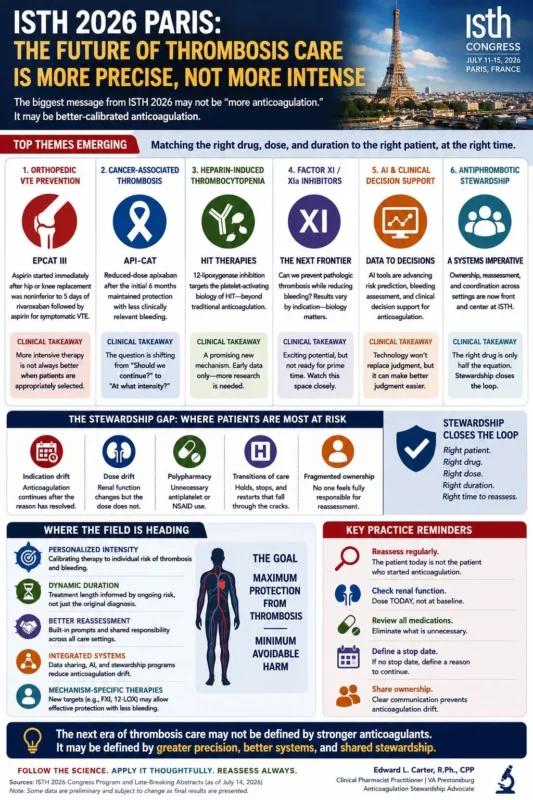
”The biggest message emerging from ISTH 2026 may not be ‘more anticoagulation.’
It may be better-calibrated anticoagulation.
As I follow the science being presented in Paris, one theme keeps surfacing:
The field appears to be moving away from a simple question:
How do we prevent more thrombosis?
Toward a harder and more clinically useful one:
How do we provide enough protection for this patient, in this setting, for the right length of time, with the least avoidable harm?
Several presentations illustrate that shift.
After hip or knee replacement, EPCAT III found that aspirin started immediately after surgery was noninferior to five days of rivaroxaban followed by aspirin for symptomatic VTE prevention, without a clinically meaningful bleeding difference.
The lesson is not that aspirin is appropriate for every orthopedic patient.
It is that more intensive therapy may not always produce better outcomes when patients are properly selected.
In cancer-associated thrombosis, API-CAT continues to reshape extended treatment.
Reduced-dose apixaban after the initial six months preserved protection while reducing clinically relevant bleeding.
New analyses are now helping us understand the uncommon recurrences that still occur.
The question is becoming less:
‘Should anticoagulation continue?’
And more:
‘At what intensity should it continue?’
In heparin-induced thrombocytopenia, early research involving 12-lipoxygenase inhibition is attempting to target the platelet-activating biology of HIT rather than relying only on downstream anticoagulation.
Promising, but not yet practice-changing.
Factor XI/XIa inhibition remains one of the field’s most important experiments: can we separate protection from pathologic thrombosis from the bleeding cost of conventional anticoagulation?
The mixed results across indications remind us that thrombus biology matters. A strategy that works after ischemic stroke may not provide adequate protection in atrial fibrillation.
And perhaps most importantly, ISTH is giving increasing attention to antithrombotic stewardship, AI, population management, and reassessment systems.
That matters because even the best drug cannot compensate for:
- the wrong indication
- the wrong duration
- an outdated renal dose
- unnecessary antiplatelet therapy
- a temporary hold that was never restarted
- fragmented ownership across multiple clinicians
My early takeaway from ISTH 2026 is this:
The next era of thrombosis care may not be defined by stronger anticoagulants.
It may be defined by greater precision:
- Less treatment when less is enough
- More targeted treatment when biology demands it
- Reassessment when the patient changes
- Stewardship when responsibility crosses settings
We spent the last two decades developing better anticoagulants.
Perhaps the next two decades will be about building better systems for choosing, monitoring, reducing, and sometimes stopping them.”
Stay updated with Hemostasis Today.
-
Oct 19, 2026, 19:44Where You Live Should not Determine Whether You Receive Care – World Federation of Hemophilia
-
Oct 19, 2026, 19:42Belen Bianco: Prevention, Early Suspicion and an Interdisciplinary Approach Save Lives
-
Oct 19, 2026, 19:40Christina Chrysohoou: Catheter-Based LAAC vs OAC for Stroke Prevention in Atrial Fibrillation
-
Oct 19, 2026, 19:38Matthew Flick: A Two-Day Research Meeting on Fibrinogen, Hemostasis and Thrombosis
-
Oct 19, 2026, 19:37Hayat Saeed: Excited to Share Our Publication on the FGL1–Hepcidin Axis in Iron Homeostasis and Disease
-
Oct 19, 2026, 19:08IPAW 2026 Comes to a Close, but the Work Continues – PPTA
-
Oct 19, 2026, 17:44Paul Riley: Moderating a Webinar on Anticoagulation Monitoring
-
Oct 19, 2026, 16:36Christopher Pittman: Blood Clot Prevention Cannot End at Hospital Discharge
-
Oct 19, 2026, 16:13Javier M. Floren: When Immune Cells Move With Their Environment