


Martina Böhm-Weigert: Supporting Precision Dosing in Hemophilia with Fitusiran
Martina Böhm-Weigert, Scientific Support at Siemens Healthineers, shared a post on LinkedIn about a recent article she and her colleagues co-authored, published in RPTH, adding:
“QFITLIA (fitusiran) helps restore hemostasis by lowering antithrombin in individuals with hemophilia A or B, with or without inhibitors.
Maintaining the right therapeutic window is critical.
A recent study published in rpth shows that the INNOVANCE Antithrombin assay can accurately quantify antithrombin activity within the 15 to 35% range required for fitusiran dosing.
With strong precision and no interference from common hemophilia therapies, these data support confident clinical decision making in hemophilia A and B management.”
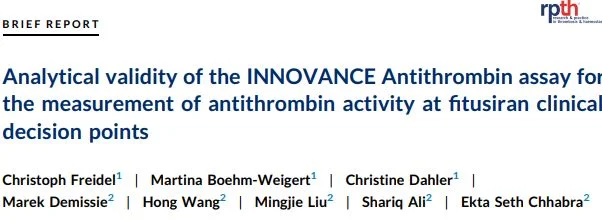
Title: Analytical validity of the INNOVANCE Antithrombin assay for the measurement of antithrombin activity at fitusiran clinical decision points
Authors: Christoph Freidel, Martina Boehm-Weigert, Christine Dahler, Marek Demissie, Hong Wang, Mingjie Liu, Shariq Ali, Ekta Seth Chhabra

Stay updated on all scientific advances with Hemostasis Today.
-
Nov 9, 2026, 09:29Veronica Sanchez: A Framework for Woman’s Health
-
Nov 8, 2026, 19:31Anna Kajaste-Rudnitski: Presenting AAV-Induced p53 Signalling in Human CNS Cells at ESGCT 26
-
Nov 8, 2026, 19:29David McIntosh: Cybersecurity Matters, but Blood Availability Remains the Bigger Challenge
-
Nov 8, 2026, 19:26Wenxue Ma: An Integrative Framework for Macrophage-Mediated Therapeutic Resistance in Cancer
-
Nov 8, 2026, 19:25Yildiz Yigit: Presenting a Polycythemia Vera Case at the MPN Subcommittee Session
-
Nov 8, 2026, 18:56Denis Oduor: Strengthening the Regulation and Delivery of Blood Transfusion and Transplantation Services
-
Nov 8, 2026, 18:28Raghavendra Rao: A Narrative Review on Chronic Venous Disease during Pregnancy
-
Nov 8, 2026, 17:57Dhiren Patel: PLD1-Derived Phospholipids Regulate NAD Kinase and ROS Production in Neutrophils
-
Nov 8, 2026, 17:48Andra T.: What Causes Antiphospholipid Syndrome? – Four Steps, not One Cause