


Anu Thomas: ET vs IUT – Two Life-Saving Procedures, Different Stages of Care
Anu Thomas, Assistant Professor at Government Medical College, Kozhikode, shared a post on LinkedIn:
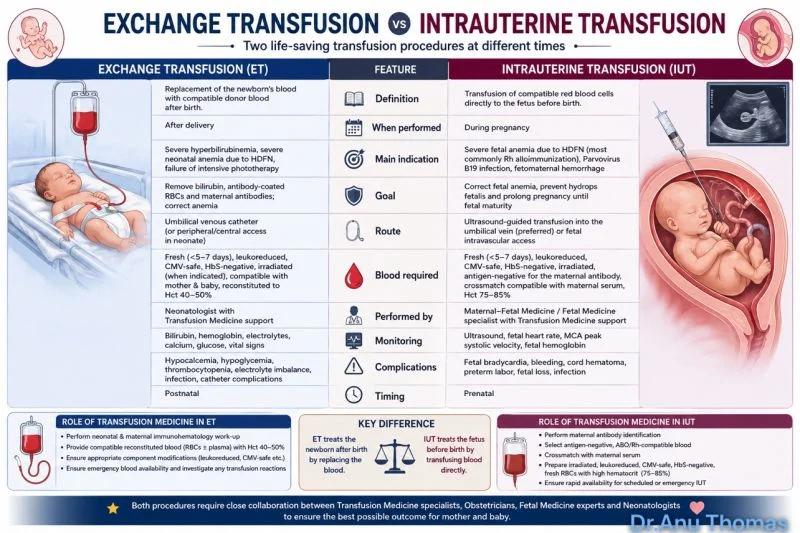
“Exchange Transfusion (ET) vs Intrauterine Transfusion (IUT): Two Life-Saving Procedures, Different Stages of Care
Although both procedures are used to manage severe fetal and neonatal anemia, they serve different purposes.
- Intrauterine Transfusion (IUT) is performed before birth to treat fetal anemia, most commonly due to red cell alloimmunization. It helps prevent hydrops fetalis, improves fetal well-being, and allows pregnancy to continue safely.
- Exchange Transfusion (ET) is performed after birth to rapidly reduce bilirubin levels, remove antibody-coated red cells, and correct severe anemia in newborns with hemolytic disease.
The Department of Transfusion Medicine plays a pivotal role in both procedures by ensuring accurate immunohematological evaluation, selection of compatible and appropriately modified blood components, and timely support to achieve the best possible outcomes for both mother and baby.
Together, multidisciplinary collaboration between Transfusion Medicine, Fetal Medicine, Obstetrics, and Neonatology makes these life-saving interventions possible.”
Stay updated with Hemostasis Today.
-
Sep 20, 2026, 09:51Ceasovschih Alexandr: A Closer Look at Lipid Disorders in CKM Syndrome
-
Sep 20, 2026, 09:05World Stroke Academy: Can Adjunct IAT Improve Tissue Reperfusion?
-
Sep 20, 2026, 06:46Neeraj Songara: From Donated Blood to Engineered Therapeutics
-
Sep 20, 2026, 06:24Louise St. Germain Bannon: Improving Awareness and Care for Women Across the Lifespan
-
Sep 20, 2026, 05:17Maxime Dely: When ABO Compatibility Isn’t Enough for Safe Transfusion
-
Sep 20, 2026, 04:54William Aird: What Does a Complete History and Physical Really Mean?
-
Sep 20, 2026, 04:34Hons Saurabh Kaushik: Why Uncontrolled LDL Can Be Harmful
-
Sep 20, 2026, 03:58Salih Ehsan: The Complexities of HbF and HbA2
-
Sep 20, 2026, 03:22The Voices of People Living With Bleeding Disorders – EHC