


Edward Lee Carter: Can Anticoagulation Be Safely De-Escalated After AF Ablation?
Edward Lee Carter, Clinical Pharmacist Practitioner at U.S. Department of Veterans Affairs, shared a post on LinkedIn:
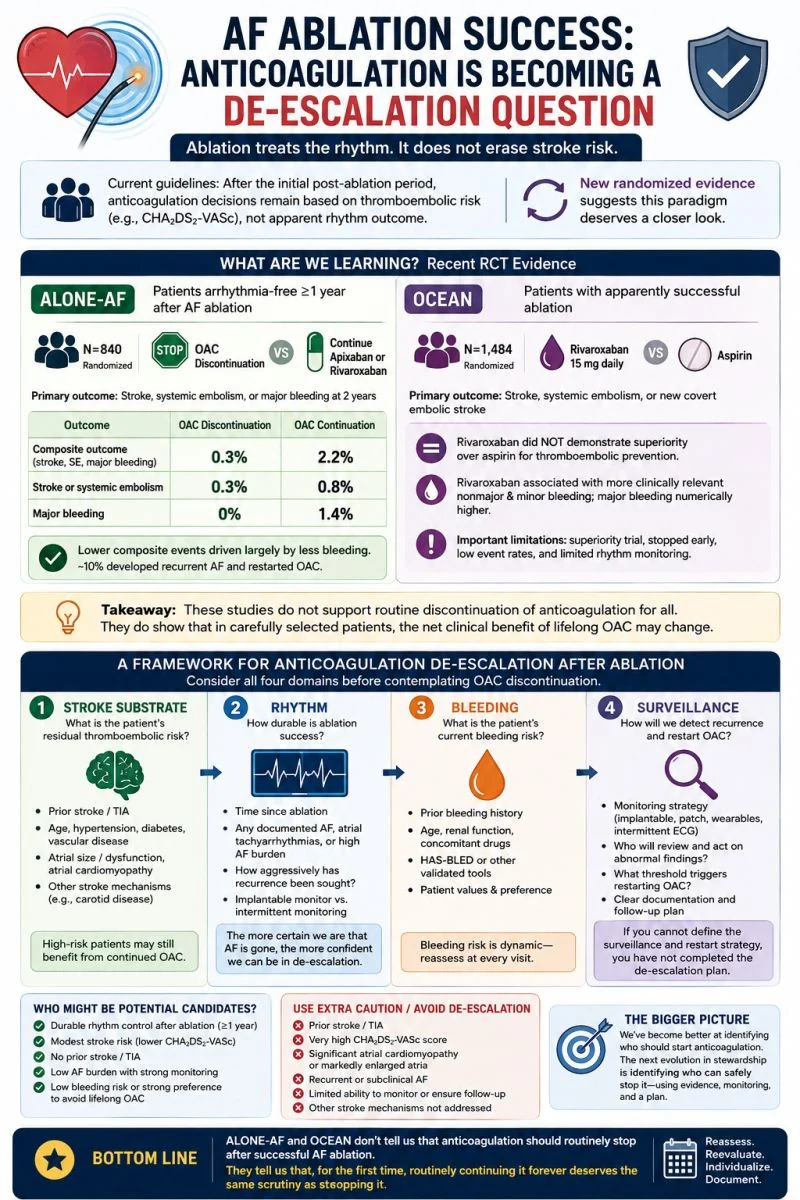
”Anticoagulation after successful AF ablation is becoming a serious de-escalation question.
For years, the framework has been straightforward:
Ablation treats the rhythm. It does not erase the indication for anticoagulation.
Long-term OAC decisions remain based primarily on thromboembolic risk—not apparent maintenance of sinus rhythm.
That remains guideline-based practice.
But ALONE-AF and OCEAN suggest the question deserves another look.
- ALONE-AF studied carefully selected patients free of documented atrial arrhythmia forat least one year after ablation.
At 2 years, stroke/systemic embolism/major bleeding occurred in 0.3 percent after OAC discontinuation vs 2.2 percent with continued OAC.
Importantly, much of the advantage came from less bleeding: major bleeding was 0 percent vs 1.4 percent, while stroke/systemic embolism was uncommon (0.3 percent vs 0.8 percent).
About 10 percent developed recurrent AF and restarted OAC.
This wasn’t simply ‘stop and forget.’
- OCEAN compared rivaroxaban with aspirin after apparently successful ablation.
Rivaroxaban did not demonstrate superiority for thromboembolic prevention and caused more bleeding.
But OCEAN was a superiority trial with low event rates, early termination and limited rhythm surveillance.
It does not establish aspirin or no anticoagulation as equivalent to OAC.
So what changes today?
Not:
Successful ablation means stop anticoagulation.
Instead:
Successful ablation means reconsider whether lifelong anticoagulation still provides net clinical benefit.
For busy clinicians, I would think in four domains:
- Stroke substrate
Prior stroke/TIA, age, vascular disease, atrial disease.
- Rhythm
How durable is ablation success?
How aggressively has recurrent/subclinical AF been sought?
- Bleeding
What is the patient’s current bleeding risk?
- Surveillance
If OAC stops, how will recurrence be detected—and what triggers restarting it?
That last point may be the most important.
De-escalation requires a surveillance system.
Stopping apixaban or rivaroxaban shouldn’t simply mean deleting it from the medication list.
A real strategy defines:
Who can stop, how recurrence is monitored, and when OAC restarts.
And there is an important paradox:
These trials make OAC withdrawal more plausible while exposing how difficult it remains to define ‘successful’ ablation.
We are not at routine anticoagulation withdrawal.
But we may be approaching structured de-escalation in carefully selected patients.
That’s an important evolution in antithrombotic stewardship.
We’ve become disciplined about identifying who should start anticoagulation.
We may need to become equally disciplined about identifying who can safely stop it.
ALONE-AF and OCEAN don’t tell us to routinely stop OAC after successful ablation.
They tell us that routinely continuing it forever now deserves the same scrutiny as stopping it.”
Other posts featuring Edward Lee Carter on Hemostasis Today.
-
Sep 25, 2026, 09:49Haley Coleman: Volunteering to Support Hemophilia Awareness
-
Sep 25, 2026, 08:55Hitarth Mehta: BHMS Students Gain Practical Exposure to Haemophilia Diagnosis
-
Sep 25, 2026, 07:25Varun Capoor: How Therapeutic Apheresis and Transfusion Medicine Can Complement Clinical Management in SCD
-
Sep 25, 2026, 07:14Manshi Kesharwani: SAK-GQDs Modulate Thrombus Burden and Endothelial Function in Deep Vein Thrombosis
-
Sep 25, 2026, 06:20Farjah Hassan Algahtani: How Can We Better Identify Patients at Risk of Blood Clots after Metabolic and Bariatric Surgery?
-
Sep 25, 2026, 05:59Carla Lewis: Kids Conquering Sickle Disease Joins Nemours Children’s Hospital for 2nd Annual Awareness Event
-
Sep 25, 2026, 05:47Omid Seidizadeh: Evolutionary Constraint and Population Variation Across Coagulation Genes
-
Sep 25, 2026, 05:40Gerald Bertrand: Presenting UMi-NGS Non-Invasive Foetal HPA Genotyping at DGTI 2026
-
Sep 25, 2026, 05:33Urge Congress to support the Sickle Cell Disease Comprehensive Care Act – ASH