

Albumin at the Bedside – Global Plasma Supply
Global Plasma Supply shared a post on LinkedIn:
”How an Indication Becomes a Treatment
Albumin reaches the bedside through many different clinical pathways.
Sometimes it is prescribed as a resuscitation fluid.
Sometimes it is used to prevent circulatory dysfunction after large-volume paracentesis.
Sometimes it supports plasma volume during a major burn.
And sometimes several litres of albumin pass through an extracorporeal circuit—not because the patient is “albumin deficient,” but because the patient’s own plasma must be removed and replaced.
These are not interchangeable indications.
Each begins with a different disease mechanism, is governed by different authorities, rests on a different evidence base and demands a different therapeutic endpoint.
Before examining albumin in critical care, cirrhosis, burns and sepsis, we must therefore establish one principle:
An albumin indication is not created by a low albumin concentration, a familiar clinical habit or the presence of albumin in a treatment protocol. It is created by a defined clinical problem, a plausible mechanism, supporting evidence and a measurable therapeutic objective.
An order appears on the screen: human albumin solution. It looks like a product request. But behind those three words should be an entire clinical argument—why this patient, why this concentration, why this dose, why now and what must improve before another bottle is opened.
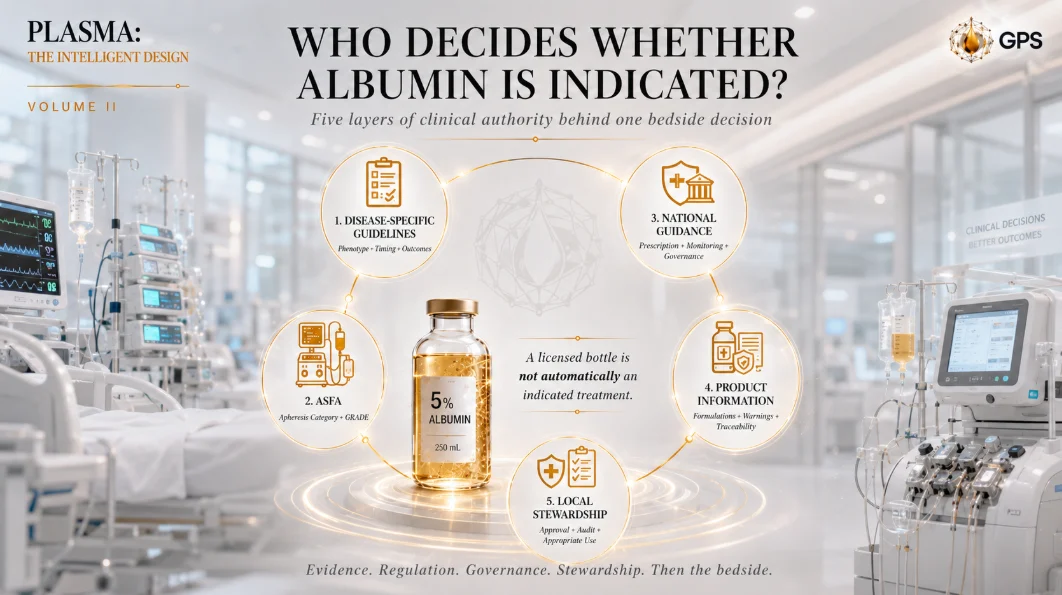
Who Decides Whether Albumin Is Indicated?
There is no single universal list that can answer every question about albumin.
Different authorities answer different parts of the clinical decision.
1. Disease-specific clinical guidelines
Specialty societies determine how albumin or therapeutic plasma exchange fits within the management of a particular disease.
Examples include guidelines and consensus statements from hepatology, intensive care, nephrology, neurology, haematology, burn medicine and transplantation organisations.
These authorities answer questions such as:
- Is the intervention first-line, rescue or adjunctive therapy?
- Which disease phenotype was studied?
- What alternative treatments should be given first?
- At what stage of disease is benefit most plausible?
- Which outcomes were improved?
- Which patients were excluded from the evidence?
- A recommendation for albumin in one clinical phenotype must not automatically be transferred to another.
A treatment can be correct in spontaneous bacterial peritonitis and inappropriate in uncomplicated hypoalbuminaemia. It can be justified during a defined plasma-exchange protocol and unjustified as routine volume replacement after the procedure has ended.
The same bottle enters two rooms. In one, it protects a failing circulation after litres of ascitic fluid have been removed. In the other, it is ordered simply because a laboratory value is low. The product is identical. The clinical reasoning is not.
2. The American Society for Apheresis
For therapeutic apheresis, the principal international evidence framework is produced by the American Society for Apheresis—ASFA.
The ninth ASFA special issue reviews and categorises therapeutic apheresis indications according to the role of the procedure in the treatment pathway and separately assigns a GRADE recommendation reflecting recommendation strength and evidence quality.[1]
ASFA therefore helps answer:
- Whether therapeutic plasma exchange is accepted for the condition.
- Whether it is first-line, second-line, individualised or unsupported.
- Which clinical presentation within the disease is being considered.
- Which apheresis modality is recommended.
- The usual exchange volume, frequency and treatment course.
- The proposed mechanism and therapeutic endpoint.
- The 2023 ASFA guideline remains the central international reference for categorising therapeutic apheresis indications, while national and specialty guidance must still be consulted for clinical implementation.[1]
The machine has not yet been switched on. Before blood enters the circuit, someone must decide whether removing the patient’s plasma is part of established treatment, a rescue strategy supported by limited evidence or an experiment that should not be disguised as routine care.
3. National apheresis guidance
National bodies translate international evidence into local clinical and operational practice.
The 2025 British Society for Haematology guideline (BSH) addresses the indications, technical prescription, staffing, governance, safety monitoring and replacement-fluid choices involved in therapeutic apheresis within UK practice.[2]
It also reflects how evidence changes referral patterns. Autoimmune encephalitis has become a more prominent indication, while routine plasma exchange for ANCA-associated vasculitis has declined following evidence questioning broad clinical benefit.[2]
National guidance therefore helps determine:
- How an apheresis service should be governed.
- Which professionals may prescribe and supervise treatment.
- What baseline investigations are required.
- How exchange volumes should be calculated.
- Which replacement fluid should be selected.
- How coagulation, fibrinogen, calcium and haemodynamic status should be monitored.
- When treatment should be modified or stopped.
- The current BSH guideline covers plasma exchange regardless of the equipment used and emphasises that therapeutic apheresis requires a documented treatment plan, appropriate monitoring and specialist oversight.[2]
What appears at the bedside as a row of albumin containers is therefore the final visible part of a much larger system: referral, evidence review, vascular access, prescription, machine configuration, anticoagulation, replacement-fluid planning, laboratory surveillance and reassessment.
4. Regulatory product information
Regulatory authorities and approved product information define:
- The authorised concentrations and formulations.
- Manufacturing and viral-safety requirements.
- Administration precautions.
- Contraindications and warnings.
- Sodium and stabiliser content.
- Risks of hypervolaemia, haemodilution and hypersensitivity.
- Requirements for batch traceability.
- However, regulatory approval of a human albumin product does not prove that albumin improves outcomes in every clinical situation where volume expansion appears biologically plausible.
The product label explains how the medicine may be used safely. Clinical trials and guidelines determine whether it should be used for the patient in front of us.
A bottle can be licensed, available and technically suitable—and still be clinically unnecessary.
5. Local transfusion, pharmacy and stewardship policies
Hospitals must integrate international guidance, national practice, local expertise, available products, cost, supply security and patient-specific risk.
Local governance should determine:
- Who may authorise albumin.
- Which indications require specialist approval.
- Which concentration and container size should be stocked.
- How usage is documented.
- What constitutes off-guideline use.
- How adverse reactions are reported.
- How consumption and wastage are audited.
- This final layer is especially important because every unnecessary gram carries a hidden donor and manufacturing burden.
The request reaches the blood bank or pharmacy as a number of bottles. The donor does not appear on the prescription. The fractionation plant does not appear on the drug chart. Yet both stand behind the treatment.
How to Read an Apheresis Indication
The ASFA category and the evidence grade are not the same thing
ASFA assigns each indication a category describing the accepted clinical role of therapeutic apheresis.
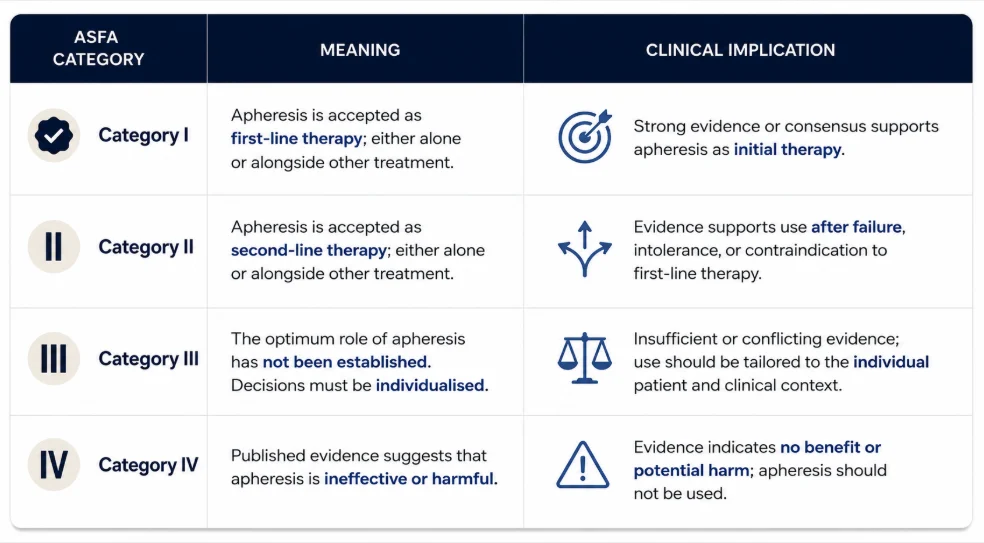
Separately, the GRADE designation describes the recommendation and evidence:
1 represents a strong recommendation.
2 represents a weak or conditional recommendation.
A represents high-quality evidence.
B represents moderate-quality evidence.
C represents low- or very-low-quality evidence.
A Category I indication is therefore not automatically supported by Grade 1A evidence.
Rare, rapidly progressive or life-threatening diseases may become accepted first-line indications even when large randomised trials are difficult or impossible to conduct. Conversely, biological plausibility alone does not elevate a therapy into Category I or II.
ASFA categories describe where the procedure belongs in treatment. GRADE describes how confidently the recommendation can be made from the available evidence.[1]
The two codes sit beside each other on the page. One tells the team when the treatment belongs. The other reveals how solid the ground beneath that decision really is.
The seven-question test
Every indication discussed in Part III will be read through the same seven questions.
1. What exact patient clinical phenotype was studied?
The disease name alone is insufficient.
‘Sepsis,’ ‘cirrhosis,’ ‘burns,’ ‘myasthenia gravis’ and ‘vasculitis’ each contain multiple clinical phenotypes with different mechanisms and risk–benefit balances.
2. What pathological process is being targeted?
Is albumin being used to:
Expand effective circulating volume?
Maintain oncotic support?
Bind or transport endogenous molecules?
Replace fluid removed during therapeutic plasma exchange?
Reduce post-paracentesis circulatory dysfunction?
Support a treatment pathway while another therapy takes effect?
3. Is albumin itself the active therapy?
During therapeutic plasma exchange, albumin is frequently the replacement fluid, while removal of pathogenic plasma is the principal therapeutic act.
In cirrhosis, albumin may contribute haemodynamic and potentially non-oncotic biological effects.
In simple correction of hypoalbuminaemia, no valid therapeutic mechanism may exist at all.
4. Where does the intervention sit in the treatment pathway?
Is it:
First-line?
Second-line?
Rescue therapy?
An adjunct?
A bridge?
Restricted to treatment failure?
Investigational?
5. What is the prescribed dose?
For albumin infusion, the dose should be expressed in grams—not merely “one bottle.”
For therapeutic plasma exchange, the prescription must include:
Calculated plasma volume.
Number of plasma volumes exchanged.
Replacement-fluid composition.
Albumin concentration.
Procedure frequency.
Planned number of procedures.
6. What measurable endpoint defines benefit?
Examples include:
Haemodynamic response.
Improvement in organ perfusion.
Reduction in vasopressor requirement.
Neurological improvement.
Reduction in pathogenic antibody or paraprotein burden.
Renal recovery.
Prevention of post-procedure circulatory dysfunction.
7. What is the stopping rule?
Treatment should stop when:
The therapeutic objective has been achieved.
Continued treatment is no longer producing response.
Harm begins to outweigh expected benefit.
A more effective definitive therapy becomes available.
The indication is shown to have been incorrect.
The treatment order is now longer than the product name. It has become a clinical hypothesis—one that can be tested, reassessed and stopped.
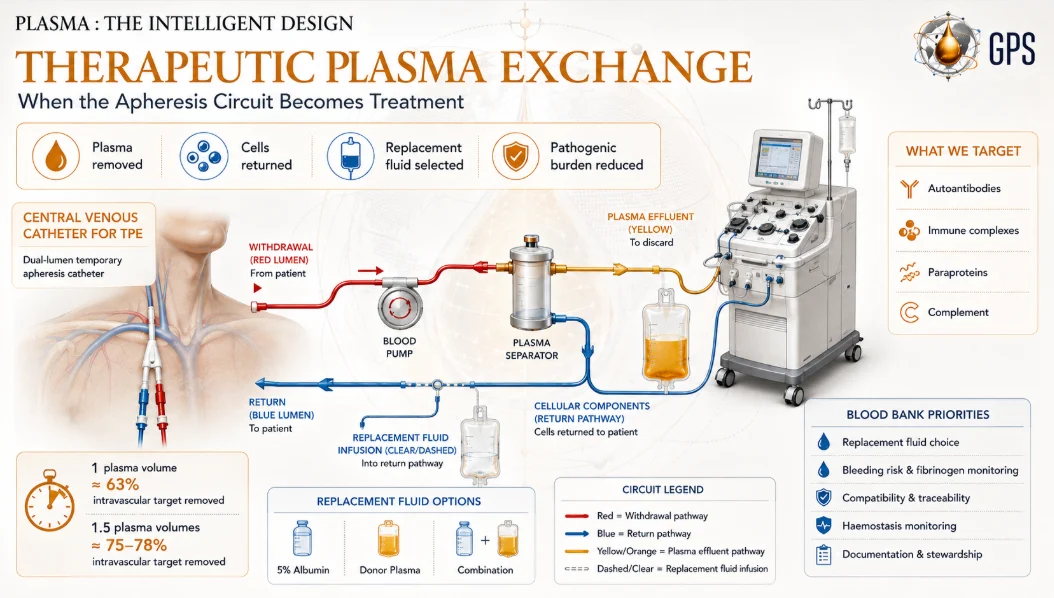
Therapeutic plasma exchange
When the Apheresis Circuit Becomes Treatment
The term therapeutic plasmapheresis is widely understood, but the standard scientific term used by ASFA is therapeutic plasma exchange—TPE.[3]
The distinction matters.
In TPE, a substantial volume of the patient’s plasma is separated and removed. Cellular blood components are returned with a prescribed replacement fluid—commonly 4.5–5 percent human albumin solution, donor plasma or a combination selected according to the indication and bleeding risk.[1,2,4]
The purpose is not simply to ‘lean the blood.’
TPE is most rational when the pathogenic substance:
Circulates substantially within the intravascular compartment.
Has a sufficiently large molecular size or protein binding that limits removal by conventional dialysis.
Contributes directly to disease.
Can be removed faster than it is redistributed or resynthesised.
Is associated with a clinical condition in which removal improves a meaningful outcome.
Potential targets include:
Pathogenic autoantibodies.
Alloantibodies.
Immune complexes.
Monoclonal immunoglobulins and paraproteins.
Cryoproteins.
Lipoproteins.
Complement components.
Protein-bound toxins.
Selected inflammatory and coagulation mediators.
One estimated plasma-volume exchange removes approximately 63 percent of an ideally distributed intravascular target. Increasing the exchange to 1.5 plasma volumes removes approximately 75–78 percent, but further increases produce progressively smaller additional removal while increasing procedure duration, exposure and cost.[4,5]
Blood begins to move through the circuit. The cells are not the enemy, so they return. The discarded plasma carries away part of the pathological burden. But the space it leaves behind cannot remain empty.
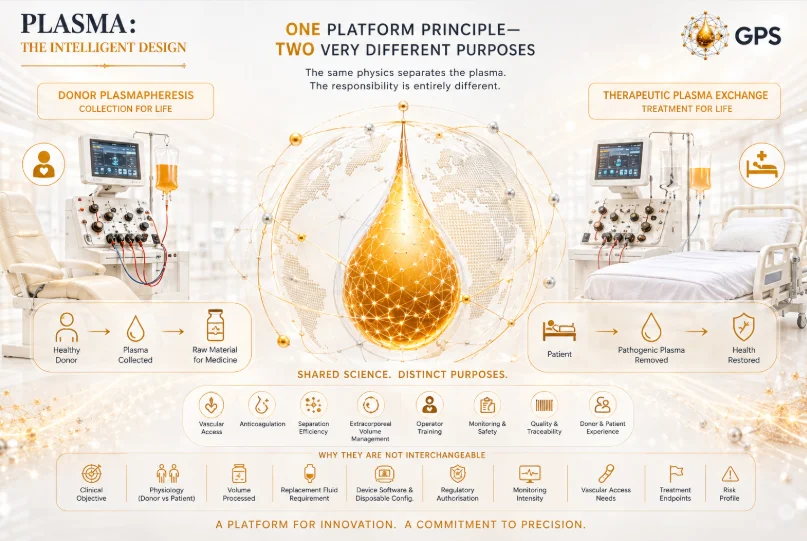
One platform principle—two very different purposes
Apheresis is a platform technology.
The underlying separation principles—centrifugation or membrane filtration—can be used in systems designed to collect plasma or cellular components from healthy donors and in systems designed to treat patients.
This creates an important opportunity for technical innovation, workforce development and service integration.
Knowledge developed in donor apheresis can inform therapeutic practice in areas such as:
Vascular access.
Anticoagulation.
Separation efficiency.
Extracorporeal-volume management.
Operator training.
Adverse-event recognition.
Quality systems.
Traceability.
Donor and patient experience.
However, donor plasmapheresis and therapeutic plasma exchange must not be presented as automatically interchangeable procedures.
They differ in:
Clinical objective.
Patient or donor physiology.
Volume processed.
Replacement-fluid requirement.
Device software and disposable configuration.
Regulatory authorisation.
Monitoring intensity.
Vascular-access needs.
Treatment endpoints.
Risk profile.
The scientifically defensible concept is therefore not that any collection machine can simply be converted into a treatment machine.
It is that apheresis technology and infrastructure can be deliberately designed, validated and optimised across both donor-collection and therapeutic environments, provided that each use has the appropriate device indication, clinical governance, trained personnel and quality controls.[2,4]
The same physics separates the plasma. But on one side sits a healthy donor contributing raw material for medicine. On the other lies a patient whose own plasma has become part of the disease. The circuit may look familiar; the responsibility is entirely different.
Why Albumin Is Used During TPE
When plasma is removed, an approximately equivalent volume must usually be returned to preserve circulating volume and haemodynamic stability.
For most TPE indications that do not require replacement of a missing plasma protein or coagulation factor, isotonic 4.5% or 5% human albumin solution is widely used as the principal replacement fluid.[2]
Albumin provides:
Colloid oncotic support.
Sustained intravascular volume replacement compared with crystalloid alone.
Lower exposure to donor plasma proteins than plasma replacement.
Lower rates of many plasma-associated allergic and transfusion reactions.
A practical replacement medium when removal—not biological replacement—is the therapeutic objective.
The BSH guideline identifies 4.5–5% human albumin solution as the most widely used TPE replacement fluid outside thrombotic thrombocytopenic purpura and related thrombotic microangiopathies.[2]
But albumin does not replace everything that has been removed.
TPE with albumin also removes and dilutes:
Fibrinogen.
Coagulation factors.
Natural anticoagulants.
Immunoglobulins.
Complement proteins.
Hormone- and drug-binding proteins.
Therapeutic monoclonal antibodies.
Highly protein-bound medications.
Repeated exchanges can therefore produce dilutional coagulopathy, particularly when procedures are performed daily. Coagulation parameters and fibrinogen should be monitored according to the patient’s bleeding risk, treatment schedule and replacement-fluid strategy.[2]
Intravenous medications that are likely to be removed should, where clinically possible, be administered after the exchange. The timing of immunoglobulin, rituximab and other monoclonal-antibody therapies must be coordinated with the TPE schedule.[2,4]
Another albumin bag is connected. It preserves volume, but it does not restore every molecule that has been discarded. The circuit solves one problem while creating physiological debts that must be anticipated.
When Plasma—Not Albumin—is Required
Albumin is inappropriate as the sole replacement fluid when the therapeutic objective includes replacing an essential missing plasma component.
The clearest example is immune thrombotic thrombocytopenic purpura (TTP).
In TTP, plasma exchange does two things:
It removes pathogenic anti-ADAMTS13 autoantibodies and ultra-large von Willebrand factor–related material.
It supplies functional ADAMTS13 through donor plasma.
Albumin can accomplish the first function as a volume replacement fluid, but it cannot accomplish the second. Plasma is therefore required.
Plasma may also be incorporated when:
Replacement of coagulation factors is clinically necessary.
There is active bleeding or a high haemorrhagic risk.
Fibrinogen has fallen to an unsafe level.
A recent invasive procedure increases bleeding concern.
The disease-specific mechanism requires a plasma constituent.
High-volume exchange is being undertaken for selected acute liver-failure protocols.
Replacement-fluid choice is therefore part of the indication itself—not an afterthought.
The machine can remove the harmful antibody perfectly and still deliver incomplete treatment if the wrong fluid is returned.
Which Conditions Commonly Use Albumin-Based TPE?
The following groups represent important albumin-dominant or albumin-compatible TPE applications. The exact ASFA category and recommendation must always be checked against the specific clinical presentation rather than the disease name alone.[1,2]
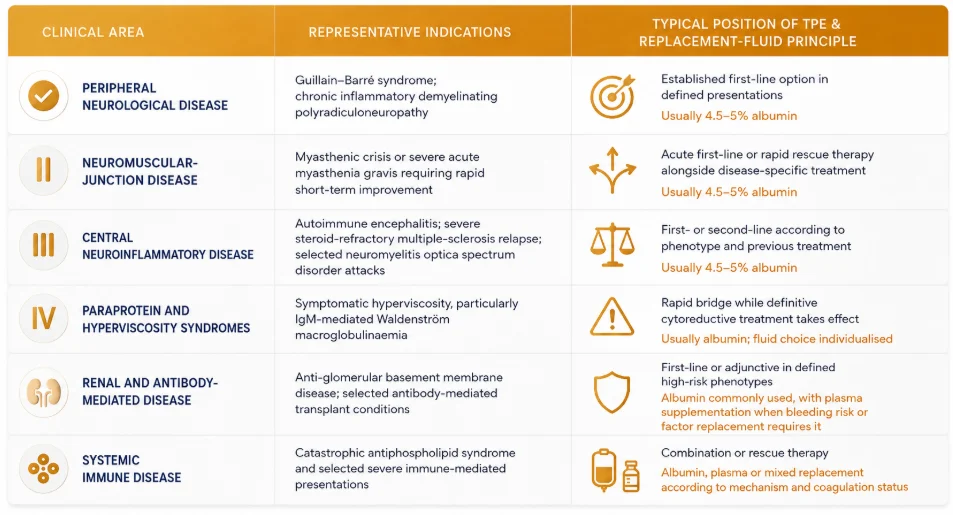
TPE should not be expanded from these established settings into loosely defined concepts such as ‘inflammation,’ ‘detoxification,’ ‘immune reset’ or ‘plasma rejuvenation’ without indication-specific evidence.
Category III conditions require individualised reasoning and transparent acknowledgment of uncertainty. Category IV conditions should not be treated with TPE outside a properly governed research context.
The patient’s diagnosis finally has a name. But the name alone is not enough. The team must still identify the clinical phenotype, the pathogenic target, the urgency, the alternative treatment and the point at which the exchange has done all that it reasonably can.
The donor scale behind one TPE course
A therapeutic plasma exchange can require substantially more albumin than a conventional bedside infusion.
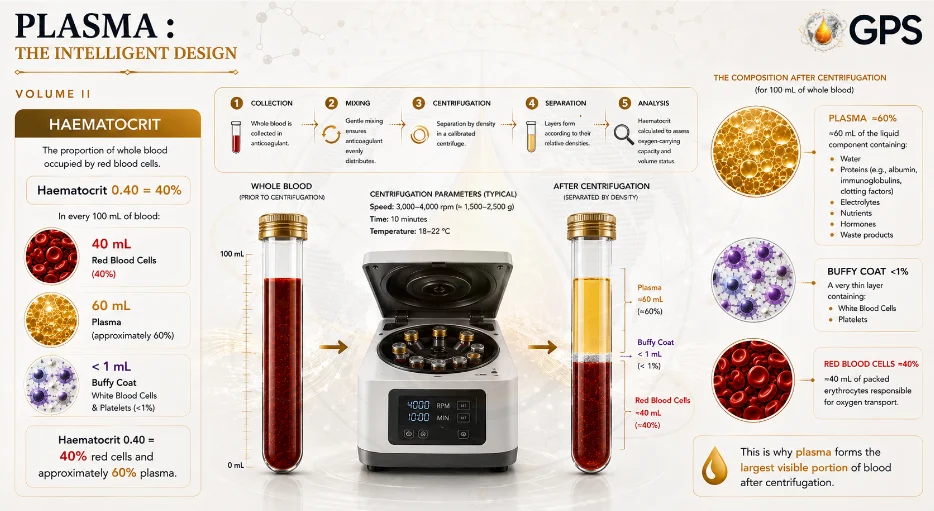
Consider a 70-kg adult with a haematocrit of 0.40.
Haematocrit is the proportion of whole blood occupied by red blood cells.
A haematocrit of 0.40 is exactly the same as 40 percent. It means that, in every 100 mL of blood, approximately:
40 mL consists of red blood cells
60 mL consists mainly of plasma
A very thin layer of white blood cells and platelets—called the buffy coat—makes up less than 1% of the blood volume. Therefore, for simple practical understanding:
Haematocrit 0.40 – 40% red cells and approximately 60% plasma.
Using the common estimated plasma-volume equation:
Estimated plasma volume equals
0.065 multiplied by weight in kilograms, multiplied by one minus haematocrit
equals
0.065 multiplied by 70, multiplied by 0.60
equals approximately 2.73 litres
A prescription of 1.0 to 1.5 plasma volumes would therefore require replacement of approximately:
2.73 L for 1.0 plasma volume
4.10 L for 1.5 plasma volumes
At 5% albumin
A 5% solution contains 50 g/L.
Therefore:
2.73 L multiplied by 50 g/L equals approximately 137 g of albumin
4.10 L multiplied by 50 g/L equals approximately 205 g of albumin
A 500-mL container of 5% albumin contains 25 g.
One procedure would therefore require approximately:
5–6 containers for a 1.0-plasma-volume exchange.
8–9 containers for a 1.5-plasma-volume exchange.
Using the established manufacturing reference of approximately 19–20 g of recovered albumin per high-volume source-plasma donation-equivalent:
One 1.0-plasma-volume procedure represents approximately 7 donation-equivalents.
One 1.5-plasma-volume procedure represents approximately 10–11 donation-equivalents.
Across a five-procedure course
Albumin administered: approximately 685–1,025 g
500-mL containers of 5% albumin: approximately 27–41
Source-plasma donation-equivalents: approximately 35–55
Across a ten-procedure course
Albumin administered: approximately 1.37–2.05 kg
Source-plasma donation-equivalents: approximately 70–110
These figures assume albumin-dominant replacement and will change with patient plasma volume, albumin concentration, exchange prescription, crystalloid dilution, partial plasma replacement, procedure losses and locally available container sizes.
They are manufacturing-equivalent estimates, not literal one-donor-to-one-patient assignments. Industrial albumin is manufactured from large pooled plasma volumes, and individual donor units are not allocated to individual recipients.
The final exchange finishes. The discarded plasma has disappeared into a waste container. The albumin containers lie empty beside the machine. One patient may never know that a short course of treatment represented the manufacturing contribution of dozens of plasma donations.

- References
Connelly-Smith L, Alquist CR, Aqui NA, Hofmann JC, Klingel R, Onwuemene OA, et al. Guidelines on the use of therapeutic apheresis in clinical practice—evidence-based approach from the Writing Committee of the American Society for Apheresis: the ninth special issue. J Clin Apher. 2023;38(2):77–278. - Howell C, Billen A, Callaghan T, Douglas K, Griffin J, Potok D, et al. Apheresis procedures for the treatment of patients and for the collection of cellular therapy products: a British Society for Haematology guideline. Transfus Med. 2025;35(6):503–530.
- Sahin Z, Christensen A, Guarente J, Vivero A, Karp JK. What’s in a name: your PLEX or PEX is our TPE. J Clin Apher. 2024;39(6).
- Cervantes CE, Bloch EM, Sperati CJ. Therapeutic plasma exchange: Core Curriculum 2023. Am J Kidney Dis. 2023;81(4):475–492.
Ahmed S, Kaplan A. Therapeutic plasma exchange using membrane plasma separation. Clin J Am Soc Nephrol. 2020;15(9):1364–
Stay updated with Hemostasis Today.
-
Oct 10, 2026, 17:58Archo Farzana Batool: Exploring Medical Writing Through an Article on Iron Deficiency Anemia
-
Oct 10, 2026, 17:53Assessing Frailty in Adults With Hemophilia – JTH
-
Oct 10, 2026, 17:52Fatma Sadeghi: Reducing Maternal Health Inequalities Through Nursing Advocacy
-
Oct 10, 2026, 17:50Grzegorz Hensler: How Apheresis Transformed Blood Cell Separation and Collection
-
Oct 10, 2026, 17:47Hemant K Sharma: Japan’s Universal Artificial Blood Research – A Potential Breakthrough in Transfusion Medicine
-
Oct 10, 2026, 17:40John Strouse: Learning About Bleeding Disorders and Sickle Cell Disease at FWGBD
-
Oct 10, 2026, 17:34Mae Caime: Speaking at the Annual Women’s Retreat for the Hemophilia Community in Florida
-
Oct 10, 2026, 17:30Chokri Ben Lamine: PNH beyond the Textbook Triad
-
Oct 10, 2026, 17:29Ruah Alyamany: Thrombosis and Anticoagulation in Hematological Malignancies at SOHO KSA 2026