


Kavya Keerthana: ASH 2026 Guidelines for Immune Thrombocytopenia
Kavya Keerthana, Hematologist at Prime Health, shared a post on LinkedIn about a recent article by Adam Cuker et al., published in Blood Advances, adding:
”ASH 2026 Guidelines for Immune Thrombocytopenia (ITP): What’s Changed?
A major update for the management of adult primary ITP has just been published by the American Society of Hematology.
The 2026 guideline is a focused update of the 2019 recommendations and incorporates evidence from newer clinical trials and therapies.
Key takeaways
1.Corticosteroids alone are no longer the only initial strategy
For adults requiring treatment, ASH 2026 conditionally favors:
- Corticosteroids and rituximab
- Corticosteroids and TPO-RA
over corticosteroids alone.
This represents one of the most important shifts from the earlier approach.
2.After corticosteroid failure, move beyond repeated steroid courses
For patients who fail first-line corticosteroids:
- TPO-RA is strongly recommended
- Rituximab is conditionally recommended
The choice should be individualized according to bleeding risk, treatment goals, comorbidities, adverse-effect profiles, and-importantly-patient preference.
3.Treatment should be individualized-not platelet-count driven alone
The goal is not simply to normalize the platelet count.
Clinical bleeding, disease duration, treatment toxicity, quality of life and patient priorities remain central to decision-making.
4.TPO-RA switching is supported
5.Splenectomy still has a role-but timing matters
Splenectomy remains an effective treatment option for selected patients, but the guideline emphasizes individualized decision-making and careful consideration of timing, particularly given the possibility of spontaneous remission earlier in the disease course.
The bigger message
The 2026 ASH guideline reflects an important evolution in ITP management:
From ‘How do I increase the platelet count?’ to ‘How do I achieve durable disease control while minimizing treatment burden and improving the patient’s quality of life?’
ITP management is increasingly becoming a shared decision between the Hematologist and patient, rather than a one-size-fits-all platelet-count algorithm.”
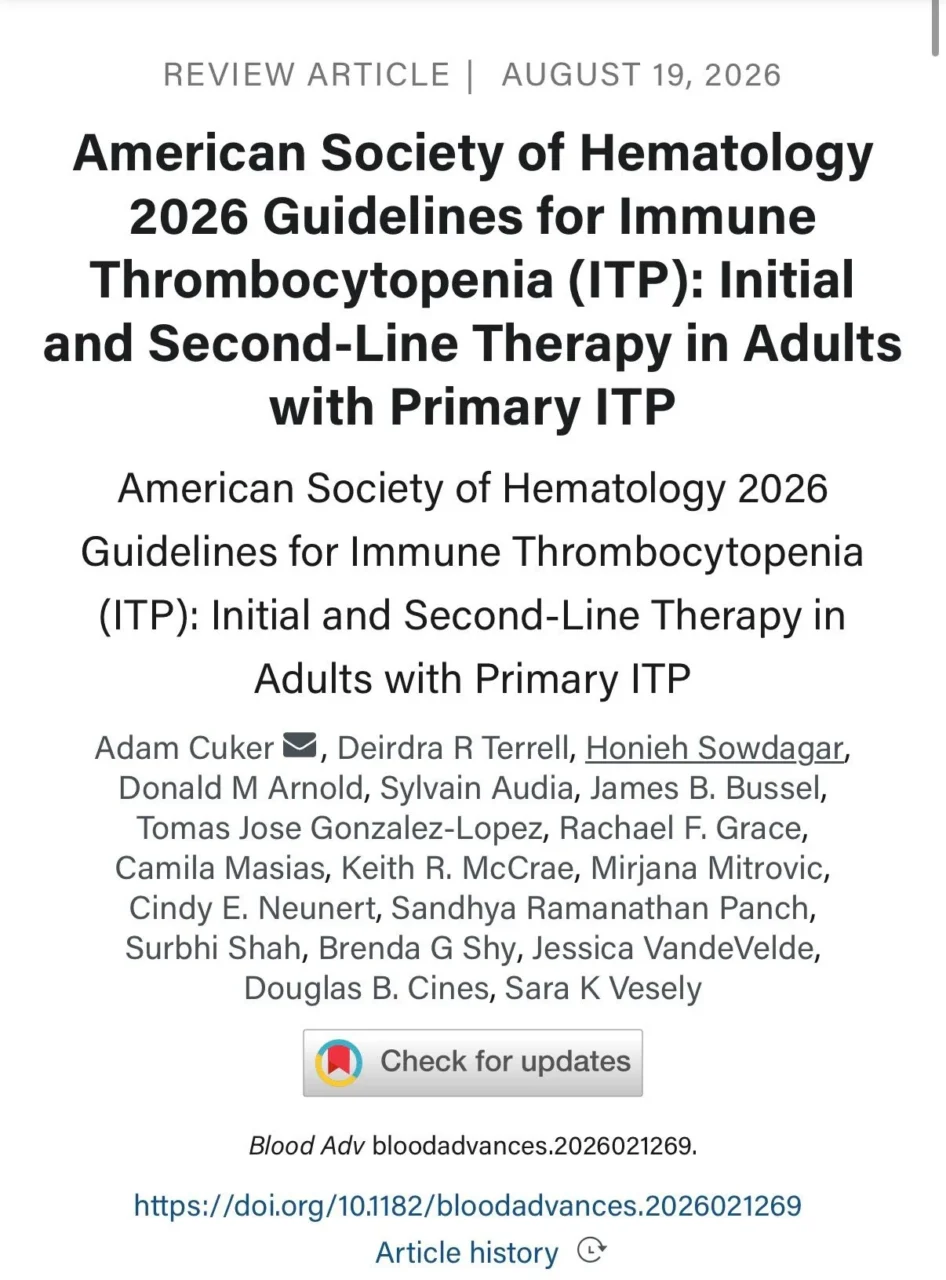
Title: American Society of Hematology 2026 Guidelines for Immune Thrombocytopenia (ITP): Initial and Second-Line Therapy in Adults with Primary ITP
Authors: Adam Cuker, Deirdra R Terrell, Honieh Sowdagar, Donald M Arnold, Sylvain Audia, James B. Bussel, Tomas Jose Gonzalez-Lopez, Rachael F. Grace, Camila Masias, Keith R. McCrae, Mirjana Mitrovic, Cindy E. Neunert, Sandhya Ramanathan Panch, Surbhi Shah, Brenda G Shy, Jessica VandeVelde, Douglas B. Cines, Sara K Vesely
Stay updated with Hemostasis Today.
-
Oct 10, 2026, 17:58Archo Farzana Batool: Exploring Medical Writing Through an Article on Iron Deficiency Anemia
-
Oct 10, 2026, 17:53Assessing Frailty in Adults With Hemophilia – JTH
-
Oct 10, 2026, 17:52Fatma Sadeghi: Reducing Maternal Health Inequalities Through Nursing Advocacy
-
Oct 10, 2026, 17:50Grzegorz Hensler: How Apheresis Transformed Blood Cell Separation and Collection
-
Oct 10, 2026, 17:47Hemant K Sharma: Japan’s Universal Artificial Blood Research – A Potential Breakthrough in Transfusion Medicine
-
Oct 10, 2026, 17:40John Strouse: Learning About Bleeding Disorders and Sickle Cell Disease at FWGBD
-
Oct 10, 2026, 17:34Mae Caime: Speaking at the Annual Women’s Retreat for the Hemophilia Community in Florida
-
Oct 10, 2026, 17:30Chokri Ben Lamine: PNH beyond the Textbook Triad
-
Oct 10, 2026, 17:29Ruah Alyamany: Thrombosis and Anticoagulation in Hematological Malignancies at SOHO KSA 2026