


Joseph R. Shaw: Thrombin Generation and the Pharmacodynamics of Oral Anticoagulants
Joseph R. Shaw, Director of Research Plus Program at Ottawa Department of Medicine, EHJ-CVP Associate Editor at European Heart Journal, shared a post on LinkedIn about a recent article he and his colleagues co-authored, published in Pharmacology and Therapeutics, adding:
”I am very happy to share our new review, ‘Thrombin generation and the pharmacodynamics of oral anticoagulants,’ published in Pharmacology and Therapeutics-one of the ten most-cited journals in pharmacology.
From a pharmacodynamic perspective, not all anticoagulants are the same. Drug levels and conventional clotting assays are useful, but do not fully describe how anticoagulants differentially impact thrombin generation.
Blocking coagulation factors near coagulation’s fulcrum, particularly prothrombinase or thrombin, is less susceptible to redundancy. Multitarget inhibition, on the other hand, disrupts the entire system. Pharmacodynamic potency therefore reflects not only binding affinity or reversibility for a primary target, but also its positional leverage within the network and the number of convergent points it engages.
We use thrombin generation as a common language for comparative anticoagulant pharmacology. Broader-acting agents such as VKAs and UFH achieve deeper, cumulative suppression. The tradeoff familiar to clinicians is pharmacokinetic fragility and, on average, less consistency. Direct inhibitors provide greater pharmacodynamic consistency despite increasingly recognized variability in drug levels within and between patients.
These differences may help explain why broader-acting anticoagulants better preserve antithrombotic efficacy in highly prothrombotic settings, mechanical heart valves, antiphospholipid syndrome, rheumatic mitral stenosis, and catheter-associated thrombosis. The same deeper suppression may also help explain the higher intracranial hemorrhage risk with VKAs versus DOACs.
These signatures may help model molecular pharmacology’s effects on coagulation and better account for pharmacological contributions to bleeding and breakthrough thrombosis, even when drug concentrations appear ‘on target.’
The review builds on and expands the framework we recently proposed for parenteral anticoagulants in Pharmacological Reviews.
We extend this framework across oral classes, with implications for how we perceive anticoagulants and how factor XI inhibitors fit within the current therapeutic landscape.
We hope it will be a useful reference for comparative anticoagulant pharmacology over the next decade.”
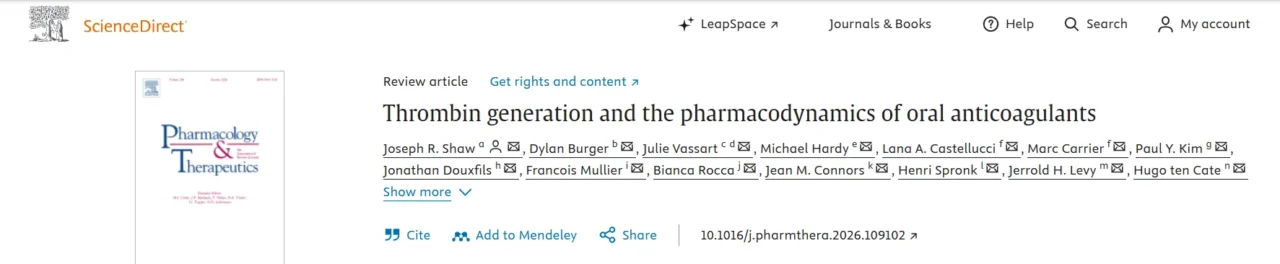
Title: Thrombin generation and the pharmacodynamics of oral anticoagulants
Authors: Joseph R. Shaw, Cheryl L. Maier, Michael Hardy, François Mullier, Jonathan Douxfils, Kenichi Tanaka, Bianca Rocca, Hugo ten Cate, Paul Y. Kim, Marc Carrier, Jean M. Connors, Jerrold H. Levy
Find more posts featuring Joseph R. Shaw on Hemostasis Today.
-
Oct 10, 2026, 17:58Archo Farzana Batool: Exploring Medical Writing Through an Article on Iron Deficiency Anemia
-
Oct 10, 2026, 17:53Assessing Frailty in Adults With Hemophilia – JTH
-
Oct 10, 2026, 17:52Fatma Sadeghi: Reducing Maternal Health Inequalities Through Nursing Advocacy
-
Oct 10, 2026, 17:50Grzegorz Hensler: How Apheresis Transformed Blood Cell Separation and Collection
-
Oct 10, 2026, 17:47Hemant K Sharma: Japan’s Universal Artificial Blood Research – A Potential Breakthrough in Transfusion Medicine
-
Oct 10, 2026, 17:40John Strouse: Learning About Bleeding Disorders and Sickle Cell Disease at FWGBD
-
Oct 10, 2026, 17:34Mae Caime: Speaking at the Annual Women’s Retreat for the Hemophilia Community in Florida
-
Oct 10, 2026, 17:30Chokri Ben Lamine: PNH beyond the Textbook Triad
-
Oct 10, 2026, 17:29Ruah Alyamany: Thrombosis and Anticoagulation in Hematological Malignancies at SOHO KSA 2026