


Charan Gubba: Adult ITP – A major shift in the 2026 ASH Guidelines
Charan Gubba, Team Head at Sri Satya Sai Aarogya Pradayini, shared a post on LinkedIn about a recent article by Adam Cuker et al., published in Blood Advances, adding:
“Adult ITP: A major shift in the 2026 ASH Guidelines
The management of adult immune thrombocytopenia (ITP) may be entering a new phase.
For years, the usual approach was simple: start with corticosteroids, see how the patient responds, and move to targeted therapies if steroids failed or the patient became dependent on them.
The 2026 ASH Guidelines now suggest moving some targeted therapies much earlier.
For adults with primary ITP who require treatment, ASH suggests starting with either rituximab with corticosteroids or a thrombopoietic agent with corticosteroids, with or without IVIG, rather than corticosteroids alone.
This is a conditional recommendation based on low-certainty evidence, so it doesn’t mean that every newly diagnosed patient should automatically receive combination therapy. Clinical circumstances, availability, cost and patient preferences still matter.
One of the main goals behind this change is to improve sustained responses while reducing exposure to corticosteroids and their cumulative toxicity.
If there is uncertainty about the diagnosis, a short course of corticosteroids, with or without IVIG, for up to 2 weeks can still be used before committing to combination therapy. Overall corticosteroid exposure should generally be limited to 6 weeks or less.
The second-line pathway has also become more structured.
For patients who need additional treatment after corticosteroids, the guideline ranks options as thrombopoietic agents first, followed by rituximab, then BTK inhibitors and MMF or SYK inhibitors, and finally azathioprine.
Another interesting change is the continued role of splenectomy. When possible, it should be delayed for at least one year after diagnosis, allowing time for spontaneous remission. Switching between different thrombopoietic agents is also supported when response, adverse effects, adherence or patient preference become issues.
What hasn’t changed?
The previous less than 30 × 10⁹/L threshold for considering treatment in newly diagnosed adults remains unchanged, as does the recommendation regarding hospital admission for newly diagnosed patients with platelet counts less than 20 × 10⁹/L and no or minor bleeding.
The bigger picture is that ITP treatment is moving away from a simple ‘steroids first, targeted therapy later’ approach toward earlier use of targeted treatment when appropriate.
The real challenge now may be translating these recommendations into everyday practice — particularly access, authorization, monitoring, cost and deciding which patients are most likely to benefit from upfront combination therapy.
How is your institution adapting to this change in the treatment pathway for newly diagnosed adult ITP?”
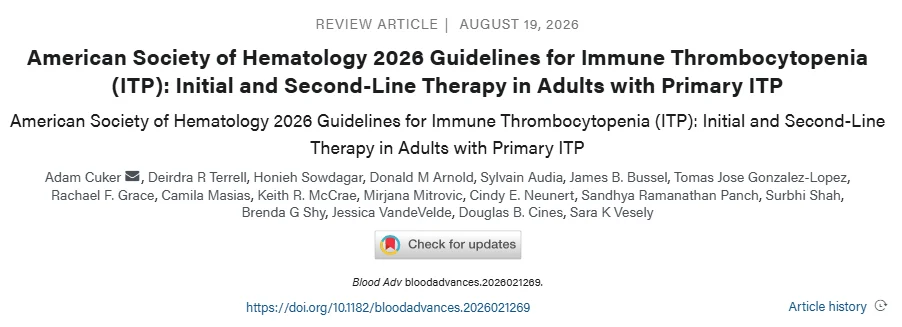
Title: American Society of Hematology 2026 Guidelines for Immune Thrombocytopenia (ITP): Initial and Second-Line Therapy in Adults with Primary ITP
Authors: Adam Cuker, Deirdra R. Terrell, Honieh Sowdagar, Donald M. Arnold, Sylvain Audia, James B. Bussel, Tomas Jose Gonzalez-Lopez, Rachael F. Grace, Camila Masias, Keith R. McCrae, Mirjana Mitrovic, Cindy E. Neunert, Sandhya Ramanathan Panch, Surbhi Shah, Brenda G. Shy, Jessica VandeVelde, Douglas B. Cines, and Sara K. Vesely
Stay updated on all scientific advances with Hemostasis Today.
-
Oct 10, 2026, 17:58Archo Farzana Batool: Exploring Medical Writing Through an Article on Iron Deficiency Anemia
-
Oct 10, 2026, 17:53Assessing Frailty in Adults With Hemophilia – JTH
-
Oct 10, 2026, 17:52Fatma Sadeghi: Reducing Maternal Health Inequalities Through Nursing Advocacy
-
Oct 10, 2026, 17:50Grzegorz Hensler: How Apheresis Transformed Blood Cell Separation and Collection
-
Oct 10, 2026, 17:47Hemant K Sharma: Japan’s Universal Artificial Blood Research – A Potential Breakthrough in Transfusion Medicine
-
Oct 10, 2026, 17:40John Strouse: Learning About Bleeding Disorders and Sickle Cell Disease at FWGBD
-
Oct 10, 2026, 17:34Mae Caime: Speaking at the Annual Women’s Retreat for the Hemophilia Community in Florida
-
Oct 10, 2026, 17:30Chokri Ben Lamine: PNH beyond the Textbook Triad
-
Oct 10, 2026, 17:29Ruah Alyamany: Thrombosis and Anticoagulation in Hematological Malignancies at SOHO KSA 2026