


Jason Carney: Challenging Long-Standing Assumptions About Women and Anemia
Jason Carney, Senior Vice President, Clinical Strategist at hc1, shared Tiffany Hall‘s post on LinkedIn:
“Important data and an important conversation. The evidence challenges a long-standing assumption about women and anemia—and shows why we need to design clinical thresholds around patient outcomes, not population averages.
At hc1, we’re focused on translating insights like these into practical, consistent clinical decision support that helps close gaps at the point of care.
Proud of Tiffany Hall and the team advancing this work and the impact it can have on safer, more equitable patient care.”
Tiffany Hall, Director of cPBM Clinical Technology at hc1, shared a post on LinkedIn about a recent article by Florian Rumpf et al. published in Frontiers in Medicine, adding:
“A landmark 842,130-patient study exposed a flaw in how we diagnose anemia in women before surgery.
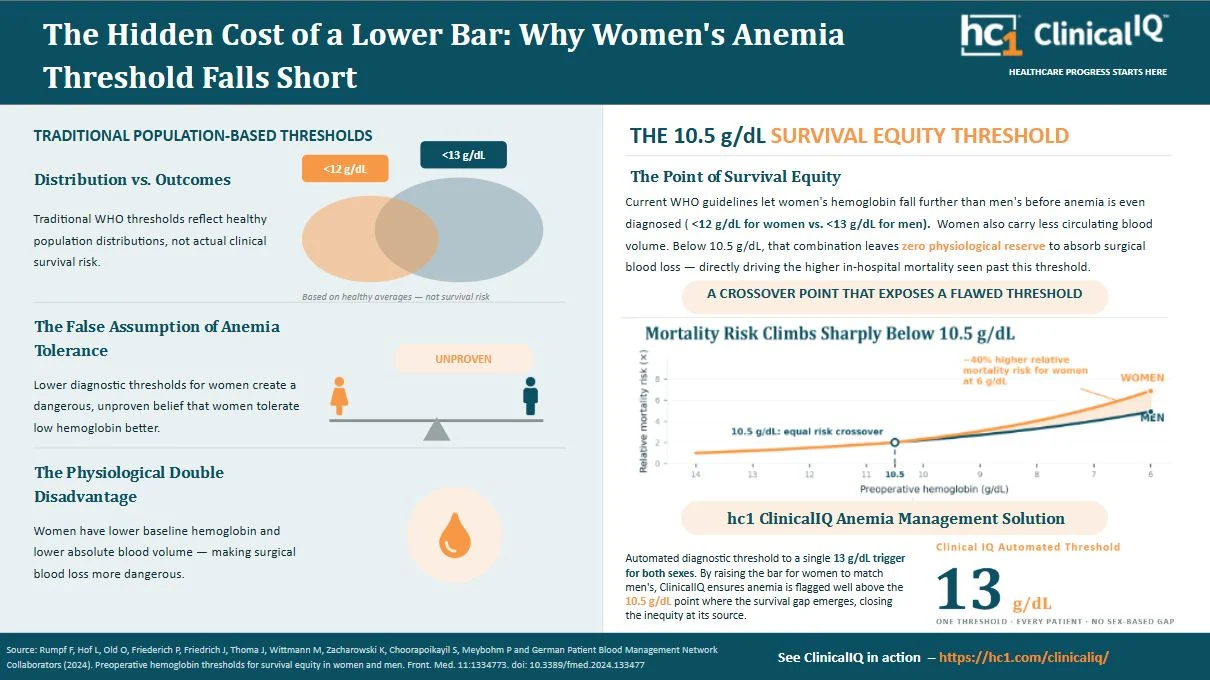
Many Pre-Surgical Testing clinics follow the current WHO guidelines which let women’s hemoglobin fall lower than men’s before anemia is even flagged (less than 12 g/dL for women vs. less than 13 g/dL for men). It’s been standard practice for decades.
But new outcomes data from Rumpf F, Hof L, Old O, et al. tells a different story. Across 14 hospitals and a decade of surgical cases, researchers found the hemoglobin level that actually predicts in-hospital mortality equally for men and women is 10.5 g/dL. Below that point, women don’t tolerate low hemoglobin better than men, they face higher mortality risk at the same level.
Why?
Women also carry less circulating blood volume. Below 10.5 g/dL, that combination leaves zero physiological reserve to absorb surgical blood loss, directly driving the mortality gap this study uncovered.
This isn’t a case of women needing a different standard. It’s a case of the current standard never being built on survival risk in the first place.
hc1 ClinicalIQ‘s anemia management module closes this gap at the source. This EHR-integrated solution automates the diagnostic threshold to a single 13 g/dL trigger for every patient, no sex-based split, no manual chart review, no missed flags. One threshold, applied consistently, well above the point where the survival gap emerges.”
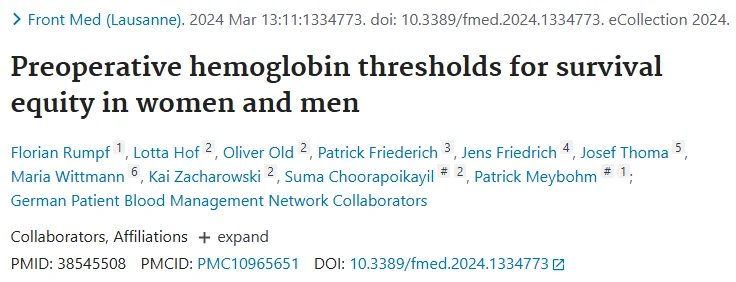
Title: Preoperative hemoglobin thresholds for survival equity in women and men
Authors: Florian Rumpf, Lotta Hof, Oliver Old, Patrick Friederich, Jens Friedrich, Josef Thoma, Maria Wittmann, Kai Zacharowski, Suma Choorapoikayil, and Patrick Meybohm
Stay updatedon all scietific advances with Hemostasis Today.
-
Oct 13, 2026, 02:01Nour Al-Mozain: Is It Really Anti-D? – Unraveling Auto-Anti-LW in the Transfusion Laboratory
-
Oct 13, 2026, 01:51Berenice Villegas: The Role of Morphologic Evaluation in Body Fluid Differential Analysis
-
Oct 13, 2026, 01:44Debadrita Ray: Evaluating vWF and VITRO Score for Detecting CSPH in cACLD Patients
-
Oct 13, 2026, 01:34Nagesh Ramesh: Donating Blood for International Plasma Awareness Week
-
Oct 12, 2026, 21:51Sam Botchey: Orthobiologics Are Advancing but the Evidence Must Keep Pace
-
Oct 12, 2026, 21:50Serum Vitamin D, Platelet Function, and Bleeding in Primary ITP – Platelets Journal
-
Oct 12, 2026, 21:30Nika Samadzadeh Tabrizi: Looking Forward to the PACeS Trial on Anticoagulation for POAF
-
Oct 12, 2026, 21:28Michael Megaly: Does Coronary Ectasia Affect Outcomes in Acute Coronary Syndromes?
-
Oct 12, 2026, 21:25Vitor Borin P. de Souza: Think Twice Before Anticoagulating an Isolated Subsegmental PE