


Adam Urato: The Platelet Paradox of SSRIs
Adam Urato, Maternal-Fetal Medicine Physician at MetroWest Medical Center, shared a post on X about a recent article by Amir Mahdi Ghafarian et al., published in AJS, adding:
“New study: Patients on SSRI/SNRIs undergoing colon surgery had increased bleeding and blood transfusion rates.
These drugs have chemical effects on platelets – lowering platelet serotonin.
Increased rates of postpartum hemorrhage, GI bleeding, & other postsurgical bleeding have previously been demonstrated.
The authors write: ‘By inhibiting platelet serotonin reuptake, these agents deplete the platelet serotonin that supports aggregation and hemostasis, providing a biological basis for increased bleeding.'”
Sanil Rege, Consultant Psychiatrist and Director of Mental Health at Beleura Private Hospital, shared this post on X, adding:
“But what’s the other side of the equation.
The same effect on platelets is protective in other scenarios.
SSRIs and myocardial infarction (MI) risk
Long-term SSRI use reduces MI risk.
‘The use of SSRIs may confer a protective effect against MI.
This could be attributable to the inhibitory effect SSRIs have on serotonin-mediated platelet activation or possibly amelioration of other factors associated with increased risk for MI in depression.’
Why?
- Serotonin promotes platelet aggregation and vasoconstriction of diseased coronary arteries.
- Less platelet serotonin is equal to lower clot formation risk which is equal to lower coronary artery occlusion risk.
Prescribing a medication is a risk benefit analysis.
If you look at only one side of the equation without understanding the person for whom you are prescribing for, you aren’t really performing a risk benefit analysis.
Thus – Bleeding risk increases due to impaired platelet aggregation – MI risk decreases due to reduced clot formation Hence nuance is needed in cardiovascular medicine where other anticoagulants and NSAIDs may be prescribed.”
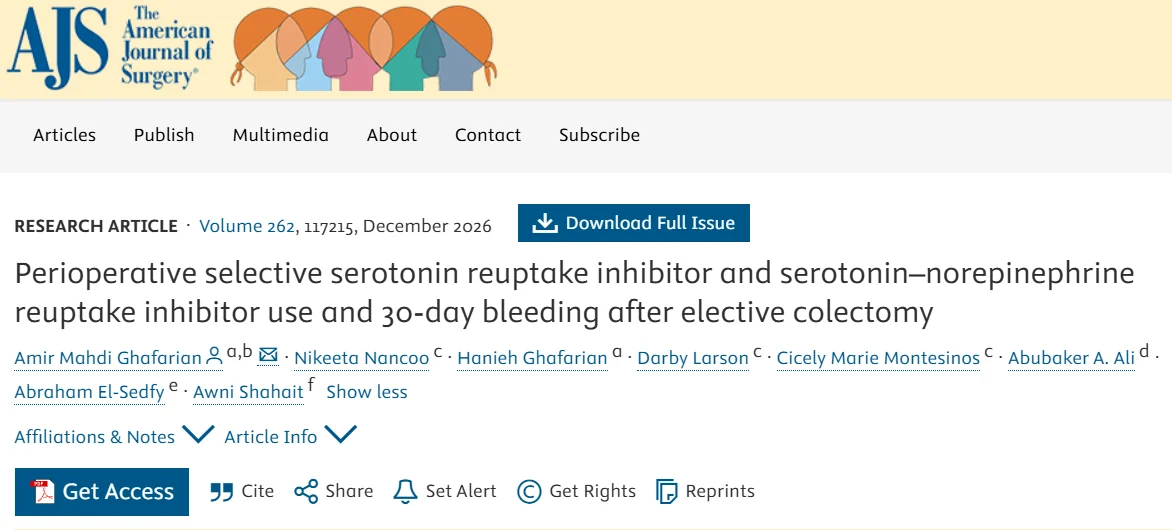
Title: Perioperative selective serotonin reuptake inhibitor and serotonin–norepinephrine reuptake inhibitor use and 30-day bleeding after elective colectomy
Authors: Amir Mahdi Ghafariana, Nikeeta Nancooc, Hanieh Ghafariana, Darby Larsonc, Cicely Marie Montesinosc, Abubaker A. Alid, Abraham El-Sedfye, Awni Shahait
Stay updated with Hemostasis Today.
-
Oct 23, 2026, 10:40Janet Tankersley: Joint and Cardiometabolic Health in Children with Severe Haemophilia A
-
Oct 23, 2026, 09:02Nikenza Viceconte: When Should Haematologists Suspect Gaucher Disease?
-
Oct 23, 2026, 08:56Kim Mahler: Human Platelet Lysate Outperforms FBS in MSC Expansion
-
Oct 23, 2026, 08:46Melissa Hollo: Improving Presurgical Anemia Management at Jefferson Health
-
Oct 23, 2026, 08:37Andrés Felipe Escobar González: Inno8 – Bringing Oral Innovation to Haemophilia Care
-
Oct 23, 2026, 08:21Rob Maloney: From Being Important to Being Useful
-
Oct 23, 2026, 07:52Catherine Canadeo: A Celebration of Compassion and Progress in Haemophilia B
-
Oct 23, 2026, 07:37Robert Hamilton: How Can a Blood Clot in the Leg Cause a Stroke?
-
Oct 23, 2026, 07:17Nahush Chafekar: Anticoagulation Strategies in Haemodialysis Patients with AF