


W. Alberto Sifuentes Giraldo: Urticarial Vasculitis Clinical Features, Systemic Involvement, and Treatment
W. Alberto Sifuentes Giraldo, Rheumatologist at Hospital Nuestra Señora de Sonsoles (Sacyl), shared a post on LinkedIn about a recent article by Angelo Valerio Marzano et al., published in The Journal of Allergy and Clinical Immunology (JACI), adding:
”Urticarial vasculitis (UV) is an uncommon clinicopathologic entity characterized by painful, often burning, urticaria-like lesions that typically persist for more than 24 hours.
A classic clinical clue is the resolution of these lesions with ecchymotic postinflammatory hyperpigmentation.
Histopathologically, UV is defined by leukocytoclastic vasculitis involving the small dermal blood vessels.
Direct immunofluorescence studies often reveal granular or continuous deposition of immunoglobulins (mostly IgM), complement components (C3 or C4), or fibrin along vessel walls and, in some cases, the dermal-epidermal junction.
Angioedema can occur in approximately 40 percent of patients.
Systemic involvement and subtypes:
While UV may remain limited to the skin, it is frequently a systemic disease. Cutaneous findings can be accompanied by fever, fatigue, and severe arthralgias.
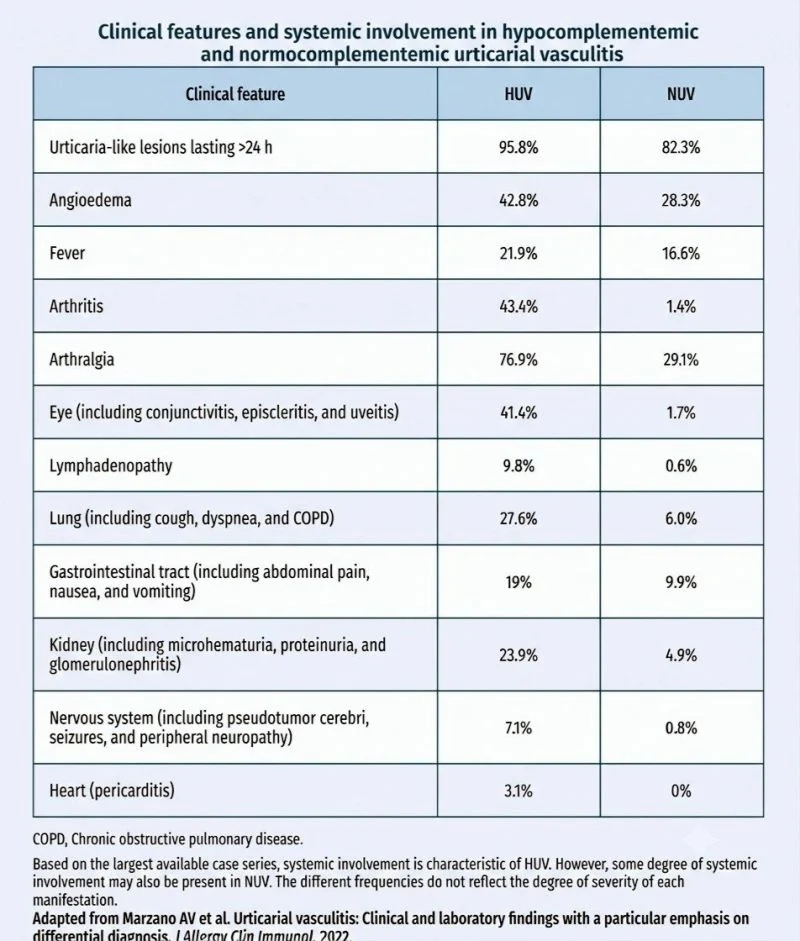
Systemic disease is most notable in the hypocomplementemic variant (HUV), with multiple organs potentially affected, including the kidneys (glomerulonephritis), lungs (cough, dyspnea, increased COPD risk), GI tract (abdominal pain, nausea, vomiting), eyes (episcleritis, uveitis), and less commonly CNS and heart.
HUV can be serious, with higher risk of complications, including potentially fatal multi-organ failure.
Classification into two major subtypes is clinically critical and based on serum complement levels:
- Normocomplementemic Urticarial Vasculitis (NUV): generally lower frequency of systemic involvement; labs show normal serum C1q, C3, and C4.
- Hypocomplementemic Urticarial Vasculitis (HUV): a more severe, immune-complex-mediated small-vessel vasculitis. Defining features are low serum C1q, C3, and C4. Up to 100 percent of HUV patients may have anti-C1q autoantibodies, an important diagnostic marker. Prognosis is generally worse, with 10-year mortality up to 17 percent, primarily from severe renal or pulmonary disease.
Treatment paradigms
Management of UV is tailored to the severity and extent of systemic organ involvement.
- For mild or skin-limited disease: antihistamines (often poorly effective alone), dapsone, omalizumab, and NSAIDs.
- For moderate or systemic disease: systemic glucocorticoids are the mainstay, with dapsone and omalizumab as steroid-sparing agents.
- For severe or multi-systemic disease: high-dose glucocorticoids plus immunosuppressive agents, including mycophenolate mofetil, cyclophosphamide, rituximab, or IL-1 inhibitors, more effective at achieving disease control.”
Title: Urticarial vasculitis: Clinical and laboratory findings with a particular emphasis on differential diagnosis
Authors: Angelo Valerio Marzano, Carlo Alberto Maronese, Giovanni Genovese, Silvia Ferrucci, Chiara Moltrasio, Riccardo Asero, Massimo Cugno
Other posts featuring W. Alberto Sifuentes Giraldo on Hemostasis Today.
-
Sep 13, 2026, 17:28Jim Hoffman: New Potential Predictive Biomarker for Lupus Nephritis
-
Sep 13, 2026, 16:58Let’s Debunk Some Myths about Blood in SCD – ASCO
-
Sep 13, 2026, 16:56William Wallace: A Magnesium Ion Decides Whether Your Brain Learns or Not
-
Sep 13, 2026, 16:54Meet NBDF’s 2026 Excellence Fellowship Recipients – National Bleeding Disorders Foundation
-
Sep 13, 2026, 16:52Kaloyan Takov: Native Lp(a) Carries a Distinct Triglyceride Signature Linked to Cardiovascular Disease
-
Sep 13, 2026, 16:51Axay Tomar: How Simulation-Based Education Shapes Safer Transfusion Practices
-
Sep 13, 2026, 16:51Edina Cenko: AZURE-HeFH Highlights the LDL-C Treatment Gap in HeFH
-
Sep 13, 2026, 16:49William Aird: Why Is LDH Elevated In Splenic Infarction?
-
Sep 13, 2026, 16:48David McIntosh: PPTA Calls for Action on the Global Shortage of Plasma-Derived Medicines