


Hani Karrar: Pleased to Share Our Review on Emicizumab in Hemophilia A Management
Hani Karrar, IV TPN Pharmacy Supervisor at Dr. Samir Abbas Hospital, shared a post on LinkedIn about a recent article he and his colleagurs co-authored, published in Saudi Journal of Clinical Pharmacy, adding:
“I’m pleased to share that our review article, ‘Long-Term Safety and Effectiveness of Emicizumab in Hemophilia A Management,” has been published in the Saudi Journal of Clinical Pharmacy (Vol. 5, Issue 3, 2026).
For decades, prophylaxis for hemophilia A has meant frequent intravenous factor VIII infusions. Many patients also develop inhibitors. Emicizumab, a bispecific monoclonal antibody that mimics activated factor VIII, has changed that picture. In our review, we bring together the clinical trial and real-world evidence on it.
- Efficacy: Across the HAVEN 1–4 trials, emicizumab sharply lowered annualized bleeding rates. In HAVEN 3, that meant about 68% fewer bleeds than with factor VIII prophylaxis in patients without inhibitors.
- Convenience: It is given subcutaneously, with flexible maintenance dosing weekly, every 2 weeks, or every 4 weeks. Patients don’t need central venous access devices.
- Safety: In pooled data from 391 patients, injection site reactions were mostly mild to moderate. Thrombotic microangiopathy and thrombotic events occurred only with concomitant high-dose aPCC.
- Surgery: Two-thirds of minor surgeries were performed without additional prophylactic factor, and 91% had no treated postoperative bleeding.
- Quality of life: Patients had fewer breakthrough bleeds, better QoL scores, and fewer missed work and school days.
We also cover practical points for clinical pharmacists, such as emicizumab’s interference with aPTT-based assays and its interactions with bypassing agents.
Sincere thanks to my co-authors for their dedication and collaboration.”
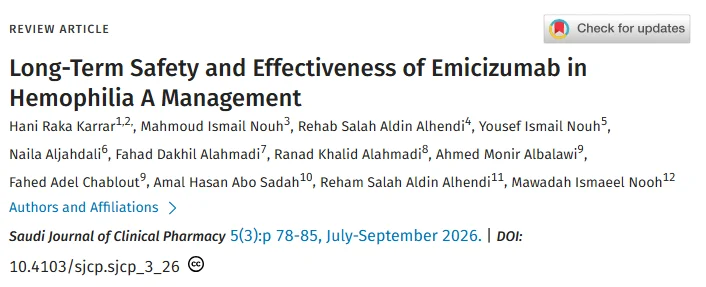
Title: Long-Term Safety and Effectiveness of Emicizumab in Hemophilia A Management
Authors: Hani Raka Karrar, Mahmoud Ismail Nouh, Rehab Salah Aldin Alhendi, Yousef Ismail Nouh, Naila Aljahdali, Fahad Dakhil Alahmadi, Ranad Khalid Alahmadi, Ahmed Monir Albalawi, Fahed Adel Chablout, Amal Hasan Abo Sadah, Reham Salah Aldin Alhendi, Mawadah Ismaeel Nooh
Stay updated on all scientific advances with Hemostasis Today.
-
Oct 21, 2026, 00:53Akshay Sharma: HSCT Leads to Sustained Improvements in Sickle Cell Cardiomyopathy for Up to 3 Years
-
Oct 21, 2026, 00:51Prateek Meena: The F. A. T. R. N. Mnemonic for Recognizing TTP
-
Oct 20, 2026, 23:51Registration Is Open for WFH CCS 2027 – World Federation of Hemophilia
-
Oct 20, 2026, 23:44Edward Lee Carter: AF in Nursing Homes – When Stroke Risk Scores Tell Only Part of the Story
-
Oct 20, 2026, 22:59Building Effective Patient Advocacy Through Collaboration Between Patients and Clinicians – EHC
-
Oct 20, 2026, 21:22Intezar Mehdi: When Prolonged Bleeding May Indicate an Underlying Bleeding Disorder
-
Oct 20, 2026, 21:06Nandini Pethe: Sharing My Experience as a Caregiver in the HOPE Factor Resource Guide
-
Oct 20, 2026, 16:51Suzan Nakasendwa: A Growing Stroke Challenge in Uganda
-
Oct 20, 2026, 16:38Steve Moon: How Does Smoking Cessation Duration Affect Ischemic Stroke Risk