


Jeremiah Morris: Why Blood Detection Reagents Work Better on Dry Bloodstains
Jeremiah Morris, Forensic Scientist at Johnson County, KS Government, shared a post on LinkedIn:
“There are several presumptive test reagents for blood which are based on the peroxidase-like activity of hemoglobin.
These include luminol, phenolphthalein, tetramethylbenzidine, leucomalachite green, and leucocrystal violet to name a few.
All of these have a color change which is the result of hemoglobin acting on hydrogen peroxide.
Hemoglobin comprises about 95 percent of a red blood cell’s dry weight and red blood cells make up about 40 percent to 45 percent of blood’s composition.
So there’s a lot of hemoglobin in whole blood for these reagents to react with.
However, there is a critical point which we need to understand.
These chemical reactions can only occur if the various reagents come into contact with the hemoglobin molecule.
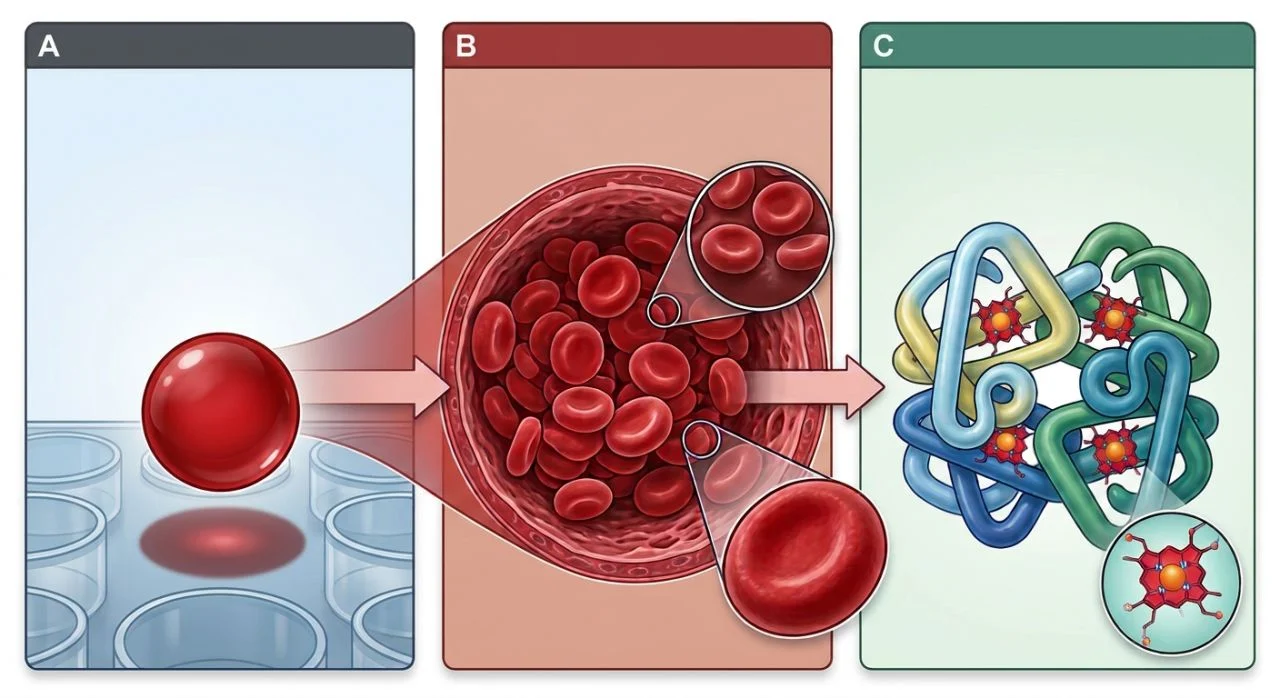
In their natural state, nearly all of the hemoglobin is contained within the membrane of the red blood cells.
And the point?
The reagents work extremely well on dry bloodstains but not nearly as well on fresh liquid blood.
Why?
Because the vast majority of the hemoglobin in fresh liquid blood is still contained with the cell membranes and protected from the reagents.
As the bloodstains dry, the red blood cells lyse causing the hemoglobin to exit the cell and become fully exposed to chemical reagents.
This is why studies on liquid dilutions of blood will produce different sensitivity levels (lower) than if you took the same dilutions and allowed them to dry before testing them with the reagent.”
Stay updated with Hemostasis Today.
-
Nov 2, 2026, 13:44Rishiraj Sinha: Strengthening ISBT–AABB Collaboration in Transfusion Medicine
-
Nov 2, 2026, 12:38Maria Τektonidou: Machine Learning – A New Approach to CVD Risk in SLE
-
Nov 2, 2026, 12:31Toby Richards: Screening for Iron Deficiency – Nearly 1 in 4 Women Anaemic
-
Nov 2, 2026, 12:22James P. Crowley: A New Adult Progenitor with Erythro-Myeloid Potential
-
Nov 2, 2026, 12:17Mokhtar Tazik: Plasma Self-Sufficiency and Sustainable Access
-
Nov 2, 2026, 12:09Alejandro González Veliz: Does More Calcium Mean More Stability
-
Nov 2, 2026, 12:05Zeev Dvashi: Advancing Synthetic Blood Technologies for Battlefield Medicine
-
Nov 2, 2026, 11:56Rob Maloney: Strengthening Patient Advocacy in Bleeding Disorders
-
Nov 2, 2026, 11:46William McKeown: Advancing Gene and Cell Therapies for Inherited Bleeding Disorders