


Gilberto de lima Lopes Junior: The Cardiovascular Consequences of Cancer in Younger Patients
Gilberto de lima Lopes Junior, Chief of Medical Oncology Division at Sylvester Comprehensive Cancer Center, Board Member at Union for International Cancer Control (UICC), Associate Director for the Cancer Center, Professor of Clinical Medicine, Fellowship Director at University of Miami, Miller School of Medicine, shared a post on LinkedIn about a recent article he and his colleagues co-authored, published in Cancers, adding:
“When cancer strikes young, the heart matters too.
Our new systematic review and meta-analysis was published today in Cancers.
As treatments improve and more young patients survive cancer, we must pay greater attention to what happens years—and sometimes decades—after diagnosis.
Together with Musa Kiyani, Robert Heins, John Hayssam Yazji, and Harith Almimar, we examined the cardiovascular burden among younger patients with cancer.
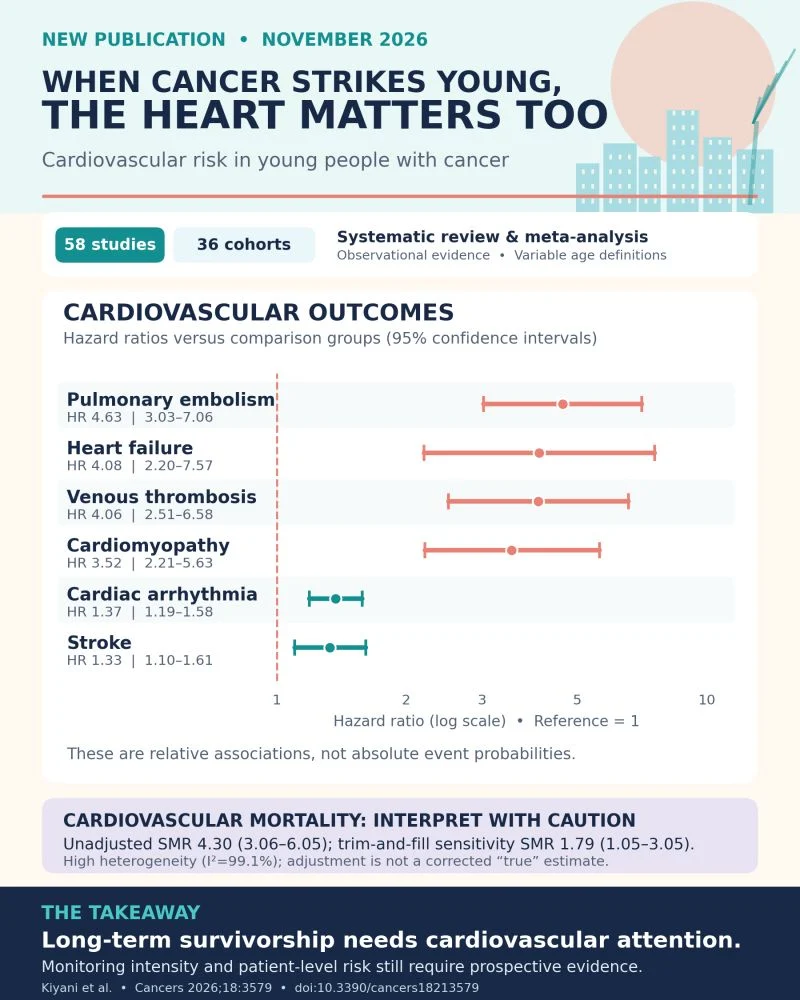
We included 58 studies from 36 unique cohort sources, evaluating cardiovascular outcomes relative to non-cancer or general-population reference groups.
The findings are concerning.
Pooled hazard ratios (95 percent CIs):
- Pulmonary embolism: 4.63 (3.03–7.06).
- Heart failure: 4.08 (2.20–7.57).
- Venous thrombosis: 4.06 (2.51–6.58).
- Cardiomyopathy: 3.52 (2.21–5.63).
- Arrhythmia: 1.37 (1.19–1.58).
- Stroke: 1.33 (1.10–1.61).
Cardiovascular mortality was elevated, but its magnitude was highly uncertain because of extreme heterogeneity (I²=99.1 percent) and sensitivity to potential publication bias.
What does this mean for clinical practice?
Cancer survivorship is not simply the absence of recurrence.
Patients treated during adolescence and young adulthood may live for decades after diagnosis.
Long-term health depends not only on cancer control but also on recognizing and managing cardiovascular risk.
Our findings reinforce individualized cardiovascular risk assessment and guideline-informed survivorship follow-up, particularly after known cardiotoxic exposures.
But important limitations remain.
These were observational studies spanning different cancers, ages, treatments, and eras.
Most outcomes had low-certainty evidence.
We could not separate cancer-related risks from treatment-related cardiotoxicity.
Nor does this meta-analysis establish that more intensive cardiac surveillance improves outcomes.
Successful cancer treatment should be measured not only by how long patients live, but how well they live afterward.
Congratulations and thanks to Musa Kiyani and our coauthors.
This is a topic deserving continued collaboration across oncology and cardiology.”
Title: Excess Cardiovascular Burden Among Young Patients with Cancer: A Systematic Review and Meta-Analysis
Authors: Musa Kiyani, Robert J. Heins, John Hayssam Yazji, Harith Almimar, Gilberto de Lima Lopes, Junior

Stay updated on all scientific advances with Hemostasis Today.
-
Nov 8, 2026, 17:48Andra T.: What Causes Antiphospholipid Syndrome? – Four Steps, not One Cause
-
Nov 8, 2026, 17:38Nasrin Samadi: Can a Normal Clotting Test Be Misleading?
-
Nov 8, 2026, 17:36Paschalis Evangelidis: The Multifactorial Nature of Cardiovascular Risk in People With Hemophilia
-
Nov 8, 2026, 17:32Evangelos Panagiotopoulos: Apixaban Reduces Stroke and Major Bleeding Risk in Secondary Stroke Prevention
-
Nov 8, 2026, 17:27Danny Gaskin: Applications Open for the BBTS Specialist Certificate in Clinical Transfusion Practice
-
Nov 8, 2026, 16:54James P. Crowley: DOAC Testing Under 50 ng/mL Safely Expedites Urgent Hip Fracture Surgery
-
Nov 8, 2026, 16:21Alessandra Bosch: Women and Girls With Bleeding Disorders and the DACH Registries at HHS 2026
-
Nov 8, 2026, 15:0310 Posts Not to Miss This Week
-
Nov 8, 2026, 14:55Andra T.: Antiphospholipid Syndrome and Its Thrombotic Risks