


Abdul Mannan: How SSRIs Might Affect Platelet Function
Abdul Mannan, Consultant Hematologist at Betsi Cadwaladr University Health Board, shared a post on LinkedIn:
“Your SSRI might be affecting how your platelets work.
Most people don’t know this.
Most doctors don’t talk about it.
But the biology is real.
Here’s what’s happening:
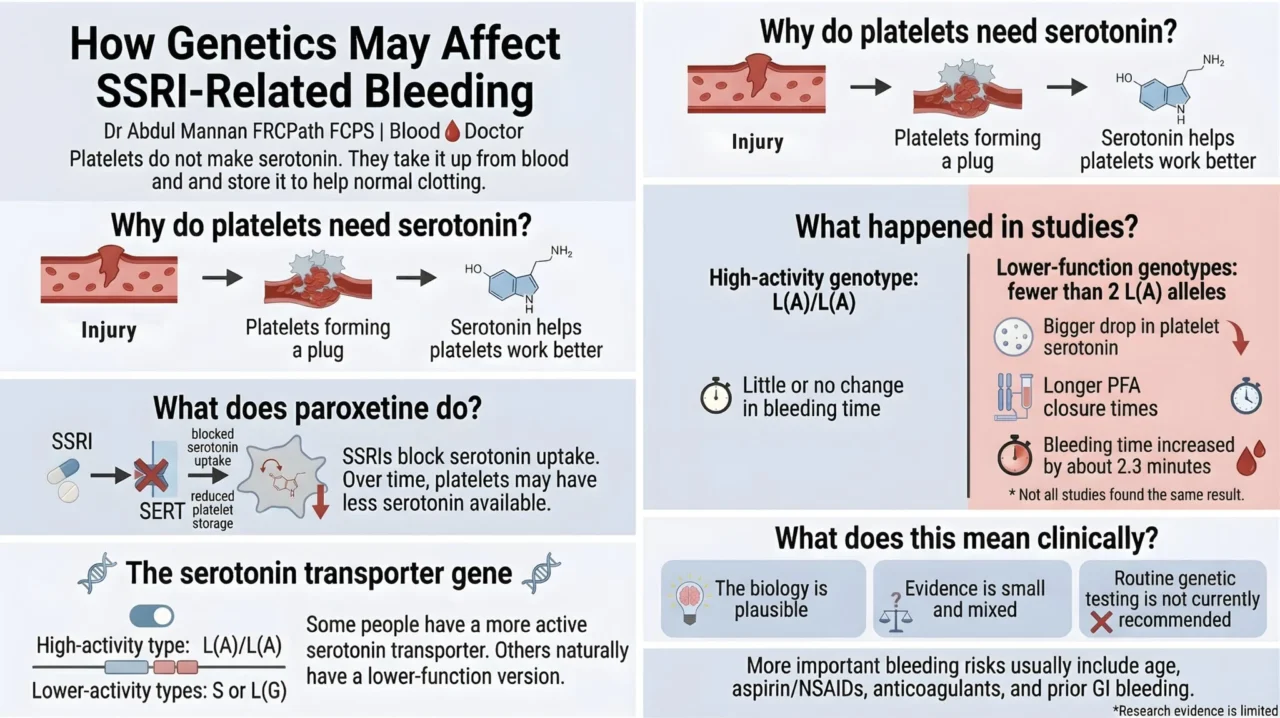
- Platelets don’t make serotonin. They absorb it from blood and store it. This stored serotonin helps activate platelets during clotting.
- SSRIs block the serotonin transporter (SERT). Over time, platelets may have less serotonin available.
- The SLC6A4 gene controls how active your SERT is. Some people carry the high-activity L(A)/L(A) genotype. Others have lower-activity types: S or L(G).
- In studies, patients with lower-activity genotypes (fewer than 2 L(A) alleles) showed longer PFA-100 closure times and prolonged bleeding times by about 2.3 minutes on SSRIs.
- In high-activity genotypes, SSRIs caused little or no change in bleeding time.
So genetics may modulate how much your platelets are affected by these drugs.
But before you order a gene panel – the clinical message is more grounded than that.
- The biology is plausible.
- The evidence is small and mixed.
- Not all studies agree.
- Routine genetic testing is not currently recommended.
The bigger bleeding risks remain age, aspirin and NSAID use, anticoagulants, and prior GI bleeding.
This is a conversation worth having with patients on SSRIs who also have other bleeding risk factors.
Have you seen unexpected bleeding in a patient on SSRIs?
How did you approach it?”
More posts featuring Abdul Mannan on Hemostasis Today.
-
Oct 6, 2026, 04:33Hessam Kakavand: Rethinking Thrombotic Risk in Modern Cancer Therapy
-
Oct 6, 2026, 04:07Moussa Zein Aldine: Acute Coronary Syndrome Every Minute Matters
-
Oct 6, 2026, 03:13Patrick Taylor: Glow Stack Trend What the Evidence Really Shows
-
Oct 6, 2026, 02:59Preventing Hospital Associated Venous Thromboembolism – Thrombosis Canada
-
Oct 6, 2026, 02:42Treatment of Iron Deficiency With and Without Anemia – American Society of Hematology
-
Oct 6, 2026, 02:36Mouna Sassi: When Clinical and Laboratory Perspectives Meet in Thrombosis Care
-
Oct 6, 2026, 02:35Lucia Stefanini: Platelet Dysfunction and Oxidized Phospholipids in MASLD
-
Oct 6, 2026, 02:18Pablo Corral: Association of Lp(a) With Coronary Atherosclerosis and CV Events
-
Oct 5, 2026, 22:55Steve Humphreys: A Big Thank You to BSHT for Providing Me With a Recent Skills Exchange Award