


Abdul Mannan: The Hidden Role of Factor XIII in Protecting Clot Stability
Abdul Mannan, Consultant Haematologist at Betsi Cadwaladr University Health Board, shared a post on LinkedIn:
“Most people think FXIII deficiency is a structural problem.
A missing glue.
It is not.
It is a fibrinolytic catastrophe in slow motion.
Your patient’s wound looked fine.
Bleeding stopped. They went home.
48 hours later: severe haemorrhage.
The clot is gone.
PT, aPTT, and thrombin time?
All completely normal.
This is FXIII deficiency.
And it behaves like nothing else in haemostasis.
Here is why:
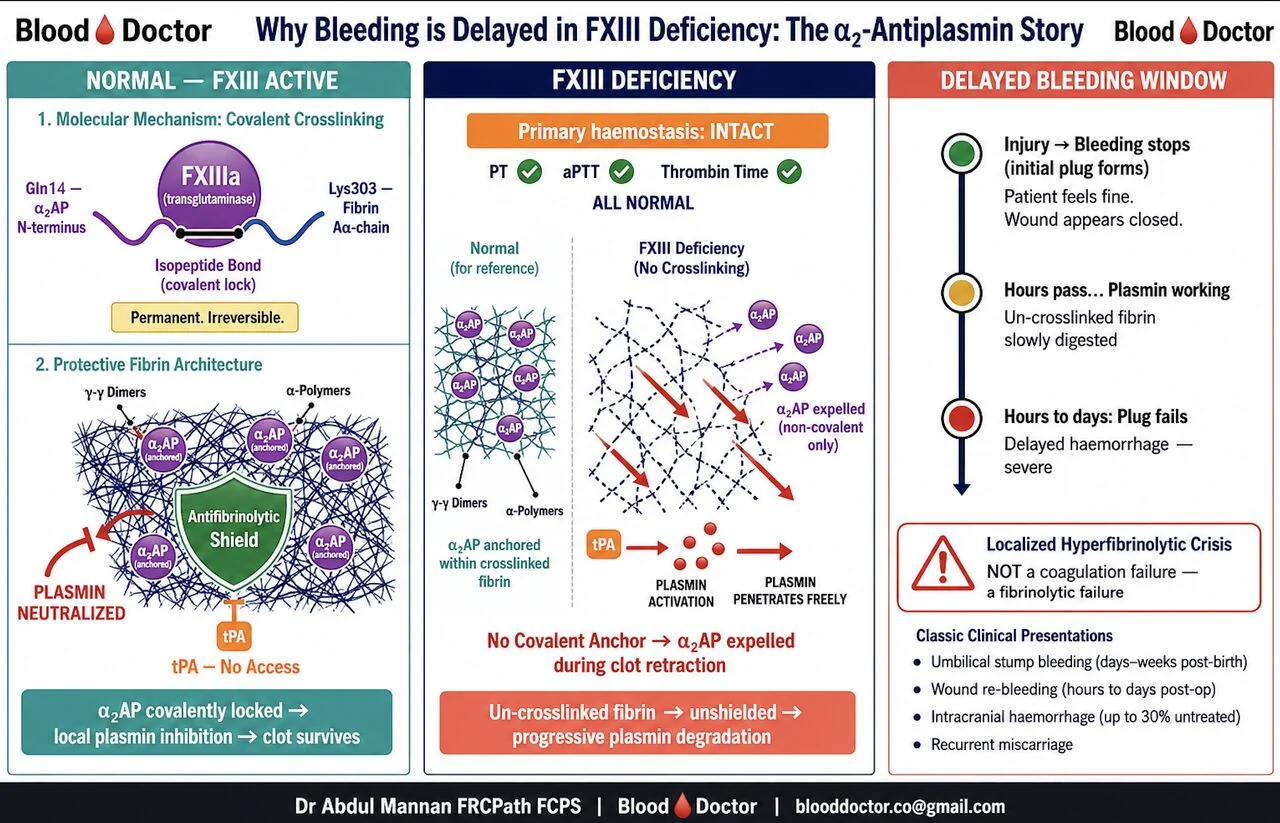
Factor XIIIa does two jobs most people only half-remember:
- It cross-links fibrin (γ-γ dimers, α-polymers) for structural strength
- It covalently anchors α₂-antiplasmin into the clot via an isopeptide bond (Gln14 on α₂AP – Lys303 on the fibrin Aα-chain)
That second job is the one that keeps the clot alive.
Without FXIIIa, α₂-antiplasmin stays loosely bound only.
During clot retraction, it gets physically squeezed out.
The un-crosslinked fibrin mesh is left completely exposed to plasmin and tPA.
Plasmin works slowly but completely unopposed.
Over 24 to 48 hours, the plug dissolves.
This is not a coagulation failure.
It is a localised hyperfibrinolytic crisis.
Standard coagulation screens will never catch it.
You need a specific FXIII assay.
Classic presentations:
- Umbilical stump bleeding in neonates
- Wound re-bleeding post-operatively
- Intracranial haemorrhage, recurrent miscarriage.
Infographic below shows the full mechanism.
What is the rarest factor deficiency you have diagnosed in your practice?”
Other posts featuring Abdul Mannan on Hemostasis Today.
-
Oct 20, 2026, 16:51Suzan Nakasendwa: A Growing Stroke Challenge in Uganda
-
Oct 20, 2026, 16:38Steve Moon: How Does Smoking Cessation Duration Affect Ischemic Stroke Risk
-
Oct 20, 2026, 16:25Cedrice Mentor: Reducing Platelet Wastage Through Cold Storage
-
Oct 20, 2026, 16:09Thirunavukkarasu Angappan: Can a Purified Fibrinogen Concentrate Replace Cryoprecipitate
-
Oct 20, 2026, 16:01Kalyan Roy: Platelet Conservation Through Evidence-Based Transfusion Practice
-
Oct 20, 2026, 15:28Stacy E. Croteau: 33 Countries, One Mission – Better Bleeding Disorder Care
-
Oct 20, 2026, 15:19Teresa Barnes: What Does a Pulmonary Embolism Mean for Jalen Hurts?
-
Oct 20, 2026, 15:04Laura S.: Could Speaking Up Prevent Maternal Deaths from Thrombosis?
-
Oct 20, 2026, 14:44Pete Stibbs: VTE in Professional Athletes – When Fitness Is Not Enough