


Abdul Mannan: Pencil Cells in IDA – Why Most, but Not All Cases Show Them
Abdul Mannan, Consultant Haematologist at Betsi Cadwaladr University Health Board, shared a post on LinkedIn:
“‘I asked myself a question this week: why do pencil cells appear in most IDA cases but not all? The answer is more interesting than I expected.’
Most haematology trainees think pencil cells are equal to iron deficiency.
That is only half the story.
I looked at this properly this week — grounded literature search, real papers, no shortcuts.
Here is what the evidence actually says:
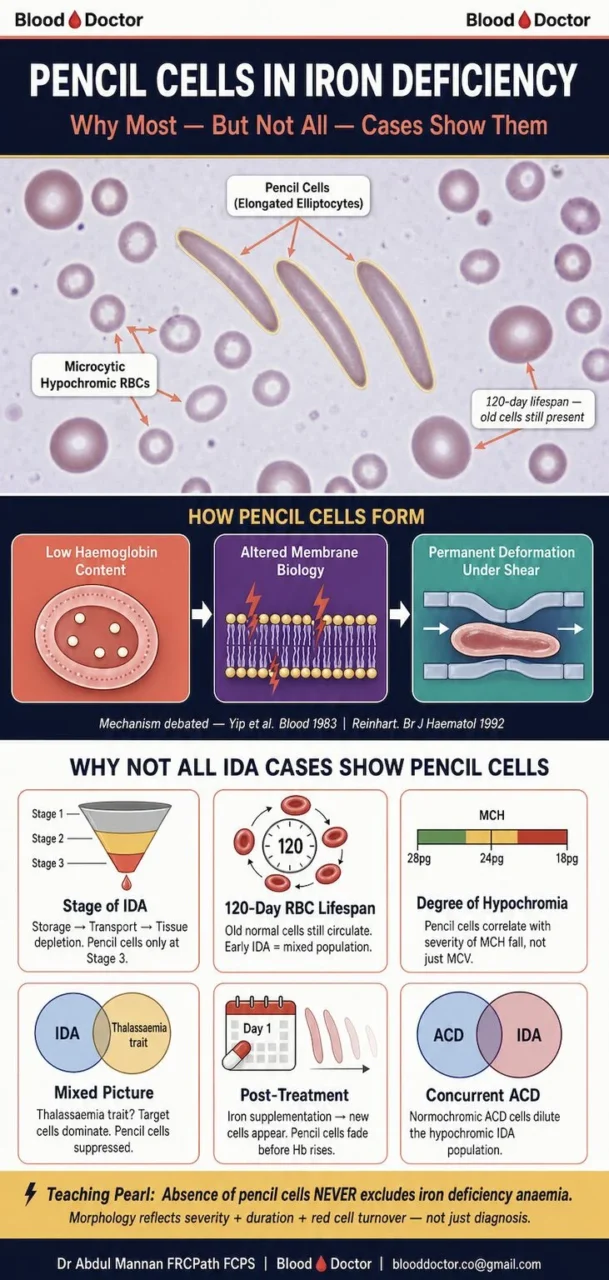
Pencil cells (elongated elliptocytes) appear in iron deficiency because low haemoglobin content changes how the red cell behaves under shear stress in the microcirculation. But the mechanism is genuinely debated.
Yip and Mohandas (Blood, 1983) found increased membrane stiffness from oxidative damage.
Reinhart (BJH, 1992) found the opposite — membrane elasticity is preserved and the cells actually pass more easily through narrow pores because of microcytosis.
Red cells live 120 days. Early iron deficiency means old, normally-shaped cells are still circulating. The film looks unremarkable. Biochemistry is already abnormal.
Severe hypochromia matters more than microcytosis alone. A patient with MCH of 18 pg shows pencil cells. One with MCH of 24 pg often does not.
Thalassaemia trait, anaemia of chronic disease, or partial treatment all suppress pencil cell formation even when IDA is present
Ford (Int J Lab Haematol, 2013) put it directly: the classic blood film appearances in iron deficiency are unreliable in practice.
So the teaching point is this.
Absence of pencil cells never excludes IDA. Their presence tells you something has been going on long enough, severely enough, for the circulating pool to turn over.
Stage. Severity. Duration. Concurrent conditions. That is why not all IDA films look the same.
What morphological finding has surprised you most in a confirmed IDA case?”
Other posts featuring Abdul Mannan on Hemostasis Today.
-
Sep 8, 2026, 16:14Heghine Khachatryan: Colombo 2026 Insights on Point-of-Care Ultrasound in Hemophilia Joint Care
-
Sep 8, 2026, 15:57Flora Peyvandi: Efficiency Meets Innovation in Hemophilia B Gene Therapy
-
Sep 8, 2026, 15:48Maxime Dely: Guillain-Barré Syndrome – What if the Key Lies in the Plasma?
-
Sep 8, 2026, 15:34Ron DePinho: A Negative Trial Highlights the Need for Precision in Cardiovascular Inflammation
-
Sep 8, 2026, 15:31Adil Yousaf: Thrombolysis Speed Matters, but Eligibility Comes First
-
Sep 8, 2026, 15:28Dhargam Aljebouri: First Molecularly Characterized Para-Bombay Phenotype in the Arab World
-
Sep 8, 2026, 15:27Mohd Ashhad: How Much Does Hemoglobin Increase After 1 Unit of PRBC?
-
Sep 8, 2026, 15:27Sanish Babu: The Hematocrit–Platelet Signal in Severe Dengue
-
Sep 8, 2026, 15:26Mary Kama: Climate-Informed Early Warning Systems for Sickle Cell Anaemia