

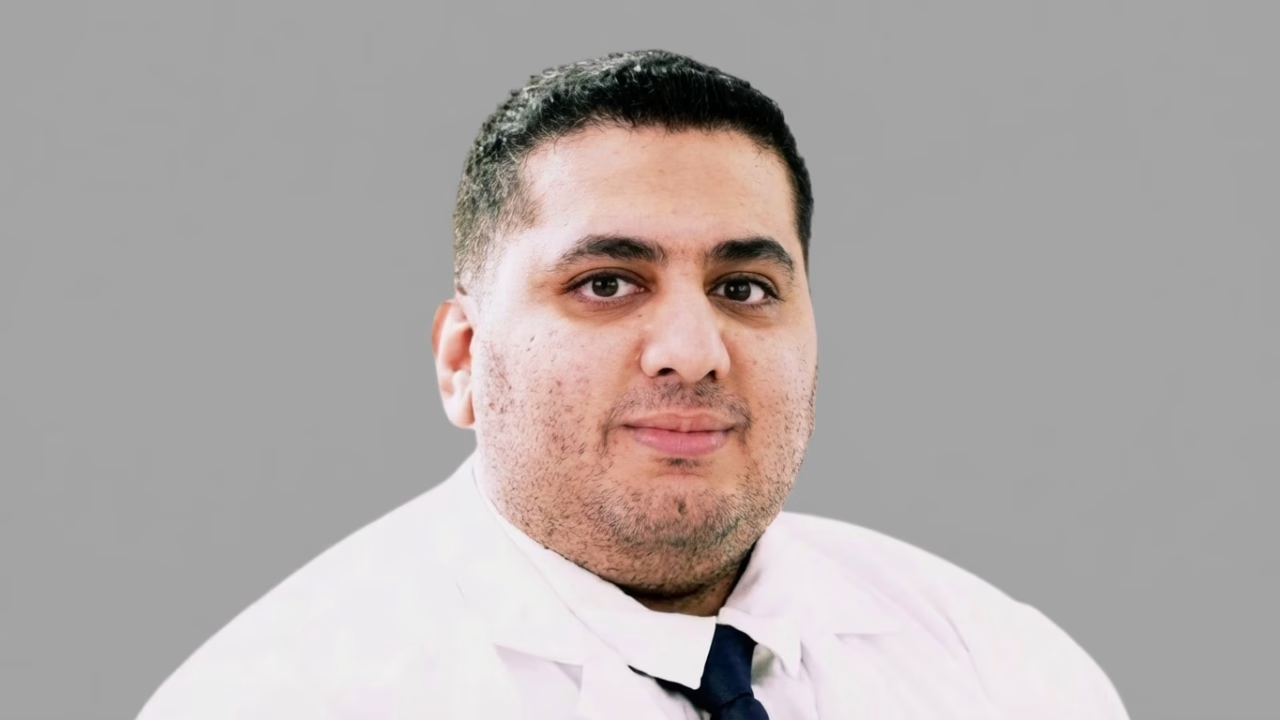
Abdulrahman Nasiri: D14 Bone Marrow Biopsy in AML Induction in the Era of Targeted Therapies
Abdulrahman Nasiri, Assistant Professor at Imam Muhammad ibn Saud Islamic University, shared a post on LinkedIn about a recent article he and his colleagues co-authored, adding:
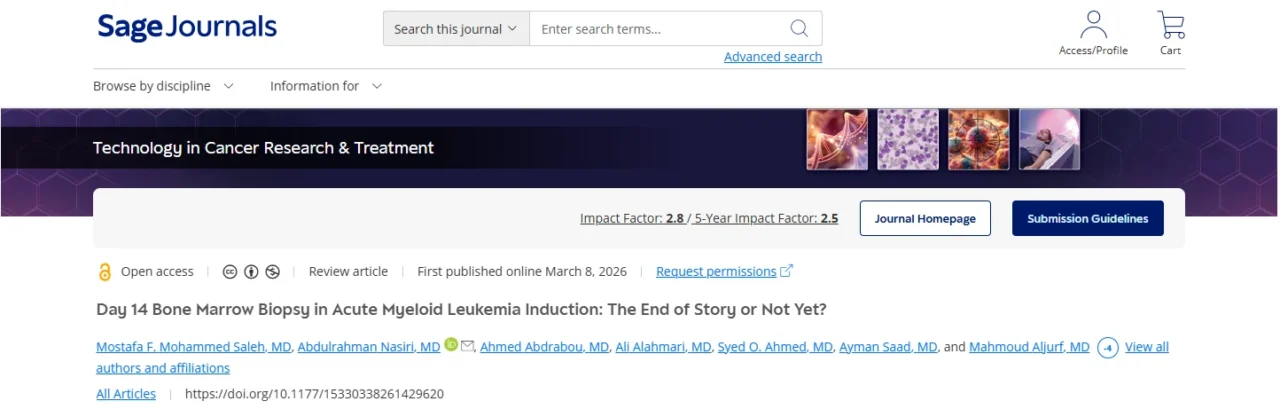
“Proud to share our newly published review in Technology in Cancer Research and Treatment: ‘Day 14 Bone Marrow Biopsy in Acute Myeloid Leukemia Induction: The End of Story or Not Yet?
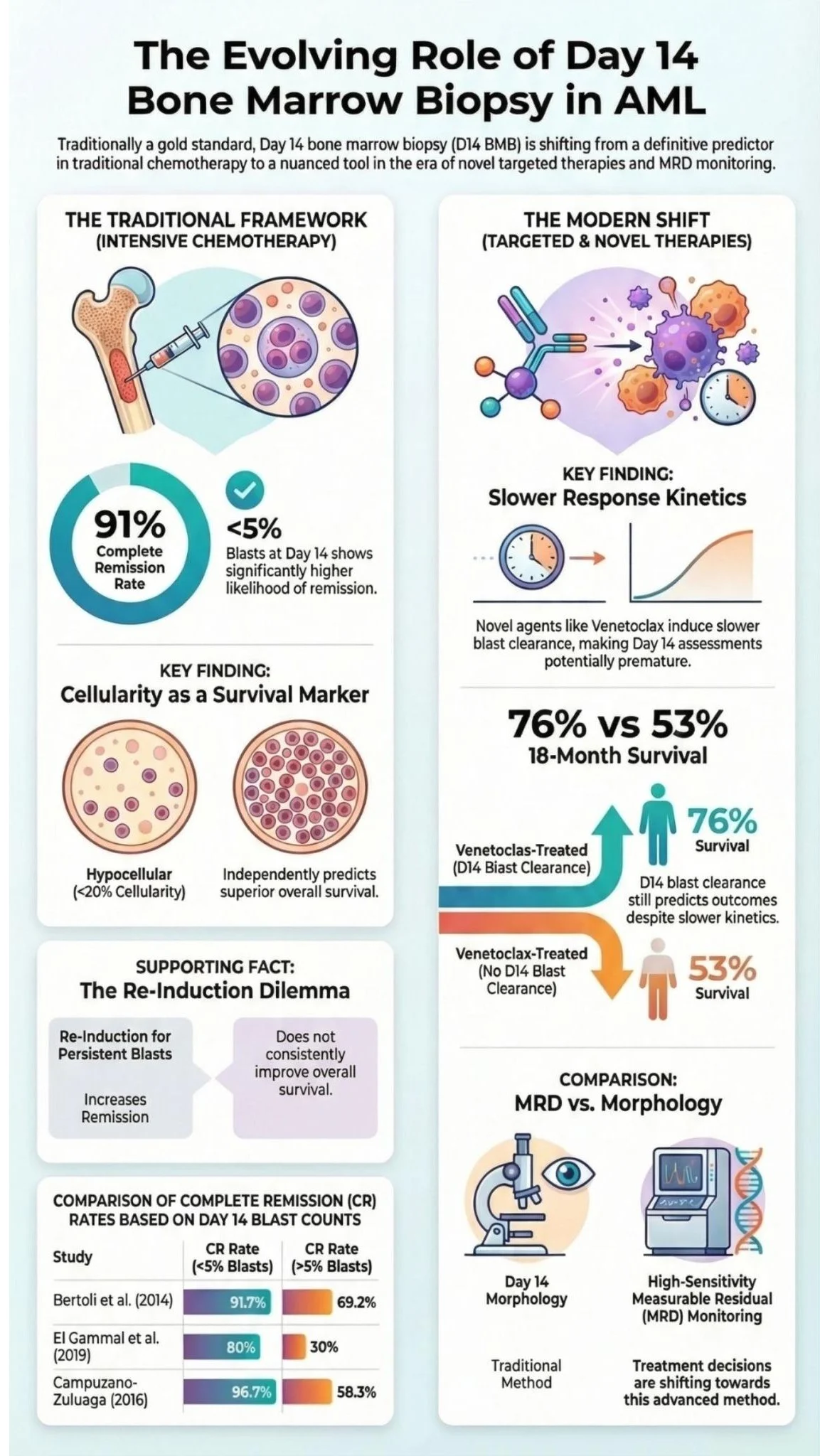
For years, the Day 14 bone marrow biopsy (D14 BMB) has guided AML treatment decisions, where less than five percent blasts strongly predicted complete remission following standard seven plus three induction.
However, as the treatment landscape shifts toward targeted therapies, we must re-evaluate this gold standard.
In our review, we explore:
- Evolving Kinetics: Novel agents like venetoclax induce slower blast clearance, meaning traditional D14 assessments may now be premature.
- Cellularity as a marker: Hypocellularity (less than twenty percent) remains a crucial, independent predictor of superior overall survival.
- The re-induction dilemma: Second-course therapy for persistent blasts increases remission rates but does not consistently translate to an overall survival benefit and carries significant morbidity risks.
- The shift to mrd: High-sensitivity Measurable Residual Disease (MRD) monitoring is increasingly becoming the standard for precise, long-term prognostic evaluation and risk stratification.
Our key takeaway: D14 BMB is not obsolete, but it must now be integrated into a risk-adapted framework that accounts for specific treatment modalities and MRD status.”
Title: Day 14 Bone Marrow Biopsy in Acute Myeloid Leukemia Induction: The End of Story or Not Yet?
Authors: Mostafa F. Mohammed Saleh, Abdulrahman Nasiri, Ahmed Abdrabou, Ali Alahmari, Syed O. Ahmed, Ayman Saad, Mahmoud Aljurf
Read Full Article on Sages Journals
Stay updated on all scientific advances with Hemostasis Today.
-
Sep 21, 2026, 14:10Aswin K Mohan: Lessons from TRANSCON 2026: Building Resilient Blood Supply Systems Before Crisis Hits
-
Sep 21, 2026, 14:00Vincent Lu: Beyond PT and aPTT – How Hemostasis Evolves Across a Lifetime
-
Sep 21, 2026, 13:56Alex Knapp: Emerging Tech, Space Tow Trucks, and New Advances in Hemophilia Treatment
-
Sep 21, 2026, 13:51Abdalhakim Shubietah: pLAAO Fails Noninferiority to OAC in Landmark Meta-Analysis of 7 RCTs
-
Sep 21, 2026, 13:21In His Last UNGA, António Guterres Delivers a Urgent Call for Global Unity
-
Sep 21, 2026, 13:14Fatih Mehmet Gul: Are We Moving Faster Than Our Ability to Ask ‘Should We?’
-
Sep 21, 2026, 13:08Sangita Reddy: How Does Our Own Healthcare Journey in India Look Through the Same Lens?
-
Sep 21, 2026, 12:53Conan McIlwrath: Strengthening Haemophilia Care Through International Collaboration
-
Sep 21, 2026, 12:41Tinatin Muradashvili: Advancing Hemophilia Care Through Education and Collaboration