


Alefiya B.: Imagine Treating a Genetic Disorder by Giving Cells the Instructions They are Missing
Alefiya B., Medical Officer at EPIC Multispecialty Hospital, Ahmedabad, shared a post on LinkedIn:
“Imagine treating a genetic disorder by giving cells the instructions they are missing.
That’s the basic idea behind gene therapy.
And a recent Nature Medicine study gives us another interesting example.
Let’s start with hemophilia B.
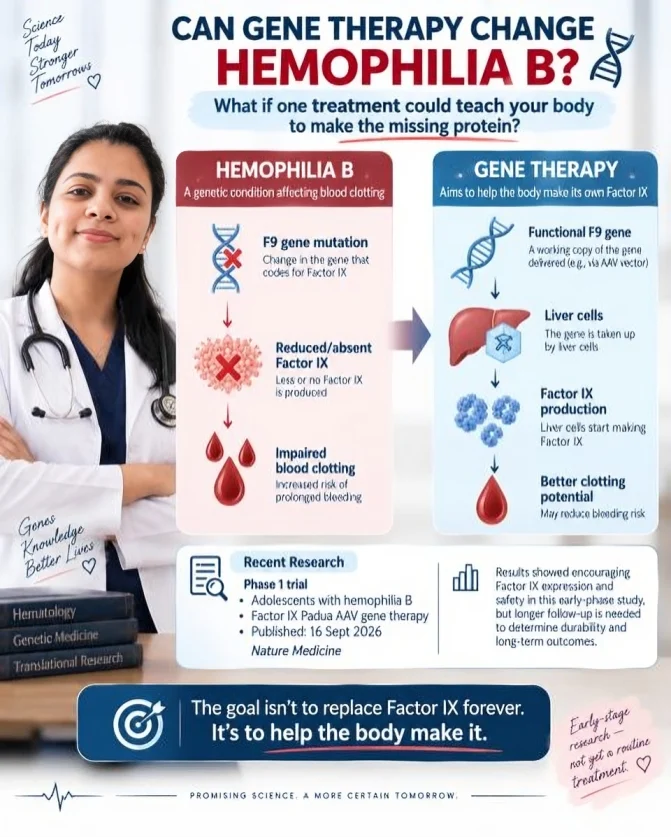
Hemophilia B is caused by pathogenic variants affecting the F9 gene, which is needed to produce coagulation factor IX.
When factor IX is deficient, the normal clotting process is impaired.
That’s why people with hemophilia B can experience prolonged or spontaneous bleeding.
Traditionally, treatment has involved replacing the missing clotting factor.
But gene therapy asks a different question:
What if we could give the patient’s cells a functional copy of the gene?
In the recent Phase 1 study, researchers investigated an AAV-based gene therapy carrying the Factor IX Padua variant in adolescents with hemophilia B.
The concept is fascinating:
Deliver genetic instructions → target liver cells → enable production of Factor IX
Instead of repeatedly supplying the missing protein from outside, the aim is to help the patient’s own cells produce it.
But here’s the important part about reading early research:
This was a Phase 1 clinical trial.
That means we’re looking at an early stage of clinical development, where safety, tolerability, dosing and biological activity are important considerations.
So this isn’t: ‘Hemophilia has been cured.’
It’s: ‘Researchers are testing whether a single gene-delivery approach can produce a clinically meaningful source of Factor IX.’
That’s a very different statement.
And that’s something I think we should all get better at when reading medical news:
Interesting is not equal to proven.
Promising is not equal to established.
Phase 1 is not equal to standard treatment.
But every established therapy once began as an experiment.
And that’s what makes following clinical research so fascinating.
One day, a concept exists mainly in molecular biology.
Then researchers test it in cells.
Then animals.
Then carefully selected human participants.
Then larger clinical trials.
And, if the evidence continues to support it, eventually clinical practice.
That’s how today’s “experimental” medicine can become tomorrow’s standard of care.
A question for my medical colleagues:
Which emerging area of medicine fascinates you most?
Gene therapy?
mRNA therapeutics?
CRISPR?
AI in diagnostics?
Personalized medicine?”
Stay updated with Hemostasis Today.
-
Sep 27, 2026, 04:5310 Posts Not to Miss This Week
-
Sep 27, 2026, 03:23Massimo Martino: VEN-DEC-GITMO – Advancing AML Treatment in Older Patients
-
Sep 27, 2026, 03:08Arrigo Francesco Giuseppe Cicero: Why Earlier LDL-C Lowering May Matter in Cardiovascular Prevention
-
Sep 27, 2026, 02:51Veronique Witko-Sarsat: Thromboinflammation at the 17th World Congress of Inflammation
-
Sep 27, 2026, 01:45Jin-Xiong She: Functional Iron Deficiency in the Setting of Chronic Inflammation
-
Sep 27, 2026, 01:44Crystal Karakochuk: Scientific Reports Launches New Collection on Iron Deficiency and Anemia
-
Sep 27, 2026, 01:44Arielle Nylander: National Expertise at the Center of Maternal Anemia Action
-
Sep 27, 2026, 01:43Muhammad Ans: Emerging Trends and Disparities in PE-Related Mortality Among Patients With AF
-
Sep 26, 2026, 18:01Kalyan Roy: Blood Group Chimerism as a Rare Cause of ABO Discrepancy