


Arrigo Francesco Giuseppe Cicero: Why Earlier LDL-C Lowering May Matter in Cardiovascular Prevention
Arrigo Francesco Giuseppe Cicero, Head of the Clinical Lipidology and Cardiovascular Prevention Laboratory at the University of Bologna, shared a post on LinkedIn:
“Hey, what if the best time to lower LDL-C is before cardiovascular risk becomes high?
In primary prevention, lipid-lowering therapy is often delayed because the short-term absolute benefit may appear modest.
But a NEW systematic review and meta-analysis suggests an important — and perhaps counterintuitive — perspective.
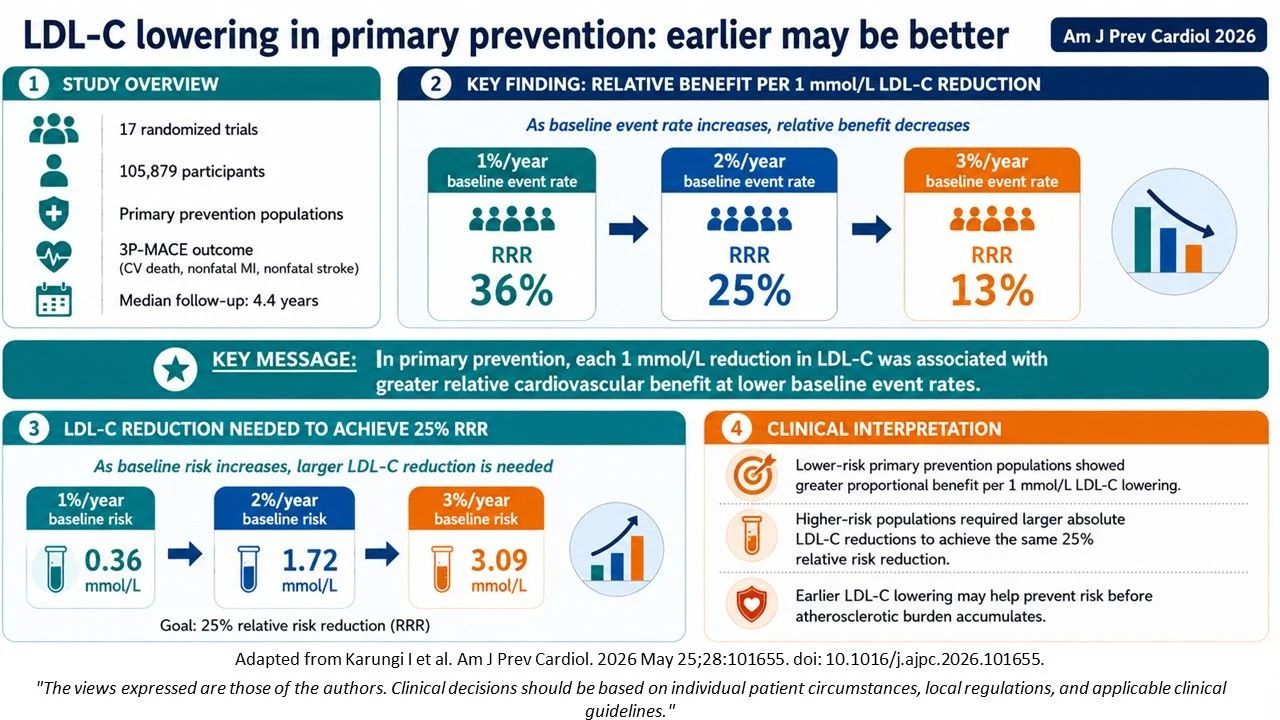
Across 17 randomized trials involving 105,879 participants, the relative cardiovascular benefit associated with each 1 mmol/L reduction in LDL-C was greater in populations with lower baseline event rates.
At an annual cardiovascular event rate of:
- 1% leads to a 36% relative risk reduction per 1 mmol/L LDL-C lowering
- 3% leads to a 13% relative risk reduction per 1 mmol/L LDL-C lowering
And the LDL-C reduction estimated to achieve a 25% relative risk reduction increased markedly as baseline risk rose:
0.36 mmol/L at 1%/year risk vs 3.09 mmol/L at 3%/year risk
Why does this matter?
Because our traditional prevention strategy tends to intensify treatment as cardiovascular risk increases.
But by the time risk is high, atherosclerosis may already be more advanced — and substantially greater LDL-C reductions may be needed to achieve the same proportional benefit.
These findings support a different way of thinking about prevention:
TREATING EARLIER MAY ALLOW US TO DO MORE WITH LESS!!!
Not because lower-risk individuals necessarily have greater absolute benefit, but because LDL-C lowering may produce a greater proportional reduction in cardiovascular events before risk — and atherosclerotic burden — accumulate.
- Earlier prevention matters.
- Cumulative LDL-C exposure matters.
We should not always wait for cardiovascular risk to become high before acting.
Perhaps the question should not only be ‘How high is the risk today?’
But also:
‘How much risk could we prevent by starting earlier?'”
Stay updated with Hemostasis Today.
-
Sep 27, 2026, 02:51Veronique Witko-Sarsat: Thromboinflammation at the 17th World Congress of Inflammation
-
Sep 27, 2026, 01:45Jin-Xiong She: Functional Iron Deficiency in the Setting of Chronic Inflammation
-
Sep 27, 2026, 01:44Crystal Karakochuk: Scientific Reports Launches New Collection on Iron Deficiency and Anemia
-
Sep 27, 2026, 01:44Arielle Nylander: National Expertise at the Center of Maternal Anemia Action
-
Sep 27, 2026, 01:43Muhammad Ans: Emerging Trends and Disparities in PE-Related Mortality Among Patients With AF
-
Sep 26, 2026, 18:01Kalyan Roy: Blood Group Chimerism as a Rare Cause of ABO Discrepancy
-
Sep 26, 2026, 17:34Arwa Z. Al-Riyami: Join ISBT and Advance Your Career
-
Sep 26, 2026, 16:58Paul Whiteley: Iron Deficiency and Behavioral Problems in Children With Autism
-
Sep 26, 2026, 16:41Matthew Smeds: Management of Thoracic Endograft Thrombosis and Mesenteric Embolization