


Augustina Isioma Ikusemoro: Not Every Antigen Speaks Loudly, But the Right Test Will Hear It
Augustina Isioma Ikusemoro, Hematology and Transfusion Medicine Specialist at Sharjah Blood Transfusion and Research Center, shared a post on LinkedIn:
“Not every antigen speaks loudly…
But the right test will hear it.
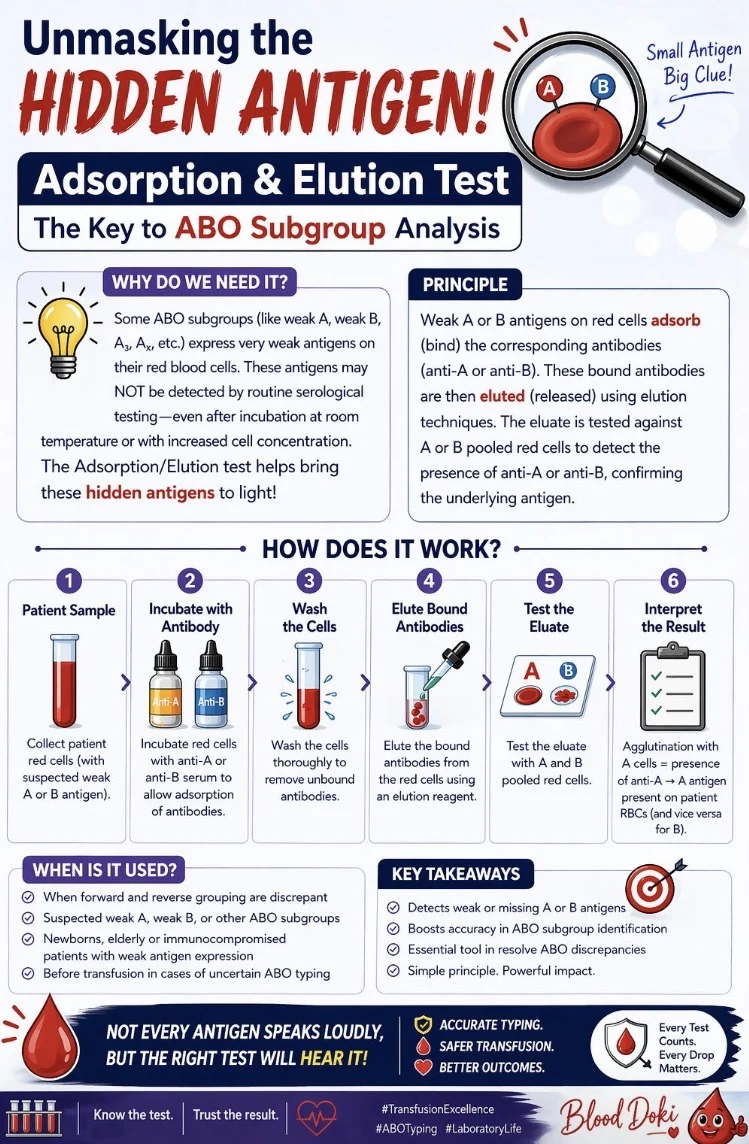
In transfusion medicine, one of the most fascinating diagnostic tools we use to unmask hidden ABO subgroups is the Adsorption and Elution Test.
When routine serology says:
‘No antigen detected…’
This test asks again:
‘Are you absolutely sure?’
And sometimes — it finds what others miss.
Why Adsorption and Elution Matters
Some ABO subgroups (like weak A, weak B, A₃, Aₓ) express very low antigen levels on red cells.
These antigens:
- may not react in routine forward grouping
- may remain undetected even after incubation
- can create ABO discrepancies
- can affect transfusion safety if overlooked
That’s where Adsorption and Elution testing becomes powerful.
It helps us detect the hidden antigen behind the silence.
The Principle (Simple but Powerful)
- Red cells are incubated with anti-A or anti-B antibodies
- Weak antigens adsorb (bind) those antibodies
- Bound antibodies are eluted (released) from the cells
- The eluate is tested with A or B pooled cells
- Agglutination confirms the presence of the weak antigen
This confirms what routine testing could not reveal.
When Should You Think About Using It?
Consider Adsorption and Elution testing when:
- Forward and reverse grouping don’t match
- Weak A or weak B subgroup suspected
- Investigating ABO discrepancies
- Testing neonates or immunocompromised patients
- Resolving uncertain pre-transfusion typing
Why This Test Is So Important
Because accurate ABO subgroup identification means:
- safer transfusion decisions
- fewer compatibility surprises
- stronger laboratory confidence
- better patient outcomes
In transfusion medicine, precision saves lives.
Not every antigen shouts.
But with the right technique, we can still hear its voice.
Do you routinely perform Adsorption and Elution testing in your blood bank when resolving subgroup discrepancies?
Let’s learn from each other — Blood Doki”
Other posts featuring Augustina Isioma Ikusemoro on Hemostasis Today.
-
Sep 19, 2026, 03:15Paulus Kirchhof: Europe’s Safe Hearts Plan to Reduce Cardiovascular Mortality
-
Sep 19, 2026, 03:10James Smith: Brain Training and Exercise for Cognitive Recovery After Stroke
-
Sep 19, 2026, 03:03Lesley Van Wyk: ASH Releases New Iron Deficiency Diagnosis Guidelines
-
Sep 19, 2026, 02:53Francisco Chacón-Lozsán: Acute Ischemic Stroke in 2026 – Expanding the Treatment Window
-
Sep 19, 2026, 01:53Thomas Dayspring: Understanding Genome and Lipid Interactions in Lipidology
-
Sep 19, 2026, 01:47Abdurrahman Tufan: Combination Targeted Therapy in Refractory Systemic Autoinflammatory Diseases
-
Sep 19, 2026, 01:44Patrick James Lynch: Mother of a Thousand Sons Premieres at BDC 2026
-
Sep 19, 2026, 01:41Genetic Fate Mapping Reveals Endothelial Cells During Venous Thrombus Resolution – RPTH Journal
-
Sep 19, 2026, 01:39Mostafa Hammam: Three Different Platelet Defects – One Common Symptom