

Augustina Isioma Ikusemoro: Thalassaemia is Not Just Anaemia – It’s a Genetic Story That Shapes
Augustina Isioma Ikusemoro, Hematology and Transfusion Medicine Specialist at Sharjah Blood Transfusion and Research Center, shared a post on LinkedIn:
“Thalassaemia: It’s not just anaemia – it’s a genetic story that shapes outcomes.
Behind every microcytic blood film lies a deeper question:
Is this iron deficiency… or something inherited?
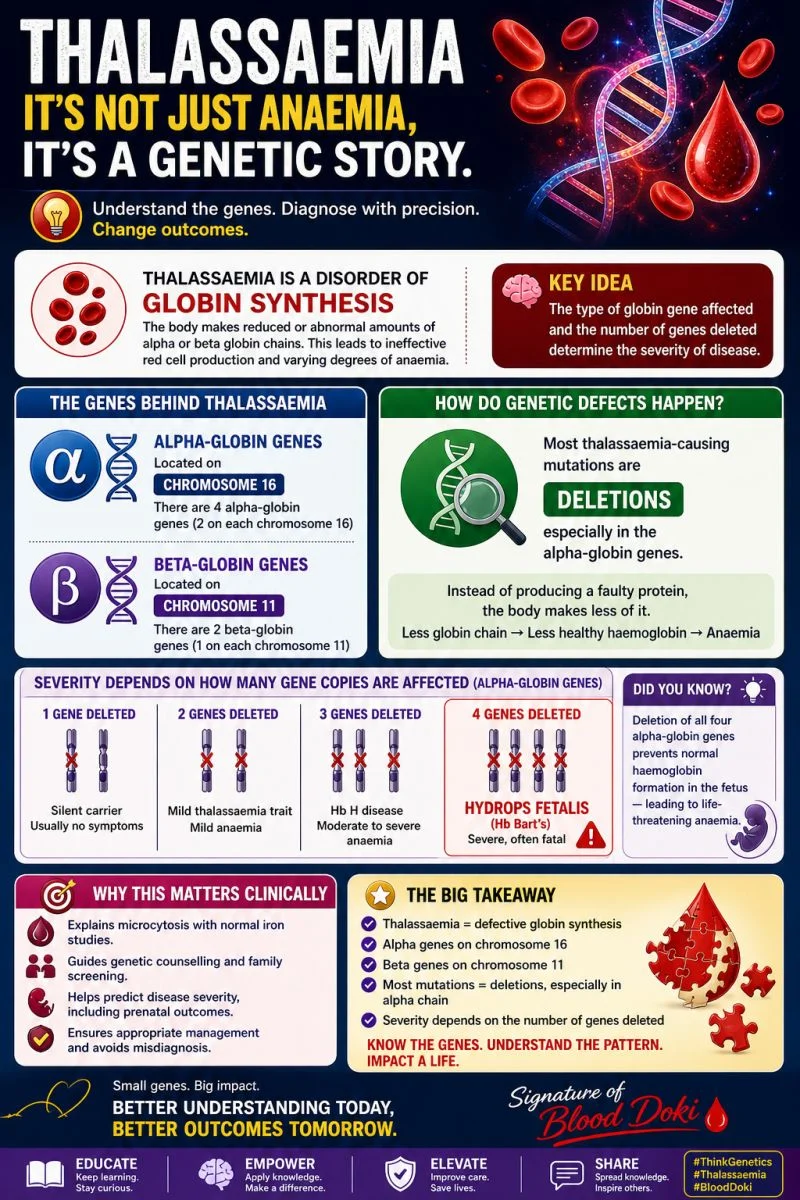
Thalassaemia is a disorder of globin chain synthesis, where the body cannot produce normal amounts of alpha or beta globin chains, leading to ineffective red cell production and varying degrees of anaemia.
Here’s what truly matters clinically:
The genetics define the disease
- Alpha-globin genes are located on chromosome 16
- Beta-globin genes are located on chromosome 11
Most α-thalassaemia cases are caused by gene deletions.
This is a key distinction – especially when interpreting microcytosis with normal iron studies.
Severity depends on how many gene copies are affected:
- Loss of 1–2 genes leads to mild or asymptomatic
- Loss of 3 genes leads to moderate to severe disease
- Loss of all 4 genes leads to Hydrops fetalis (Hb Bart’s) — often fatal without intervention
This is why thalassaemia should never be approached as ‘just another anaemia.’
It requires:
- Understanding of genetic patterns
- Correlation with RBC indices and Hb analysis
- Awareness of population risk and inheritance patterns
Because accurate diagnosis is not just academic – it directly impacts:
- Patient management
- Genetic counselling
- Prenatal outcomes
The real takeaway?
- Don’t just treat anaemia.
- Understand the biology behind it.
When you understand the genes, you diagnose with precision.
— Signature of Blood Doki
Educate.
Empower.
Elevate.”
Find more posts featuring Augustina Isioma Ikusemoro on Hemostasis Today.
-
Sep 25, 2026, 09:49Haley Coleman: Volunteering to Support Hemophilia Awareness
-
Sep 25, 2026, 08:55Hitarth Mehta: BHMS Students Gain Practical Exposure to Haemophilia Diagnosis
-
Sep 25, 2026, 07:25Varun Capoor: How Therapeutic Apheresis and Transfusion Medicine Can Complement Clinical Management in SCD
-
Sep 25, 2026, 07:14Manshi Kesharwani: SAK-GQDs Modulate Thrombus Burden and Endothelial Function in Deep Vein Thrombosis
-
Sep 25, 2026, 06:20Farjah Hassan Algahtani: How Can We Better Identify Patients at Risk of Blood Clots after Metabolic and Bariatric Surgery?
-
Sep 25, 2026, 05:59Carla Lewis: Kids Conquering Sickle Disease Joins Nemours Children’s Hospital for 2nd Annual Awareness Event
-
Sep 25, 2026, 05:47Omid Seidizadeh: Evolutionary Constraint and Population Variation Across Coagulation Genes
-
Sep 25, 2026, 05:40Gerald Bertrand: Presenting UMi-NGS Non-Invasive Foetal HPA Genotyping at DGTI 2026
-
Sep 25, 2026, 05:33Urge Congress to support the Sickle Cell Disease Comprehensive Care Act – ASH