

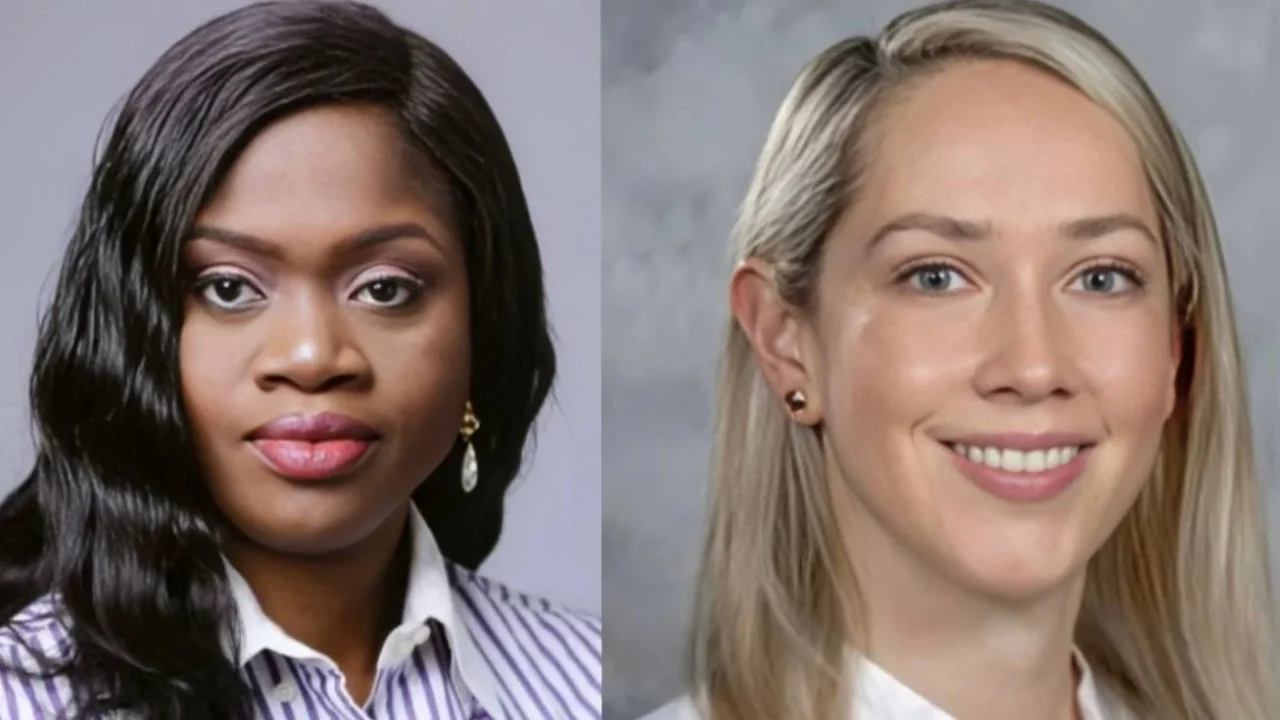
Hannah Omunakwe: Have You Ever Encountered a Clot in a Child That Surprised You?
Hannah Omunakwe, Lecturer at Rivers State University, Consultant Haematologist at Rivers State University Teaching Hospital, shared a post on LinkedIn about a recent article by Marisol Betensky et al., published in Blood Advances Journal:
”A haematologist’s honest conversation with the paediatricians saving children’s lives every day.
A few years ago, around World Thrombosis Day (October 13), I was on a mission.
For an entire week, I had been everywhere; on the wards, in the antenatal clinic, in grand rounds, even on the radio – talking passionately about venous thromboembolism (VTE) in hospitalised patients. Risk assessment, prevention strategies, anticoagulation… I was in my element.
There was just one problem. It was all about adults.
My paediatric colleagues attended politely. Some were curious. Some… less so. A few quietly exited once it became clear there would be no discussion of dosing in mg/kg. Fair enough.
Then, a few days later, my phone rang. A close friend, a brother so to speak, fresh into his role as a paediatric nephrologist, asked, ‘Can you come take a look at a patient with me?’
My brain raced. Why was he calling me?
Because everything I had just spent a week confidently teaching… did not quite apply in the paediatric ward. And for good reason.
Clots in Children? Really?
For a long time, we treated VTE, deep vein thrombosis and pulmonary embolism as an adult diseases. Children, we thought, were protected by biology: healthier vessels, balanced coagulation systems, and fewer comorbidities. We now know that’s only partly true.
VTE in children is uncommon, but rising. In the general population, it’s rare. But in hospitalised children, rates climb significantly, up to 21.9 per 10,000 admissions. The highest risk groups? It looks bimodal – neonates and adolescents.
Why now? Some of this is better detection. But some of it is real. And crucially, we are still not always looking for it.
The Practice Has Shifted (Even If We Haven’t)
In May 2025, updated ASH and ISTH guidelines reshaped paediatric VTE care.
The headline? Direct oral anticoagulants (DOACs) are now recommended in many children.
For decades, we relied on low-molecular-weight heparin, largely extrapolated from adult data. Now, paediatric-specific trials are changing that. But guidelines don’t diagnose patients; Clinicians do.
And more often than not, in children, that first clinician is you.
VTE in Children Is a Tipping Point
Unlike adults, most paediatric clots are not spontaneous. They happen when risk factors accumulate until the system tips.
The major ones:
- Central venous catheters (CVCs): responsible for up to 85% of hospital-acquired VTE
- Cancer and chemotherapy: especially L-asparaginase
- Congenital heart disease
- Nephrotic syndrome: a hypercoagulable state hiding in plain sight
- Sepsis and severe infection
- Immobility and prolonged hospital stay
Each factor adds weight; eventually, the balance shifts.
What We’re Missing in Our Context
In many settings, particularly across Africa and Asia, there’s an added layer:
- Sickle cell disease: chronic endothelial injury and thrombosis risk beyond stroke
- Severe malaria: microvascular thrombosis is central, but rarely framed that way
- Severe anaemia and transfusion states
- Tuberculosis: linked to cerebral and systemic thrombosis
- Malnutrition: acquired deficiencies in natural anticoagulants
These are not rare conditions.
They are a daily practice, just without a thrombotic lens.
These are not rare conditions.
They are a daily practice, just without a thrombotic lens.
So, what am I asking?
Not perfection. Not subspeciality expertise. Just three small shifts:
- Think about it. If something doesn’t fit – swelling, hypoxia, unexplained deterioration – let VTE enter your differential.
- Check the line. If a child has a central line, ask if it’s still needed. That one question can prevent harm.
- Escalate early. The guidelines have evolved. Treatment options have expanded. But early suspicion still changes outcomes.
Full Circle
That patient my colleague called me about? It turned out that the “adult problem” I had just spent a week talking about… was sitting quietly in a paediatric ward. That moment stayed with me. Because it reminded me of something simple, but easy to miss:
- Disease does not read our textbooks.
- It doesn’t respect age categories. It doesn’t wait for guidelines to catch up.
- It shows up where it wants and hopes we’re paying attention.
The Vital Sign We’re Missing
Paediatric VTE is not always obvious. But it is increasingly visible if we choose to see it. Sometimes, the difference between missing and catching it is simply this: thinking of it in the first place.
That’s not just science. That’s awareness. That’s growth.
Have you ever encountered a clot in a child that surprised you?
What made you suspect it, or miss it?
Let’s learn from each other.”
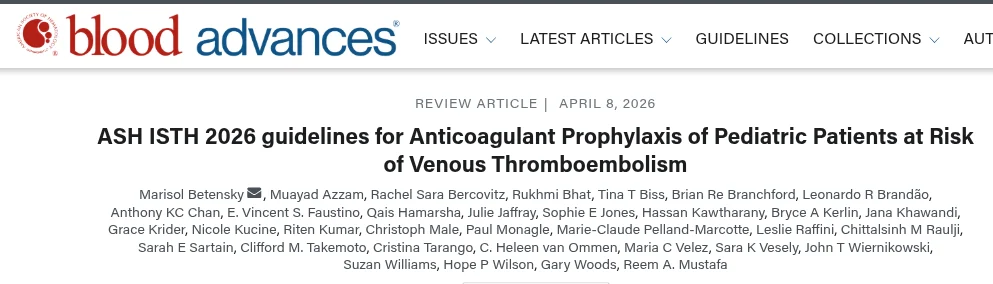
Title: ASH ISTH 2026 guidelines for Anticoagulant Prophylaxis of Pediatric Patients at Risk of Venous Thromboembolism
Authors: Marisol Betensky, Muayad Azzam, Rachel Sara Bercovitz, Rukhmi Bhat, Tina T Biss, Brian Re Branchford, Leonardo R Brandão, Anthony KC Chan, E. Vincent S. Faustino, Qais Hamarsha, Julie Jaffray, Sophie E Jones, Hassan Kawtharany, Bryce A Kerlin, Jana Khawandi, Grace Krider, Nicole Kucine, Riten Kumar, Christoph Male, Paul Monagle, Marie-Claude Pelland-Marcotte, Leslie Raffini, Chittalsinh M Raulji, Sarah E Sartain, Clifford M. Takemoto, Cristina Tarango, C. Heleen van Ommen, Maria C Velez, Sara K Vesely, John T Wiernikowski, Suzan Williams, Hope P Wilson, Gary Woods, Reem A. Mustafa
Stay updated on all scientific advances with Hemostasis Today.
-
Sep 29, 2026, 03:53Nahrwan Masaoodi: Iron Deficiency Can Exist Without Anemia
-
Sep 29, 2026, 03:38Muhammad Yousaf: Iron Deficiency Beyond Diet
-
Sep 29, 2026, 03:21Parvez Ahmed Chowdhury: Synthesizing Aspirin in the Organic Chemistry Lab
-
Sep 29, 2026, 03:12Ahmed Hamandi: Building the Future of Hematopoietic Transplantation in Iraq
-
Sep 29, 2026, 03:09M V Chandrakanth: Aspirin in CRC – Old Drug, New Precision Oncology?
-
Sep 29, 2026, 03:07Caroline Pothet: Advancing Treatment Development in Sickle Cell Disease and Thalassaemia
-
Sep 29, 2026, 02:53Astha Jain: Thalassemia Care Through a Public Health Lens
-
Sep 29, 2026, 02:50Emma Groarke: Starting a New Career Path in Homeland
-
Sep 28, 2026, 19:14Aditya Sharma: An Outstanding Start to the Final Day of VSS 2026!