

Caitlin Raymond: Augmented Intelligence Enhancing Human Capability Without Replacement
Caitlin Raymond, Assistant Professor of Pathology and Transfusion Medicine at University of Wisconsin-Madison, shared a post on LinkedIn:
“The AI in medicine discourse has two settings: it’s going to replace physicians, or it’s too dangerous to touch.
Both arguments imagine AI as an autonomous agent.
That’s not how I use it, and I don’t think it’s how physicians should.
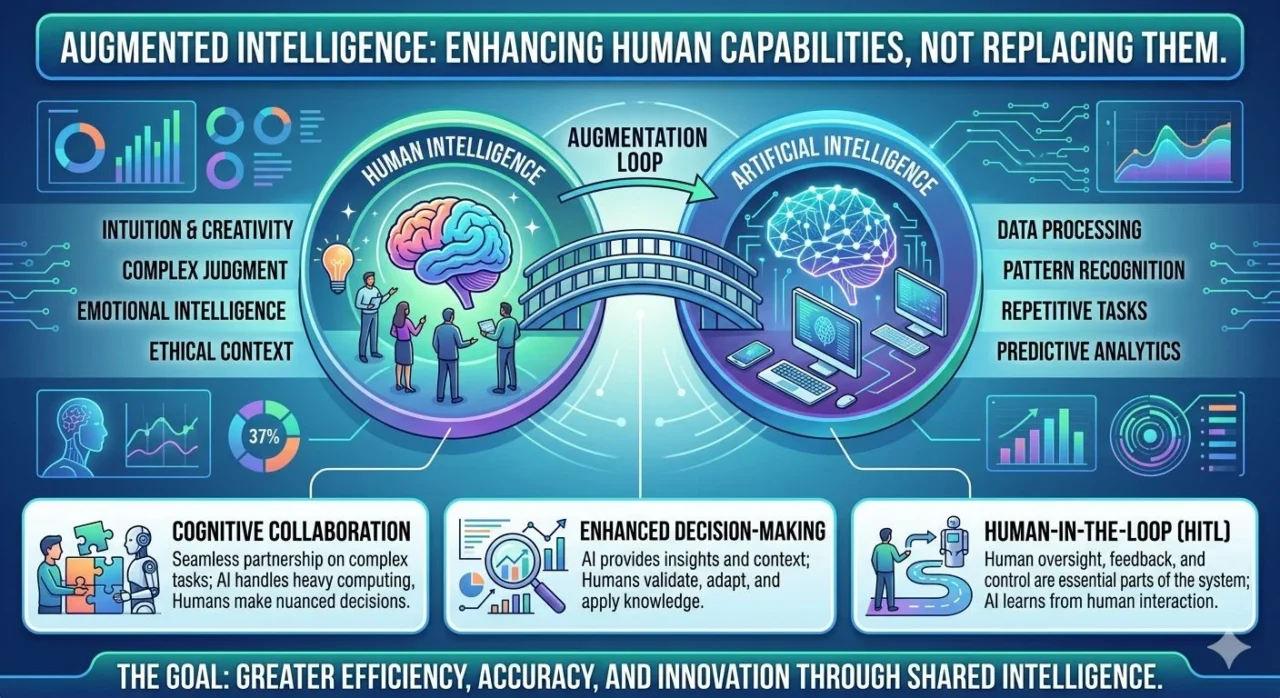
There’s a better frame: augmented intelligence.
- The AI amplifies your thinking, drafting, and analysis
- You retain intellectual ownership of the output
- You direct the work, evaluate what comes back, and correct what’s wrong
- Accountability never leaves the physician
In practice, I use Claude for writing and coding – drafting posts, structuring arguments, generating diagrams.
I use Gemini for assistant tasks.
In every case, I’m directing the work and evaluating the output critically before anything goes anywhere.
The post that goes up is mine.
The thinking is mine.
The AI accelerated production of a written artifact that represents my analysis.
It did not perform the analysis.
Anyone in laboratory medicine already understands the oversight principle intuitively.
We don’t report analyzer results without understanding what the analyzer did.
We run QC.
We investigate flags.
AI output requires the same scrutiny — because the distinctive failure mode of these tools isn’t garbled output. It’s fluent, confident, plausible-sounding output that is wrong.
And on opting out: physicians who wait aren’t avoiding risk.
They’re outsourcing the learning curve.
Someone will set the norms for how AI gets used in your institution and your specialty.
Better that it’s clinicians with hands-on experience than administrators and vendors who don’t see patients.
Augmented intelligence, done right, is not about ceding judgment to a machine.
It’s about using a powerful tool with the same rigor we bring to every other tool in medicine.
Full post in the first comment.”
Other posts featuring Caitlin Raymond on Hemostasis Today.
-
Oct 17, 2026, 04:07Weihao Li: Global HEPATIC Registry Findings on Post-Transplant Arterial Thrombosis
-
Oct 17, 2026, 03:56Ghaith Abu-Zeinah: ASH Publishes 2026 Guidelines for Myelofibrosis Management in Blood Advances
-
Oct 17, 2026, 03:48Tristan Siokos: Why Vascular Occlusion Is More Than Just Clots – Breakdown of the 8 Pathways
-
Oct 17, 2026, 02:36Archil Jaliashvili: Oxygen Transport in Capillaries
-
Oct 17, 2026, 02:35Carly Newton: Understanding Access to Red Blood Cell Exchange for People Living With SCD
-
Oct 17, 2026, 02:34Raising Awareness of Blood Clots During and After Pregnancy – Thrombosis UK
-
Oct 17, 2026, 02:33Alaa Salamat: Our Research Accepted for Publication at ASH 2026
-
Oct 17, 2026, 02:32Mohammed Al Sharif: Discussing Factor XIII Testing and Its Clinical Significance
-
Oct 17, 2026, 02:31Joanna Popiolek-Kalisz: Talking about Novel Pharmacotherapy for Hypertension at CV Prevention and Intervention