

Chukwuemeka Amarachi: Thalassemia – Types, Diagnosis and Management
Chukwuemeka Amarachi, Medical Laboratory Scientist (BMLS), shared a post on LinkedIn:
“Thalassemia
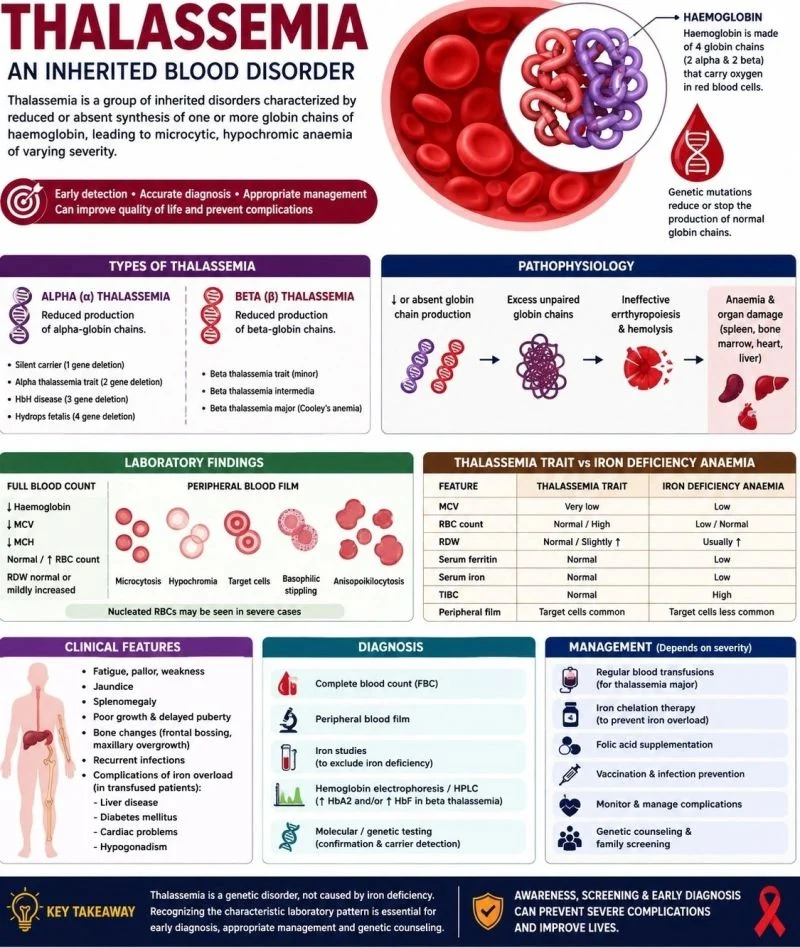
Thalassemia is an inherited blood disorder in which the body produces reduced amounts or abnormal forms of globin chains, which are components of haemoglobin.
This leads to microcytic, hypochromic anaemia of varying severity.
Types of Thalassemia
The main types are:
- Alpha (α) thalassemia – reduced production of α-globin chains.
- Beta (β) thalassemia – reduced or absent production of β-globin chains.
Beta thalassemia can be classified as:
- Minor/trait: usually mild or asymptomatic anaemia.
- Intermedia: moderate disease with variable transfusion requirements.
- Major: severe anaemia, usually presenting in early childhood and often requiring regular blood transfusions.
Signs and symptoms
Depending on severity, patients may develop:
- Pallor and fatigue
- Weakness and shortness of breath
- Jaundice
- Enlarged spleen (splenomegaly)
- Poor growth and delayed development in severe childhood disease
- Bone changes due to expansion of bone marrow
- Iron overload, particularly in patients receiving repeated transfusions
Laboratory findings
A typical blood picture may show:
- FBC
- Decreased Haemoglobin
- Decreased MCV
- Decreased MCH
- RBC count may be normal or relatively high, especially in thalassemia trait
- RDW may be normal or increased depending on the type
- Peripheral blood film
- Microcytosis
- Hypochromia
- Target cells
- Anisopoikilocytosis
- Basophilic stippling may occur
- Nucleated RBCs may appear in severe disease
Haemoglobin analysis
- Hb electrophoresis or HPLC can help identify and classify many forms, particularly β-thalassemia.
Thalassemia vs iron deficiency anaemia
- Feature – thalassemia trait – iron deficiency
- MCV – very low – low
- RBC count – often normal/high – usually low/normal
- Ferritin – usually normal – low
- Target cells – common – less prominent
- RDW – often normal/slightly high – usually high
Treatment
Treatment depends on severity and may include:
- Regular blood transfusions for severe disease
- Iron chelation when transfusion-related iron overload develops
- Folic acid in selected patients
- Management of complications
- Haematopoietic stem-cell transplantation can be potentially curative in suitable patients.
Key point: Thalassemia is genetic and is not caused by iron deficiency, although a person with thalassemia can also develop iron deficiency.”
Stay updated with Hemostasis Today.
-
Oct 4, 2026, 15:06Vasiliki Gkalea: Journal of Clinical Medicine Launches Special Issue on Hematologic Thrombosis and Bleeding
-
Oct 4, 2026, 14:55Quentin Brebant: What Defines a High-Quality Red Blood Cell Concentrate?
-
Oct 4, 2026, 14:47Rana Al-Hrout: Recognizing Non-Anemic Iron Deficiency – Why Iron Matters Beyond Hemoglobin
-
Oct 4, 2026, 14:41David McIntosh: International Plasma Awareness Week 2026 – Closing the Global Plasma Gap
-
Oct 4, 2026, 14:33Pete Stibbs: CleanerVac Real-World Study Presented at VIVA and The VEINS 2026
-
Oct 4, 2026, 13:56Maria Elisa Mancuso: EHC 2026 Highlights the Unmet Needs of Women with Bleeding Disorders
-
Oct 4, 2026, 13:53Nirmal Shaji George: Individualizing Anticoagulation in Complex APS and Thrombocytopenia
-
Oct 4, 2026, 13:5210 Posts Not to Miss This Week
-
Oct 4, 2026, 13:45Suswapna Singh Rawat: The Clinical Significance of Coronary Plaque Stability