


Dino Mehic: Can Global Coagulation Testing Detect Abnormalities in BDUC?
Dino Mehic, Physician Scientist at the Medical University of Vienna, shared a post on LinkedIn about a recent article he and his colleagues co-authored, adding:
“Can global coagulation testing detect abnormalities in BDUC?
Bleeding disorder of unknown cause (BDUC) remains one of the most common diagnoses in patients with a lifelong bleeding tendency, yet routine laboratory testing is normal and objective biomarkers are lacking.
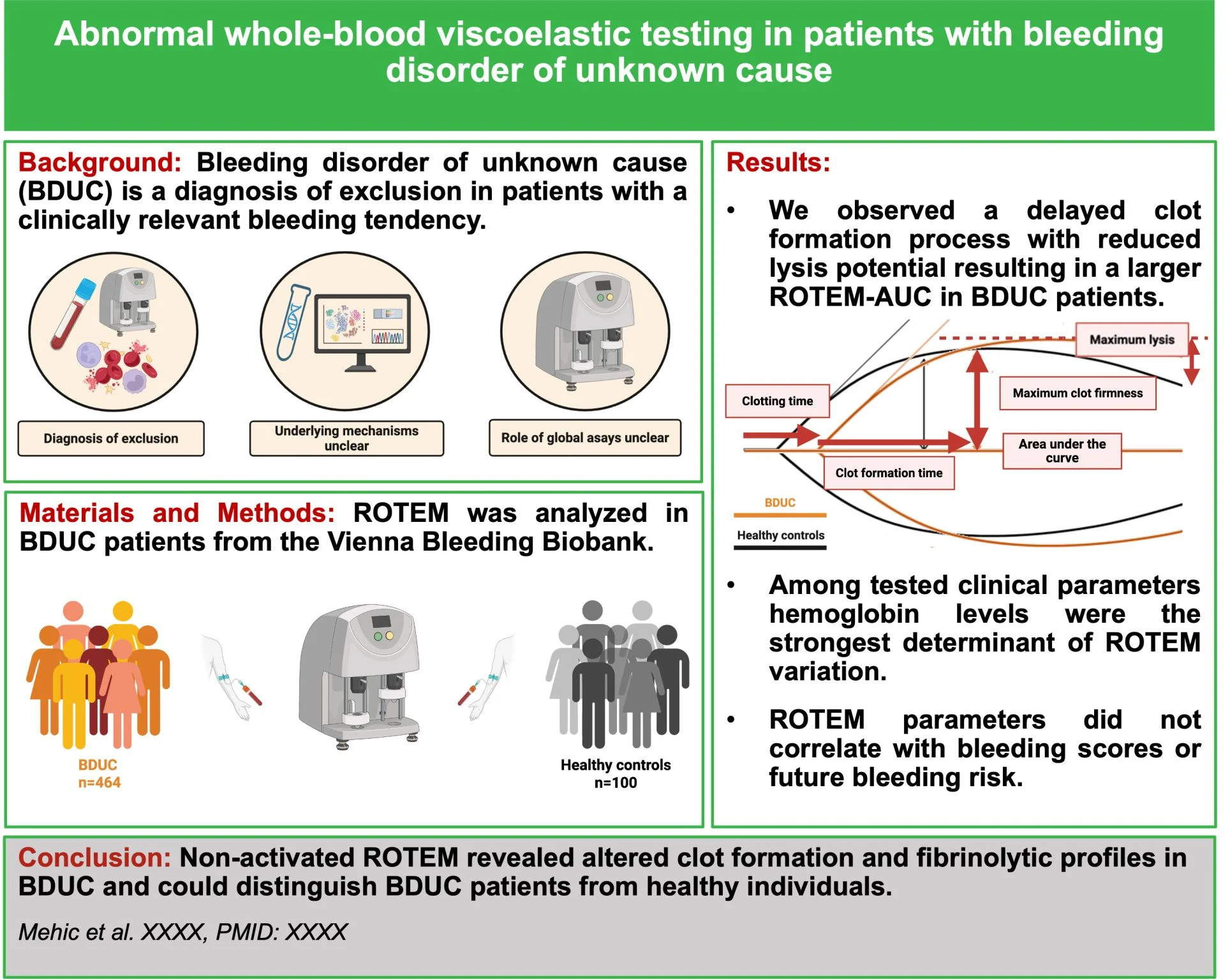
In our study of 464 BDUC patients from the Vienna Bleeding Biobank and 100 healthy controls, we evaluated non-activated whole-blood viscoelastic testing (ROTEM) to determine whether global assays capture hemostatic alterations.
Key findings:
- BDUC patients showed delayed clot formation and reduced maximum lysis resulting in an impaired overall clot formation profile.
- ROTEM parameters discriminated BDUC patients from healthy controls with good performance (ROC-AUC up to 0.81 using machine-learning models).
- Hemoglobin was the strongest determinant of ROTEM variability among clinical and laboratory parameters.
- However, ROTEM parameters did not correlate with bleeding severity, highlighting the complexity of bleeding phenotypes in BDUC.
Take-home: Global viscoelastic testing reveals detectable but modest alterations in clot formation in BDUC, yet these changes do not explain bleeding severity.
The search for robust biomarkers and underlying mechanism in BDUC therefore continues.
Grateful to all collaborators and the Vienna Bleeding Biobank team: Johanna Gebhart, Cihan Ay, Alice Assinger, Bernd Jilma, Maximilian Koeller.”
Title: Abnormal whole-blood viscoelastic testing in patients with bleeding disorder of unknown cause
Authors: Dino Mehic, Tim Dreier, Maximilian C. Koeller, Justin Oosterlee, Christa Drucker, Alice Assinger, Bernd Jilma, Cihan Ay, Ingrid Pabinger, Johanna Gebhart
Read the Full Article on Blood Vessels, Thrombosis and Hemostasis.

Other articles featuring Dino Mehic on Hemostasis Today.
-
Sep 23, 2026, 16:04Monia Ezzalfani: Advancing Patient-Centered Care in Hemophilia A and B
-
Sep 23, 2026, 15:49Bilge Başak: How Activated PRP Modulates Osteoarthritic Chondrocyte Function
-
Sep 23, 2026, 14:50Mbonjo Bitsie Dora: Strengthening Sickle Cell Care Through Education, Awareness and Innovation
-
Sep 23, 2026, 13:58The New B12 Diagnostic Algorithm: From Serum Cobalamin to Functional Deficiency
-
Sep 23, 2026, 13:56Noha Soror: Preparing for Hematology and Medical Oncology Board Certification
-
Sep 23, 2026, 13:46Ugochi Ogu: What Can Platelet Proteomics Reveal about Pain and Neurocognitive Vulnerability in Sickle Cell Disease?
-
Sep 23, 2026, 13:42Melissa Hollo: Connecting Obesity and Anemia for Earlier Maternal Risk Intervention
-
Sep 23, 2026, 13:16Beverley Hunt: Advances in Haemostatic Management of Postpartum Haemorrhage
-
Sep 23, 2026, 13:13Ioanna Mela: Recruiting a Research Associate on DNA nanotechnology