


Edward Lee Carter: Anticoagulation Is Not a Prescription – It’s a Longitudinal Clinical Decision
Edward Lee Carter, Clinical Pharmacist Practitioner at U.S. Department of Veterans Affairs, shared a post on LinkedIn:
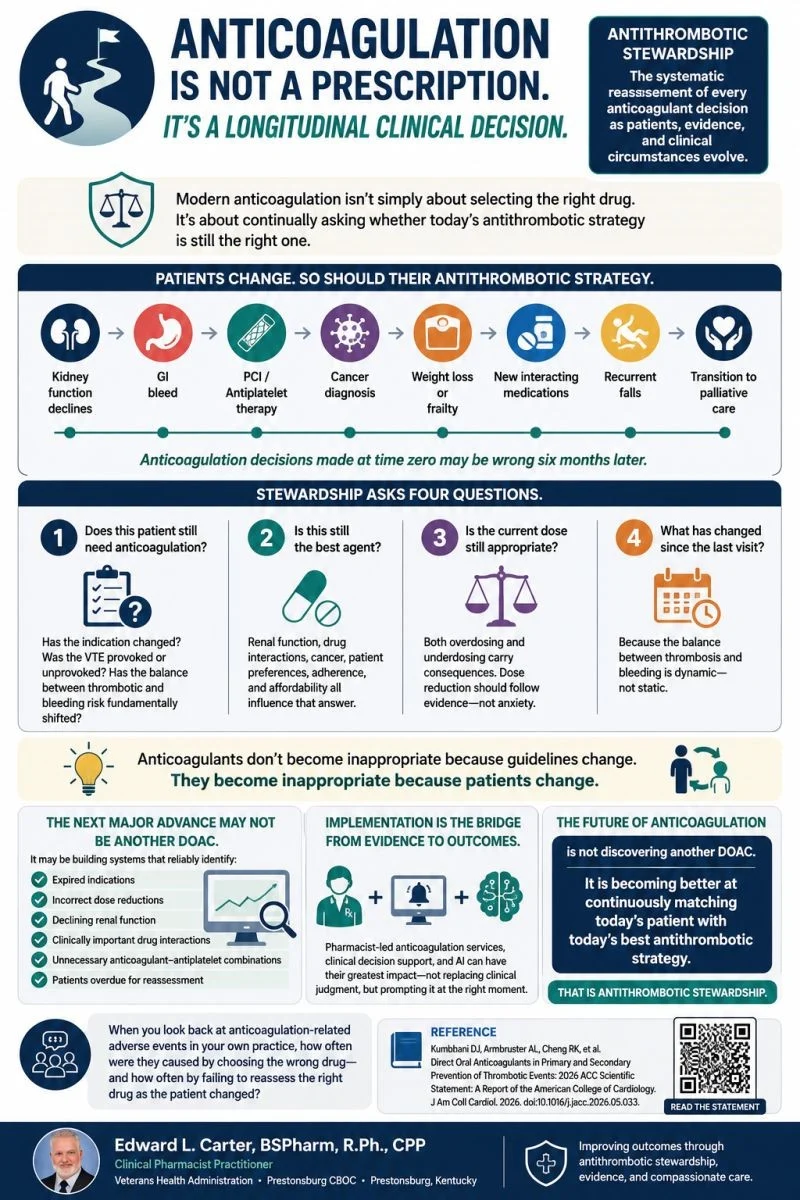
“Anticoagulation is not a prescription. It’s a longitudinal clinical decision.
We’ve become very good at choosing anticoagulants.
I’m not sure we’ve become equally good at deciding when to change them—or when to stop them.
The new 2026 ACC Scientific Statement on Direct Oral Anticoagulants reinforced something I’ve been thinking about for a long time.
Modern anticoagulation isn’t simply about selecting the right drug.
It’s about continually asking whether today’s antithrombotic strategy is still the right one.
That’s what I believe antithrombotic stewardship really means.
The systematic reassessment of every anticoagulant decision as patients, evidence, and clinical circumstances evolve.
Every anticoagulant decision is made at time zero.
Patients don’t stay the same.
Six months later they may have:
- Progressive chronic kidney disease
- A gastrointestinal bleed
- A coronary stent requiring antiplatelet therapy
- A new cancer diagnosis
- Weight loss or frailty
- New interacting medications
- Recurrent falls
- Transition to palliative care
The patient changes.
Their antithrombotic strategy should too.
Stewardship asks four questions.
1. Does this patient still need anticoagulation?
Has the indication changed? Was the VTE provoked or unprovoked? Has the balance between thrombotic and bleeding risk fundamentally shifted?
2. Is this still the best agent?
Renal function, drug interactions, cancer, patient preferences, adherence, and affordability all influence that answer.
3.Is the current dose still appropriate?
Both overdosing and underdosing carry consequences. Dose reduction should follow evidence—not anxiety.
4.What has changed since the last visit?
Because the balance between thrombosis and bleeding is dynamic—not static.
Anticoagulants don’t become inappropriate because guidelines change.
They become inappropriate because patients change.
Although the ACC statement covers specific agents, indications, doses, and durations, I came away with a broader message: anticoagulation should never be managed as a one-time prescribing decision.
The next major advance in anticoagulation may not be another DOAC.
It may be building systems that reliably identify:
- Expired indications
- Incorrect dose reductions
- Declining renal function
- Clinically important drug interactions
- Unnecessary anticoagulant–antiplatelet combinations
- Patients overdue for reassessment
This is where pharmacist-led anticoagulation services, clinical decision support, and AI can have their greatest impact – not replacing clinical judgment, but prompting it at the right moment.
The ACC statement provides the evidence framework.
Our challenge is implementation.
The future of anticoagulation is not discovering another DOAC.
It is becoming better at continuously matching today’s patient with today’s best antithrombotic strategy.
That is antithrombotic stewardship.”
Other posts featuring Edward Lee Carter on Hemostasis Today.
-
Sep 17, 2026, 20:38Konstantinos Bistas: Reduced Circulating Tregs in Pediatric Chronic Neutropenia
-
Sep 17, 2026, 15:33Gopal Patidar: Honoured to Contribute to the ASFA 2026 Guidelines for Therapeutic Apheresis
-
Sep 17, 2026, 20:36Cosima C. Hoch: Developing a 3D Organotypic Co-Culture Model for Pleomorphic Adenoma
-
Sep 17, 2026, 20:19Riten Kumar: Boston Children’s Hospital Ranked No. 1 in Seven Pediatric Specialties
-
Sep 17, 2026, 20:17Katrina Snow: Whole Blood or Component Therapy – Which Would You Choose?
-
Sep 17, 2026, 16:30Daria Camilli: Empowering Bleeding Disorder Advocacy Through Health Economics
-
Sep 17, 2026, 16:17Mehran Ghasemzadeh: Platelet NK Cell Crosstalk in Advanced Coronary Artery Disease
-
Sep 17, 2026, 16:16Barbara Adams Krolak: Do GLP-1s Affect Blood Clot Risk?
-
Sep 17, 2026, 15:46Heghine Khachatryan: Clinical Context at the Core of Thrombosis and Thrombophilia Management