

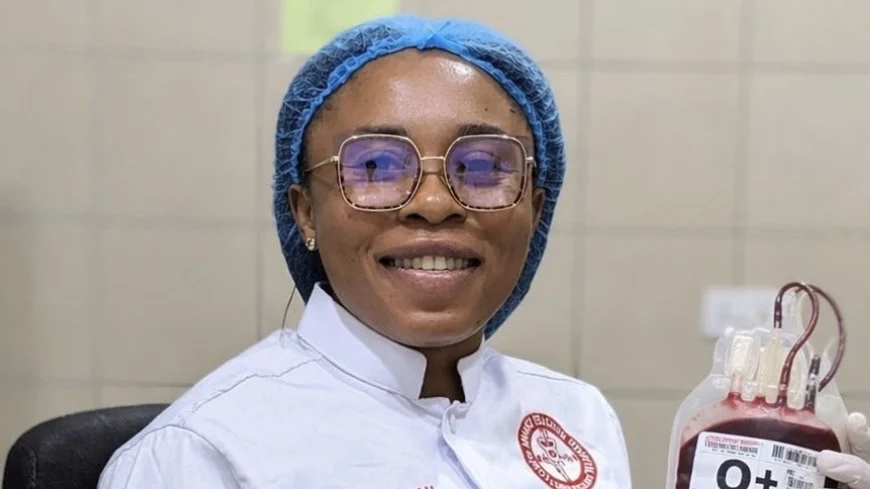
Gloria Duah: Regular Voluntary Blood Donation Remains One of the Most Powerful Acts of Humanity in Healthcare
Gloria Duah, Doctor of Medical Laboratory Science at Komfo Anokye Teaching Hospital, Gender Children and Social Protection Minister of United Nations Youth Association-Ghana (UNYA-GH), shared a post on LinkedIn:
” ‘I donated blood and didn’t use it, so give me back my blood.’
This is one of the common statements we hear from patients and relatives at the transfusion medicine unit.
Some even request that the exact blood they donated be transfused back into them.
Honestly, from their perspective, it sounds reasonable at first.
But blood donation doesn’t work like a personal bank account where you deposit and withdraw anytime you want. In reality, you are very unlikely to receive the exact unit you donated.
Once blood is donated, it goes through several critical processes: screening, grouping, processing, storage, and inventory management.
After that, it becomes part of a lifesaving pool meant to serve whoever urgently needs it first, it could be accident victims, surgical patients, cancer patients, mothers with severe bleeding, and many others.
Blood also has a shelf life. Red cells expire, platelets expire even faster, and some units may no longer remain suitable over time.
The blood bank system is built on availability and replacement, not ‘ownership’.
It is a community support system for healthcare.
Every donation strengthens the system and increases the chances that blood will be available when anyone, including the donor someday, urgently needs it.
That is why regular voluntary blood donation remains one of the most powerful acts of humanity in healthcare.
Healthcare workers in transfusion medicine and related units, what are some misconceptions or experiences you’ve encountered regarding blood donation?”
Stay updated with Hemostasis Today.
-
Oct 20, 2026, 16:51Suzan Nakasendwa: A Growing Stroke Challenge in Uganda
-
Oct 20, 2026, 16:38Steve Moon: How Does Smoking Cessation Duration Affect Ischemic Stroke Risk
-
Oct 20, 2026, 16:25Cedrice Mentor: Reducing Platelet Wastage Through Cold Storage
-
Oct 20, 2026, 16:09Thirunavukkarasu Angappan: Can a Purified Fibrinogen Concentrate Replace Cryoprecipitate
-
Oct 20, 2026, 16:01Kalyan Roy: Platelet Conservation Through Evidence-Based Transfusion Practice
-
Oct 20, 2026, 15:28Stacy E. Croteau: 33 Countries, One Mission – Better Bleeding Disorder Care
-
Oct 20, 2026, 15:19Teresa Barnes: What Does a Pulmonary Embolism Mean for Jalen Hurts?
-
Oct 20, 2026, 15:04Laura S.: Could Speaking Up Prevent Maternal Deaths from Thrombosis?
-
Oct 20, 2026, 14:44Pete Stibbs: VTE in Professional Athletes – When Fitness Is Not Enough