


Isa Oboirien: Why Might Factor XI Inhibition Work Differently in Stroke and ACS?
Isa Oboirien, Higher Specialty Trainee at Health Education England, shared a post on LinkedIn:
“Why might Factor XI inhibition work differently in stroke and ACS?
The contrasting signals with factor XIa inhibition may reflect differences in thrombotic biology.
Recurrent coronary events after ACS are predominantly platelet-driven, arising from plaque rupture or erosion with intense platelet activation.
Contemporary PCI and potent dual antiplatelet therapy already target this pathway effectively, potentially leaving little residual coagulation-mediated risk for additional FXIa inhibition to modify.
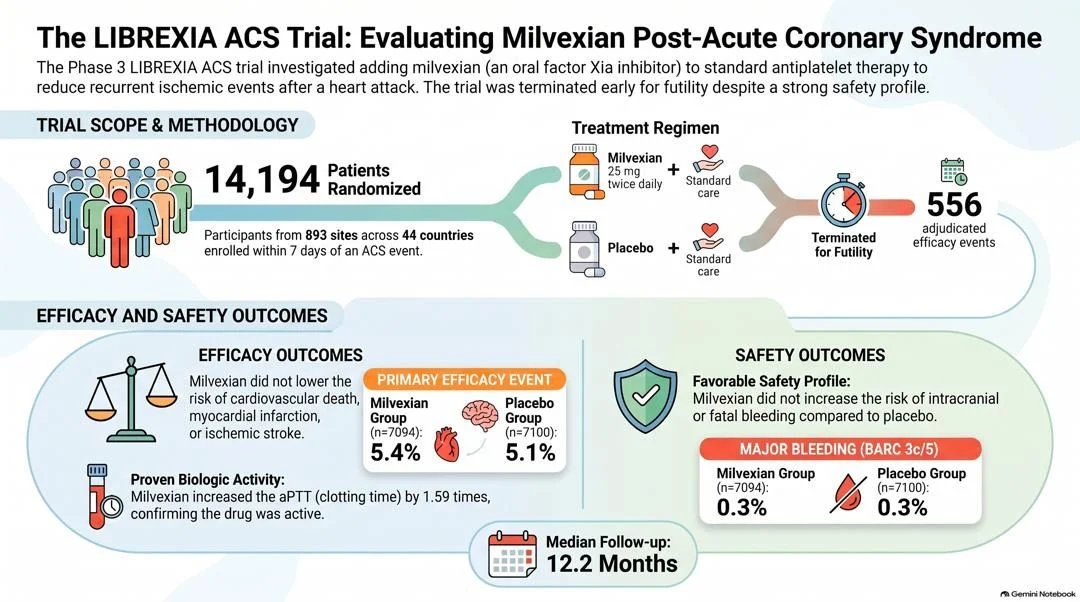
Indeed, LIBREXIA-ACS showed no reduction in cardiovascular death, MI or ischaemic stroke with milvexian.
In contrast, recurrent ischaemic stroke is mechanistically heterogeneous, involving artery-to-artery thromboembolism, thrombin generation and fibrin-rich clot propagation, alongside platelet activation.
FXI may therefore contribute more importantly to thrombus amplification within cerebral circulation.
The encouraging symptomatic-stroke signal in AXIOMATIC-SSP and OCEANIC-STROKE trials, coupled with minimal intracranial bleeding, raises the intriguing possibility that FXIa inhibition may be better suited to cerebral than coronary thrombosis – a hypothesis that LIBREXIA-STROKE will ultimately test.”
Stay updated with Hemostasis Today.
-
Oct 19, 2026, 11:37Beth Faiman: APSHO Fellows Celebrated for Advancing Hematology and Oncology Practice
-
Oct 19, 2026, 11:26Emanuele Pacini: Myelodysplastic Syndromes Research Featured at JSH Annual Meeting in Kyoto
-
Oct 19, 2026, 10:57Jesmond Dalli: How Erythroblasts Shape Neutrophil Development and Function
-
Oct 19, 2026, 10:41Hisham Fahmi: SCD – Should Gene Editing Begin Before Organ Damage?
-
Oct 19, 2026, 10:33Pallavi Madhiraju: YARTEMLEA Faces Another European Rejection Despite FDA Approval
-
Oct 19, 2026, 10:28Brig Tathagata Chatterjee: Acute Leukemias in AYAs at the Japanese Society of Hematology Conference
-
Oct 19, 2026, 10:27Heather M. Johnson: Join the Discussion on Optimizing the CTEPH Diagnostic Pathway
-
Oct 19, 2026, 10:18Flora Peyvandi: Unravelling the Complexity of VWF Through Genetics
-
Oct 19, 2026, 09:55High DOAC Adherence in Patients With Ischemic Stroke and AF – International Journal of Stroke