

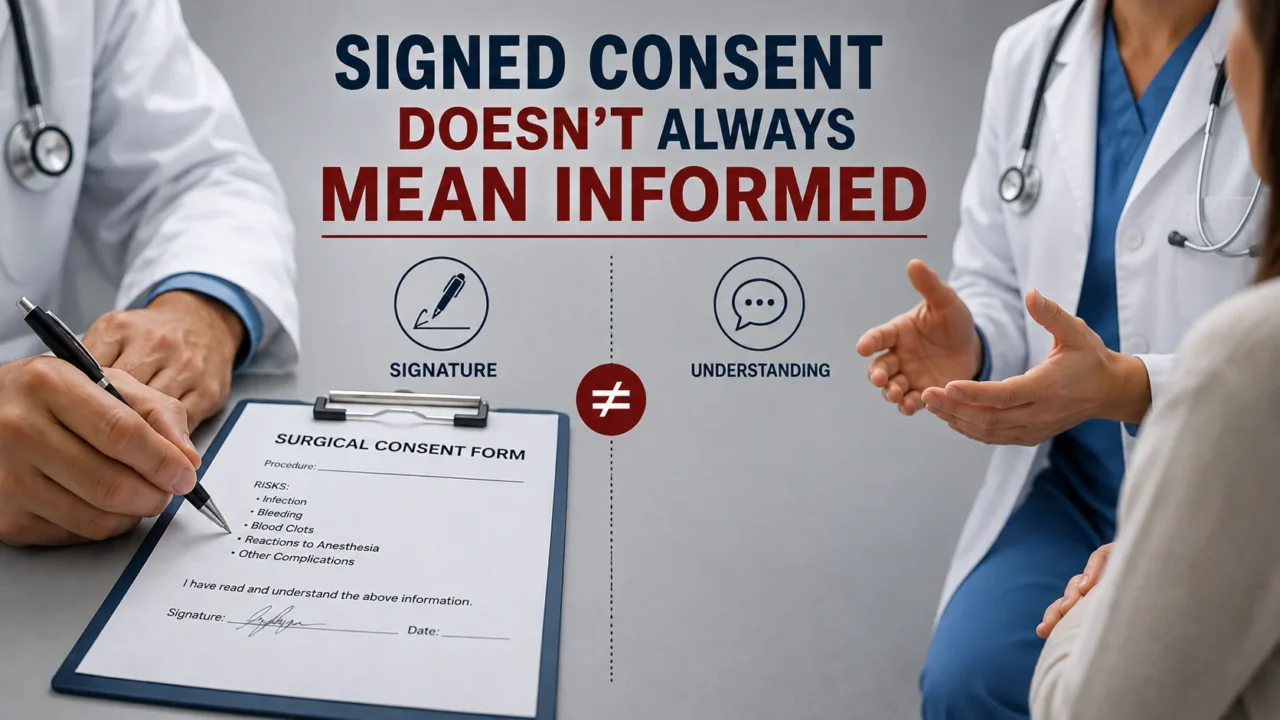
Khalid Alfawaz: Signed Consent Doesn’t Always Mean Informed
Khalid Alfawaz, Chief Patient and Community Services at Royal Commission Health Services Program in Jubail, shared a post on LinkedIn:
“He Signed the Consent Form.
But Did He Really Consent?
The patient was ready for surgery.
The paperwork was complete.
The consent form was signed.
Everything seemed ready to proceed.
Then, just before being taken to the operating room, he asked:
‘What happens if I don’t have the surgery?’
Suddenly, that signature meant something very different.
Because informed consent is not about getting a signature.
It is about earning understanding.
A patient can sign a form and still not understand the procedure, the risks, the alternatives, or even that saying ‘no’ is an option.
True informed consent means the patient understands:
- What is being recommended and why?
- The expected benefits and significant risks.
- Reasonable alternatives.
- What could happen without treatment.
- Their right to ask questions, refuse, or change their mind.
But there is another challenge.
A physician says:
‘There is a risk of postoperative thromboembolism.’
The patient nods.
‘Do you understand?’
‘Yes.’
We documented understanding.
But did we actually confirm it?
Now imagine saying:
‘There is a risk of developing a blood clot after surgery.
To make sure I explained it clearly, can you tell me in your own words what you understand?’
That small change represents something much bigger:
Moving from information delivered to understanding achieved.
This is why plain language, teach-back, qualified interpreters, and meaningful conversations matter.
And perhaps the hardest part of informed consent is this:
The patient has the right to make a decision we disagree with.
A patient who understands the recommendation, risks, benefits, and alternatives may still say:
‘No.’
Our responsibility is not to pressure the patient into making the decision we would make.
It is to help them make an informed decision that reflects their values, preferences, and goals.
And even after signing?
The patient can still say:
‘I changed my mind.’
Consent is not a moment.
It is an ongoing conversation.
So perhaps the question healthcare organizations should ask is not:
‘Did we get the consent form signed?’
But:
‘Did the patient truly understand what they were agreeing to?’
Because the form may document consent.
But the conversation is what makes it informed.”
Stay updated with Hemostasis Today.
-
Oct 18, 2026, 17:11Owen McCarty: Understanding Prekallikrein and Its Role in Inflammation and Thrombosis
-
Oct 18, 2026, 17:04Emna Gouider Belhadjali: Don’t Miss GPAS 2026 on Bleeding Disorders
-
Oct 18, 2026, 16:53Mehran Ghasemzadeh: Microparticle-Associated Mitochondrial DNA in Stored Platelet Products
-
Oct 18, 2026, 16:38Edward Lee Carter: A 15-Minute Blood Test for Brain Hemorrhage?
-
Oct 18, 2026, 16:29Patrick Taylor: Oral vs Transdermal Estrogen and Cardiovascular Risk in Menopausal Women
-
Oct 18, 2026, 16:19Artangela Henry: A Meaningful Week at the SCDAA National Convention
-
Oct 18, 2026, 16:04Emília Araújo։ New Insights Into the Genetics of Hemophilia B Leyden
-
Oct 18, 2026, 15:43André Marcel Harris: Award-Winning Research on Texas Sickle Cell Data Collection
-
Oct 18, 2026, 15:21Eleonora Gambineri: First Results of the IEI-Haem Consortium at ESID 2026