


Huyen Nguyen: Highlights from the NCCN Cancer-Associated Venous Thromboembolic Disease Guidelines
Huyen Nguyen, Clinical Pharmacist at Vinmec Healthcare System, shared on LinkedIn:
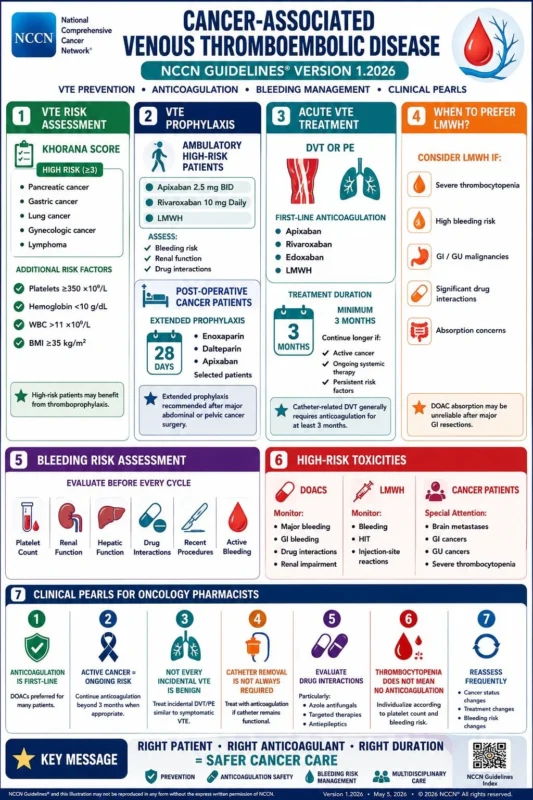
”NCCN Cancer-Associated Venous Thromboembolic Disease Guidelines Version 1.2026
Venous thromboembolism (VTE) remains one of the most common and potentially life-threatening complications in patients with cancer.
It is associated with increased morbidity, treatment interruptions, hospitalisations, and mortality.
Some important clinical updates and reminders:
- Cancer increases the risk of VTE several-fold compared with the general population, making risk assessment an essential component of routine oncology care.
- The Khorana Score remains one of the most validated tools for identifying ambulatory patients at high risk for chemotherapy-associated thrombosis.
- Direct oral anticoagulants (DOACs), including apixaban and rivaroxaban, are increasingly used for both thromboprophylaxis and treatment of cancer-associated thrombosis in appropriately selected patients.
- Extended thromboprophylaxis should be considered following major abdominal or pelvic cancer surgery in patients at high risk of postoperative VTE.
- Catheter-related thrombosis can often be managed with anticoagulation without immediate catheter removal when the device remains functional and clinically necessary.
Some practical clinical pearls:
- Assess thrombosis and bleeding risk before initiating anticoagulation
- Review renal function, hepatic function, platelet count, and drug interactions regularly
- Consider LMWH in selected patients with severe thrombocytopenia, gastrointestinal malignancies, genitourinary cancers, or concerns regarding DOAC absorption
- Evaluate interactions with targeted therapies, azole antifungals, anticonvulsants, and other CYP/P-gp modulators
- Reassess anticoagulation needs periodically as cancer status, treatment plans, and bleeding risks evolve
- Remember that active cancer often represents a persistent thrombotic risk factor, and anticoagulation beyond 3 months may be appropriate for selected patients
Another important reminder:
Optimal management of cancer-associated thrombosis requires multidisciplinary collaboration among oncologists, hematologists, pharmacists, surgeons, nurses, and thrombosis specialists to maximize efficacy while minimizing bleeding complications.”
Stay updated with Hemostasis Today.
-
Oct 19, 2026, 09:55High DOAC Adherence in Patients With Ischemic Stroke and AF – International Journal of Stroke
-
Oct 19, 2026, 08:20Cory Dugan: The IRONWOMAN Trial Individual Responses to IV Iron Therapy in Active Women
-
Oct 19, 2026, 07:36Johannes Kaesmacher: Cerebral No-Reflow After Thrombectomy Toward a Standardized Definition
-
Oct 19, 2026, 07:33Beth Psaila: Highlights from IACH Annual Meeting and MPN Horizons
-
Oct 19, 2026, 07:29Wolfgang Miesbach: Can Losartan Activate Brown Fat? – Nature Study Explores New Therapeutic Link
-
Oct 19, 2026, 07:22Ruben Mesa: Honored to Speak at the Tandem MPN Meetings of IACH
-
Oct 19, 2026, 07:19Saneha Anjum Shaikh: Parul University Partners with Raktasevak Bike Ride 2026 for Blood Donation Drive
-
Oct 19, 2026, 07:09Alejandro González Veliz: No ST Elevation Does Not Guarantee an Open Coronary Artery
-
Oct 19, 2026, 06:02Thomas Dayspring: Vascular Resilience – What Is It and How Can We Measure It?