


Ifeanyichukwu Ifechidere: COVID-19 Changed Our Understanding of Coagulation
Ifeanyichukwu Ifechidere, Specialist Biomedical Scientist at Sheffield Teaching Hospitals NHS Foundation Trust, shared a post on LinkedIn:
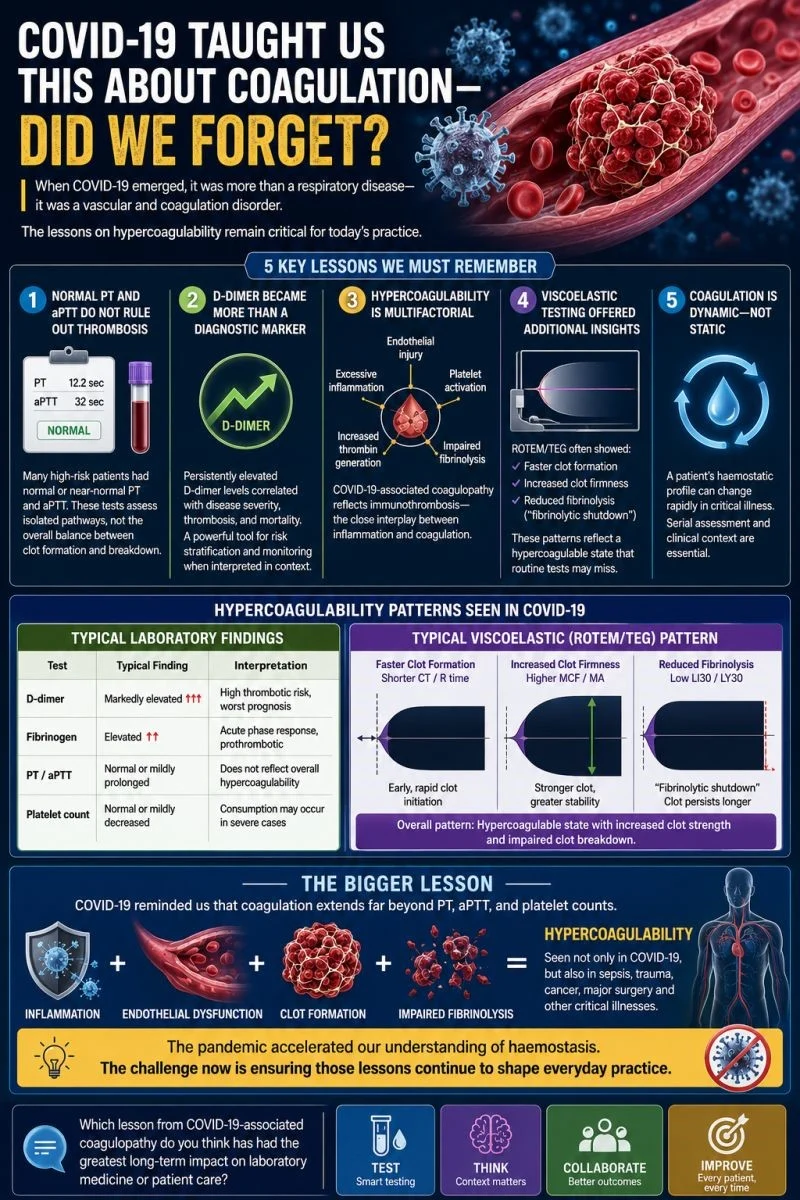
“COVID-19 taught us this about coagulation-did we forget?
When COVID-19 emerged, we initially viewed it as a respiratory disease.
It soon became clear that it was also a vascular and coagulation disorder, with thrombotic complications driving morbidity and mortality in many critically ill patients.
Although the pandemic has receded, the lessons it taught us about hypercoagulability remain highly relevant.
Here are a few worth remembering:
1.Normal PT and aPTT do not rule out thrombosis Many patients with significant thrombotic risk had only mild abnormalities in routine coagulation tests. Conventional assays assess isolated components of coagulation – not the overall balance between clot formation and breakdown.
2.D-dimer became more than a diagnostic marker Persistently elevated D-dimer levels were associated with severe disease, venous thromboembolism, and poorer outcomes. While nonspecific, D-dimer proved invaluable for risk stratification and clinical monitoring when interpreted alongside the patient’s overall condition.
3.Hypercoagulability is multifactorial COVID-19-associated coagulopathy was driven by a complex interplay of:
- Endothelial injury
- Excessive inflammation
- Platelet activation
- Increased thrombin generation
- Impaired fibrinolysis
This reinforced the concept of immunothrombosis-the close relationship between inflammation and coagulation.
4.Viscoelastic testing offered additional insights ROTEM and TEG frequently demonstrated:
- Faster clot formation
- Increased clot firmness
- Reduced fibrinolysis (‘fibrinolytic shutdown’)
These patterns often reflected a hypercoagulable state that routine coagulation tests could not fully capture.
5.Coagulation is dynamic-not static A patient’s haemostatic profile can evolve rapidly during critical illness. Serial assessment and interpretation in the clinical context are often more informative than a single laboratory result.
The bigger lesson
COVID-19 reminded us that coagulation extends far beyond PT, aPTT, and platelet counts.
Understanding the interaction between inflammation, endothelial dysfunction, fibrinolysis, and clot formation is essential – not only in COVID-19 but also in sepsis, trauma, cancer, major surgery, and other critical illnesses.
The pandemic accelerated our understanding of haemostasis.
The challenge now is ensuring those lessons continue to influence everyday clinical practice.
Which lesson from COVID-19-associated coagulopathy do you think has had the greatest long-term impact on laboratory medicine or patient care?”
Find more posts featuring Ifeanyichukwu Ifechidere on Hemostasis Today.
-
Sep 18, 2026, 16:13Christian Irsara: PF4 Immunothrombosis Following Natural Adenovirus Infection
-
Sep 18, 2026, 16:10Leo Nicolai։ The Spleen Emerges as a Key Regulator of Thromboinflammation
-
Sep 18, 2026, 16:05Targeting Factor XI to Reduce Thrombosis Without Compromising Hemostasis – ISTH
-
Sep 18, 2026, 15:54Swapnil Pawar: Why Aren’t We Using Cryopreserved Platelets Everywhere Yet?
-
Sep 18, 2026, 15:37Abdul Mannan: Evaluating Longitudinal Platelet Trends Beyond Standard Reference Intervals
-
Sep 18, 2026, 15:30Peter A. Everts։ Platelet Phenotype May Hold the Key to More Consistent PRP Therapy
-
Sep 18, 2026, 15:25Brandon Temple: Turning Personal Experience Into Advocacy for wAIHA Research
-
Sep 18, 2026, 15:01A. M. Thirugnanam: Antiplatelet Discontinuation and the Risk of Stent Thrombosis
-
Sep 18, 2026, 14:52Abdul Muqtadir Abbasi: How Do Hematologists Know Which Coagulation Factor Is the Problem?