


Ifeanyichukwu Ifechidere: Protein S Deficiency – When the Timing of the Test Matters
Ifeanyichukwu Ifechidere, Specialist Biomedical Scientist at Sheffield Teaching Hospitals, shared on LinkedIn:
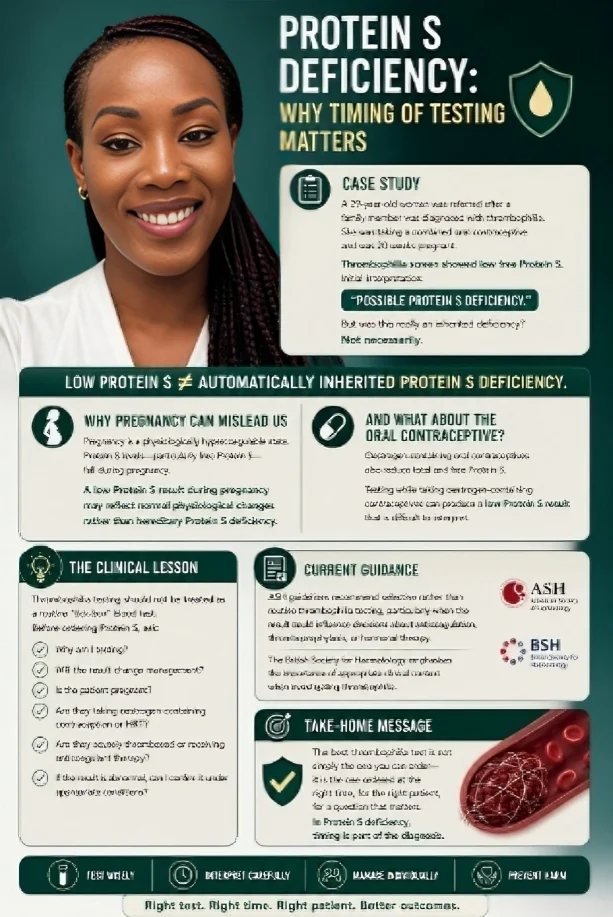
”Protein S Deficiency: When the Timing of the Test Matters
Case study from internal medicine:
A 29-year-old woman was referred after a family member was diagnosed with thrombophilia. She was taking a combined oral contraceptive and was 20 weeks pregnant.
A thrombophilia screen showed low free Protein S, and the initial interpretation was:
‘Possible Protein S deficiency.’
But was this really an inherited deficiency?
Not necessarily.
Protein S is a natural anticoagulant. Deficiency can increase the risk of venous thromboembolism (VTE), but interpreting Protein S results requires careful attention to the clinical context.
Why pregnancy can mislead us?
Pregnancy is a physiologically hypercoagulable state. Protein S levels — particularly free Protein S — fall during pregnancy.
Therefore, a low Protein S result during pregnancy may reflect normal physiological changes rather than hereditary Protein S deficiency.
And what about the oral contraceptive?
Oestrogen-containing oral contraceptives also alter haemostasis and are associated with a reduction in total and free Protein S.
So, testing someone who is pregnant or taking an oestrogen-containing contraceptive can produce a low Protein S result that is difficult to interpret.
That creates a clinical trap:
Low Protein S does not automatically indicate inherited Protein S deficiency.
An incorrect diagnosis may lead to unnecessary anxiety, inappropriate counselling, changes to contraceptive choices, or altered management during future pregnancies.
The clinical lesson.
Thrombophilia testing should not be treated as a routine ‘tick- b ox’ blood test.
Before ordering Protein S, ask:
- Why am I testing?
- Will the result change management?
- Is the patient pregnant?
- Are they taking oestrogen-containing contraception or HRT?
- Are they acutely thrombosed or receiving anticoagulant therapy?
- If the result is abnormal, can I confirm it under appropriate conditions?
Current ASH guidance recommends selective rather than routine thrombophilia testing, particularly when the result could influence decisions about anticoagulation, thromboprophylaxis, or hormonal therapy.
The British Society for Haematology similarly emphasises the importance of appropriate clinical context when investigating thrombophilia.
Take-home message.
The best thrombophilia test is not simply the one you can order — it is the one ordered at the right time, for the right patient, for a question that matters.
In Protein S deficiency, timing is part of the diagnosis.”
Stay updated with Hemostasis Today.
-
Oct 11, 2026, 16:27Giuseppe Bellelli: Reevaluating Anticoagulation Net Benefit in Frail Older Adults
-
Oct 11, 2026, 16:17Johnathan Whetstine: How Does MYC Go From 2 Copies to an Amplified Oncogene?
-
Oct 11, 2026, 16:03Parth Parmar: Practical Guidelines for Managing Venous Thromboembolism
-
Oct 11, 2026, 15:31Muhammad Alvi: CASPR Study Explores Treatment Response Across ESUS Phenotypes
-
Oct 11, 2026, 15:15Thalassaemia International Federation Joins ASCAT 2026 to Advance Sickle Cell and Thalassaemia Care
-
Oct 11, 2026, 15:14Challenges and Perspectives on Gene Therapy in Hemophilia A – Seminars in Thrombosis and Hemostasis
-
Oct 11, 2026, 15:07Neysa Rahardjo: Platelet Estimation Pitfalls and Discrepancy Resolution
-
Oct 11, 2026, 15:05Lance Trewhella: Reflections from the ASCLS Region V Fall Symposium
-
Oct 11, 2026, 15:04The Anti-Inflammatory Rationale for GLP-1 Agonists in Hemophilia – CRH French Reference Center for Hemophilia Lyon