


Ifeanyichukwu Ifechidere: Why Coagulation Samples Can Be “Too Valuable to Throw Away”?
Ifeanyichukwu Ifechidere, Specialist Biomedical Scientist at Sheffield Teaching Hospitals, shared a post on LinkedIn:
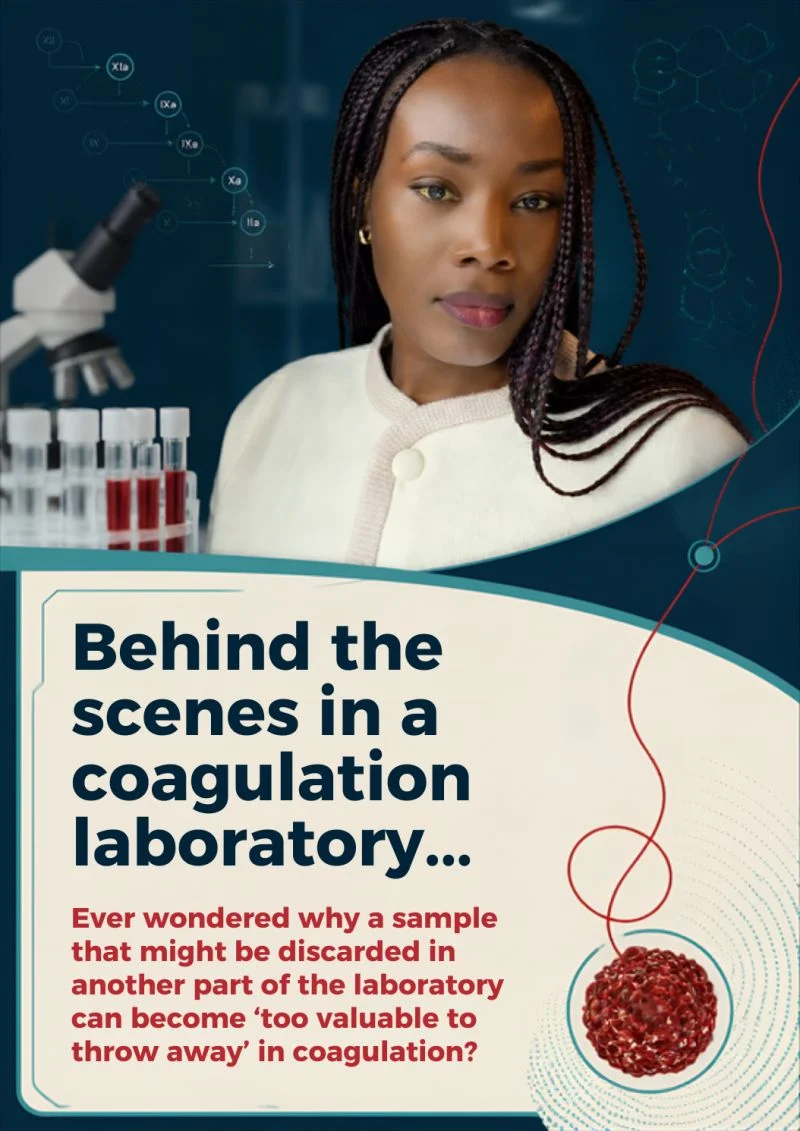
“Ever wondered why a sample that might be discarded in another part of the laboratory can become ‘too valuable to throw away’ in coagulation?
Welcome to one of the things I love about working in haemostasis and coagulation. When you look at a coagulation sample, you’re not just looking at a blue-top tube. You’re looking at a piece of a clinical puzzle.
A patient may have an unexpected prolonged APTT today.
But tomorrow, the clinician may ask:
- ‘Can we investigate a possible factor deficiency?’
- ‘Could this be an inhibitor?’
- ‘Can we repeat that result?’
- ‘Could we compare it with a previous sample?’
And this is where sample storage becomes incredibly important.
Why are samples aliquoted and retained?
Depending on the laboratory’s SOP, test requirements and clinical context, plasma may be separated and stored in aliquots for appropriate periods—particularly when specialised or additional coagulation investigations may be required.
Aliquoting helps to:
- Preserve the original specimen for potential additional testing.
- Reduce repeated freeze–thaw cycles, which can affect some haemostatic analytes.
- Allow multiple investigations to be performed without repeatedly handling the original sample.
- Support specialised investigations, such as factor assays or inhibitor-related testing, where appropriate.
- Provide a useful reference when results need to be reviewed or confirmed according to laboratory policy.
And here’s something important:
Not every coagulation sample is stored long-term.
Storage duration and conditions depend on the analyte, specimen type, clinical indication, laboratory policy and applicable guidelines.
Also, serum and plasma are not interchangeable. Plasma is the primary specimen for many coagulation investigations because it retains fibrinogen and other clotting components; serum has already clotted and therefore has different applications.
Some laboratories may retain serum or paired specimens for specific investigations or biobanking purposes, but this is not a universal coagulation requirement.
And this is what makes coagulation fascinating…One sample can lead you down an entire investigative pathway:
PT or APTT, followed by a mixing study, factor assays, inhibitor investigation, and specialised testing
You’re not simply producing a result.
You’re asking:
‘Why is this result abnormal?’
Then using laboratory science to work backwards towards an explanation. That’s the beauty of coagulation. It’s part science, part investigation, part problem-solving—and every unexpected result can be a clue.
If you’re a biomedical science student, new biomedical scientist or clinician trying to build a stronger understanding of haemostasis and coagulation:
Follow me for more practical coagulation education, laboratory insights and real-world learning.
Let’s make coagulation less intimidating and more understandable—one sample at a time.”
Find more posts featuring Ifeanyichukwu Ifechidere on Hemostasis Today.
-
Sep 24, 2026, 18:33Aswin K. Mohan: When a Superpower Hears the Call for Blood
-
Sep 24, 2026, 18:31Mercy Lung’aho: Anemia Is Not Only An Iron Problem
-
Sep 24, 2026, 18:29Nick Hanson: Before a Dementia Diagnosis Check Vitamin B12
-
Sep 24, 2026, 18:28Rachel McBryan: Nearly One in Five Older Canadians Has Low Vitamin B12
-
Sep 24, 2026, 18:27Kemal Karaagac: Early DOAC Initiation After Acute Ischaemic Stroke in Atrial Fibrillation
-
Sep 24, 2026, 18:26Mohammed A. AlOmar: What Characterizes Young Stroke in the UAE?
-
Sep 24, 2026, 18:12Alan Nurden: How Genotype and Phenotype Can Vary in von Willebrand Disease
-
Sep 24, 2026, 16:02Leonardo Roever: Understanding Peripheral Artery Disease in the Modern Era
-
Sep 24, 2026, 15:49Sthanu Subramanian: When HbA1c Does Not Reflect True Glycemia