

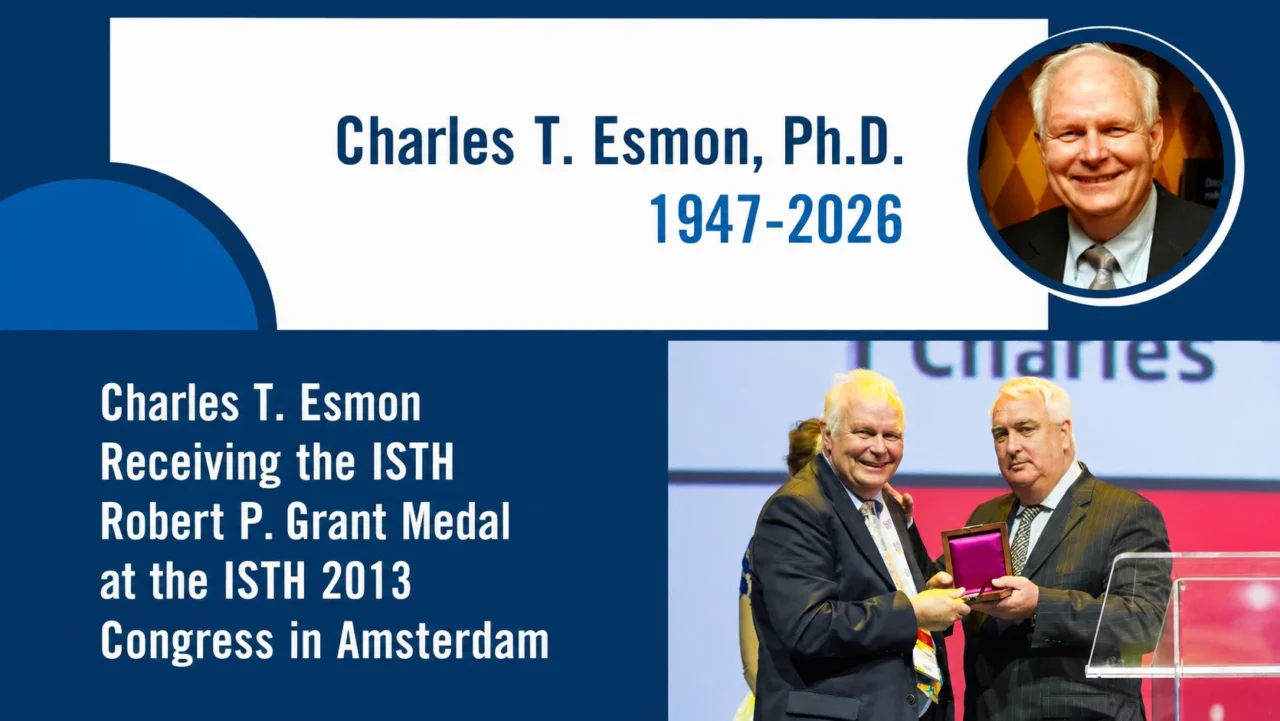
Honoring the Legacy of Charles T. Esmon in Hemostasis and Thrombosis – ISTH
International Society on Thrombosis and Haemostasis (ISTH) shared a post on LinkedIn:
“The ISTH staff, leadership and members extend their sincere condolences to the family of Charles ‘Chuck’ T. Esmon, Ph.D., a longtime ISTH member and influential leader within the field of thrombosis and hemostasis, who passed away on May 1, 2026.
Chuck and his wife Naomi joined the Oklahoma Medical Research Foundation in 1982, where they made many pioneering discoveries related to thrombosis and hemostasis.
Chuck is credited with identifying two proteins on the endothelial blood vessel lining: thrombomodulin and the endothelial cell protein C receptor.
His extensive research work often focused on the connection between blood clotting and inflammation.
To recognize his contributions, the ISTH honored Chuck with the ISTH Robert P. Grant Medal, the highest honor of the Society in 2013.
He had previously received the ISTH Distinguished Career Award in 1999 and the ISTH Investigator Recognition Award in 1983.”
Other posts about International Society on Thrombosis and Haemostasis on Hemostasis Today.
-
Sep 21, 2026, 13:51Abdalhakim Shubietah: pLAAO Fails Noninferiority to OAC in Landmark Meta-Analysis of 7 RCTs
-
Sep 21, 2026, 13:21In His Last UNGA, António Guterres Delivers a Urgent Call for Global Unity
-
Sep 21, 2026, 13:14Fatih Mehmet Gul: Are We Moving Faster Than Our Ability to Ask ‘Should We?’
-
Sep 21, 2026, 13:08Sangita Reddy: How Does Our Own Healthcare Journey in India Look Through the Same Lens?
-
Sep 21, 2026, 12:53Conan McIlwrath: Strengthening Haemophilia Care Through International Collaboration
-
Sep 21, 2026, 12:41Tinatin Muradashvili: Advancing Hemophilia Care Through Education and Collaboration
-
Sep 21, 2026, 12:15Kholoud Al Busaidi: Cold Agglutination and Its Impact on CBC and Blood Grouping Results
-
Sep 21, 2026, 11:03Shaurav Bhattacharyya: Honoring the 2026 Lasker Award Winners
-
Sep 21, 2026, 10:41Jamshid Ullah: Recognizing Blood Disorders Through Laboratory Findings