


Mohd Ashhad: What Should Be Done Immediately When a Blood Transfusion Reaction Occurs?
Mohd Ashhad, Assistant at Blood bank, shared on LinkedIn:
”What If a Blood Transfusion Reaction Occurs?
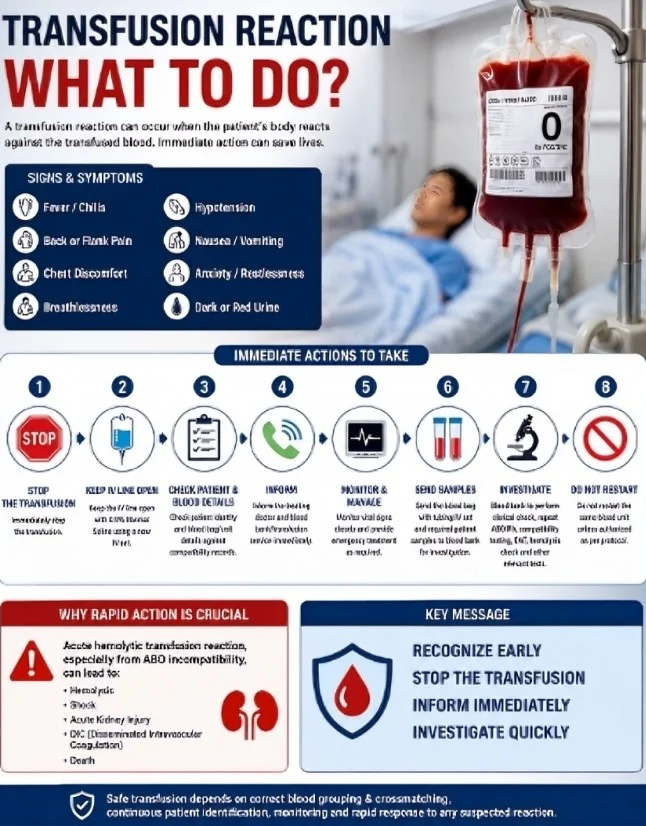
A blood transfusion is a life-saving procedure, but a transfusion reaction can become a medical emergency if incompatible blood is transfused.
If a patient develops symptoms such as:
- fever,
- chills,
- back/flank pain,
- chest discomfort,
- breathlessness,
- hypotension,
- nausea,
- dark/red urine,
immediate action is essential.
What should be done immediately?
- Stop the transfusion immediately.
- Keep the IV line open with 0.9% normal saline using a new IV set, according to hospital protocol.
- Check the patient’s identity and blood bag/unit details against the compatibility records.
- Inform the treating doctor and blood bank/transfusion service immediately.
- Monitor vital signs closely and provide emergency treatment as clinically indicated.
- Send the blood bag with the tubing/IV set and required patient samples to the blood bank for investigation.
- The blood bank should perform appropriate clerical checks, repeat ABO/Rh testing, compatibility testing, DAT, hemolysis assessment, and other investigations based on the suspected reaction.
- Do not restart the same blood unit unless specifically authorized under the applicable transfusion protocol.
Why is rapid action important?
An acute hemolytic transfusion reaction, especially from ABO incompatibility, can lead to hemolysis, shock, acute kidney injury, DIC, and potentially death.
The key message for every healthcare professional is:
Recognize early, then stop the transfusion, inform immediately and investigate quickly.
Safe transfusion depends not only on correct blood grouping and crossmatching, but also on continuous patient identification, monitoring, and rapid response to any suspected reaction.”
Stay updated with Hemostasis Today.
-
Oct 10, 2026, 17:58Archo Farzana Batool: Exploring Medical Writing Through an Article on Iron Deficiency Anemia
-
Oct 10, 2026, 17:53Assessing Frailty in Adults With Hemophilia – JTH
-
Oct 10, 2026, 17:52Fatma Sadeghi: Reducing Maternal Health Inequalities Through Nursing Advocacy
-
Oct 10, 2026, 17:50Grzegorz Hensler: How Apheresis Transformed Blood Cell Separation and Collection
-
Oct 10, 2026, 17:47Hemant K Sharma: Japan’s Universal Artificial Blood Research – A Potential Breakthrough in Transfusion Medicine
-
Oct 10, 2026, 17:40John Strouse: Learning About Bleeding Disorders and Sickle Cell Disease at FWGBD
-
Oct 10, 2026, 17:34Mae Caime: Speaking at the Annual Women’s Retreat for the Hemophilia Community in Florida
-
Oct 10, 2026, 17:30Chokri Ben Lamine: PNH beyond the Textbook Triad
-
Oct 10, 2026, 17:29Ruah Alyamany: Thrombosis and Anticoagulation in Hematological Malignancies at SOHO KSA 2026