


Nahrwan Masaoodi: Iron Deficiency Can Exist Without Anemia
Nahrwan Masaoodi, Academic content creator and Educational Communicator, shared a post on LinkedIn:
Iron deficiency does not necessarily mean that a person has anemia.
This is a very important point highlighted in the new guidelines issued by the American Society of Hematology (ASH) in September 2026.
For a long time, Ferritin low 15 ng mL was commonly used as a threshold for diagnosing iron deficiency in adults.
The new guidelines suggest using Ferritin low 30 ng mL to diagnose iron deficiency in adults, as well as in people who menstruate and during pregnancy, with some recommendations varying depending on the clinical context.
More importantly, ASH does not treat this number as a one size fits all rule.
In certain higher risk or symptomatic situations, such as Heavy Menstrual Bleeding, a threshold of low 50 ng mL may be appropriate.
When inflammation is present, Ferritin alone may not be sufficient to assess iron status. In these cases, the guidelines also recommend considering Transferrin Saturation (TSAT).
What stood out to me in these guidelines is the clear distinction between:
Iron Deficiency not equal Iron Deficiency Anemia
Iron stores can begin to decline before there is a clear decrease in Hemoglobin.
Therefore, having a normal CBC does not necessarily mean that iron stores are normal.
However, this does not mean that everyone needs to have their Ferritin checked or take iron supplements.
Diagnosis depends on symptoms, risk factors, laboratory results, and the overall clinical context.
For me, these guidelines are an important reminder that a laboratory value should never be interpreted separately from the full clinical picture.
Source:
Powers JM, et al. American Society of Hematology 2026 guidelines for diagnosis of iron deficiency. Blood Advances. 2026.
DOI: 10.1182 bloodadvances.2025015950″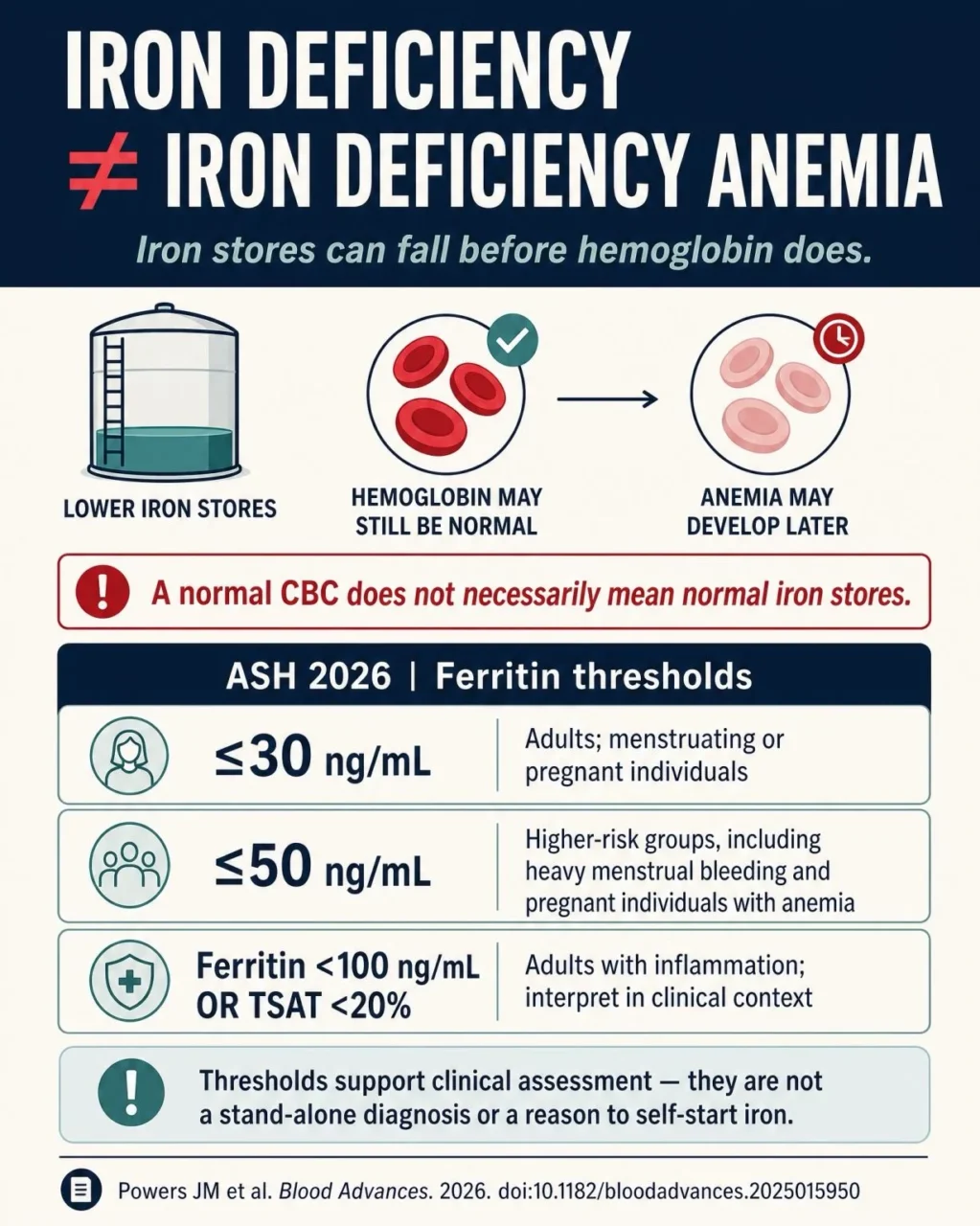
Stay updated with Hemostasis Today.
-
Nov 8, 2026, 18:56Denis Oduor: Strengthening the Regulation and Delivery of Blood Transfusion and Transplantation Services
-
Nov 8, 2026, 18:28Raghavendra Rao: A Narrative Review on Chronic Venous Disease during Pregnancy
-
Nov 8, 2026, 17:57Dhiren Patel: PLD1-Derived Phospholipids Regulate NAD Kinase and ROS Production in Neutrophils
-
Nov 8, 2026, 17:48Andra T.: What Causes Antiphospholipid Syndrome? – Four Steps, not One Cause
-
Nov 8, 2026, 17:38Nasrin Samadi: Can a Normal Clotting Test Be Misleading?
-
Nov 8, 2026, 17:36Paschalis Evangelidis: The Multifactorial Nature of Cardiovascular Risk in People With Hemophilia
-
Nov 8, 2026, 17:32Evangelos Panagiotopoulos: Apixaban Reduces Stroke and Major Bleeding Risk in Secondary Stroke Prevention
-
Nov 8, 2026, 17:27Danny Gaskin: Applications Open for the BBTS Specialist Certificate in Clinical Transfusion Practice
-
Nov 8, 2026, 16:54James P. Crowley: DOAC Testing Under 50 ng/mL Safely Expedites Urgent Hip Fracture Surgery