


Ney Carter Borges: Controlling Thrombosis Without Increasing Bleeding Risk – A New Frontier in Antiplatelet Therapy
Ney Carter Borges, Member Cardiologist of Global Physician Association at Cleveland Clinic Florida, shared a post on LinkedIn about a recent article Meinrad Paul Gawaz and Manuel Sigle published in European Heart Journal, adding:
“Controlling Thrombosis Without Increasing Bleeding Risk: A New Frontier in Antiplatelet Therapy
Antithrombotic therapy remains a central pillar in the prevention and management of atherosclerotic cardiovascular disease, significantly reducing morbidity and mortality over the past decades.
However, its major limitation persists: the inherent trade – off between effective thrombosis prevention and increased bleeding risk.
This balance is particularly critical in patients receiving dual antiplatelet therapy (DAPT), where bleeding events are independently associated with worse outcomes, including higher mortality .
The editorial from the European Heart Journal (2026) introduces an innovative and promising concept — selectively modulating platelet activation without impairing physiological haemostasis. At the core of this paradigm is the identification of novel molecular targets capable of dissociating thrombosis from bleeding.
Among these, the low – density lipoprotein receptor-related protein 5 (LRP5) emerges as a compelling candidate.
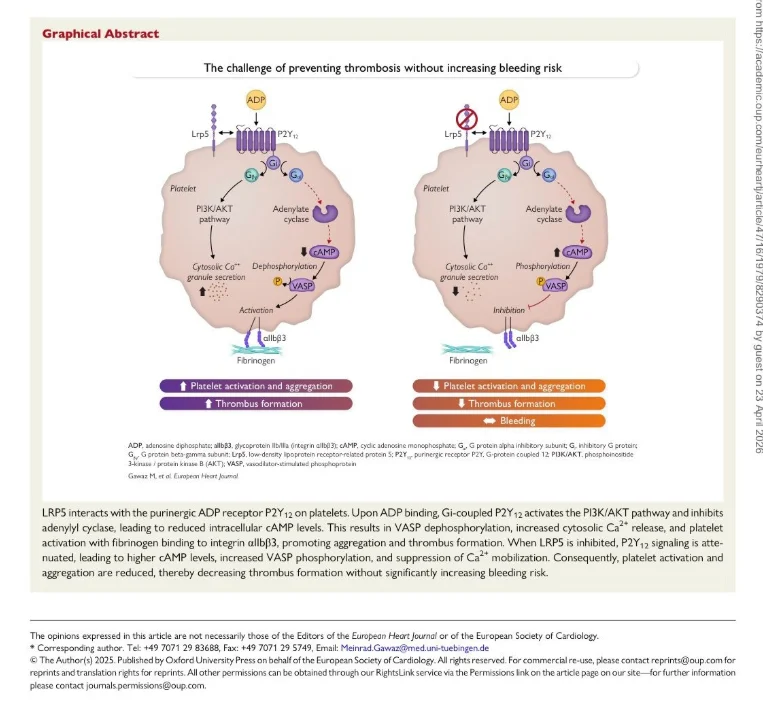
Mechanistically, LRP5 interacts with the platelet ADP receptor P2Y12, a key mediator of platelet activation.
Under normal conditions, ADP binding to P2Y12 triggers Gi – protein signaling, leading to reduced intracellular cAMP, decreased phosphorylation of vasodilator – stimulated phosphoprotein (VASP), increased cytosolic calcium, and ultimately platelet aggregation.
However, inhibition or deficiency of LRP5 attenuates this pathway — resulting in higher cAMP levels, increased VASP phosphorylation, reduced calcium mobilization, and diminished platelet activation .
Importantly, experimental models demonstrate that LRP5 deficiency significantly impairs thrombus formation while only minimally affecting bleeding parameters. This dissociation suggests that LRP5-targeted therapies may achieve effective antithrombotic action without the safety limitations of current agents.
Beyond classical thrombosis, this pathway also intersects with broader processes such as thrombo-inflammation, immunothrombosis, and metabolic regulation, expanding its potential clinical relevance.
Collectively, these findings represent a significant step toward next-generation antiplatelet therapies — aimed not only at efficacy but also at precision and safety.”
Title: Controlling thrombosis without bleeding: a challenging concept that gathers pace
Authors: Meinrad Paul Gawaz, Manuel Sigle
Find more posts featuring Ney Carter Borges on Hemostasis Today.
-
Sep 21, 2026, 13:21In His Last UNGA, António Guterres Delivers a Urgent Call for Global Unity
-
Sep 21, 2026, 13:14Fatih Mehmet Gul: Are We Moving Faster Than Our Ability to Ask ‘Should We?’
-
Sep 21, 2026, 13:08Sangita Reddy: How Does Our Own Healthcare Journey in India Look Through the Same Lens?
-
Sep 21, 2026, 12:53Conan McIlwrath: Strengthening Haemophilia Care Through International Collaboration
-
Sep 21, 2026, 12:41Tinatin Muradashvili: Advancing Hemophilia Care Through Education and Collaboration
-
Sep 21, 2026, 12:15Kholoud Al Busaidi: Cold Agglutination and Its Impact on CBC and Blood Grouping Results
-
Sep 21, 2026, 11:03Shaurav Bhattacharyya: Honoring the 2026 Lasker Award Winners
-
Sep 21, 2026, 10:41Jamshid Ullah: Recognizing Blood Disorders Through Laboratory Findings
-
Sep 21, 2026, 10:18Mana Alshehri: A New Step Toward Hemophilia B Gene Therapy in Adolescents