


Robert Talac: Platelet Concentration Gap – PRP vs Advanced PRF
Robert Talac, Medical Director at Renaxis Regenerative Orthopedic Center, shared a post on LinkedIn:
“PRP Has More Platelets. Except When It Doesn’t.
I’ve made two arguments in my last 2 posts:
1. Standard PRP contains foreign substances. PRF – in plain glass tubes – doesn’t.
2. PRP’s growth-factor burst is the wrong delivery profile for durable regeneration.
Here’s the counterargument I hear most often:
‘Fine. But PRP still delivers higher platelet concentration.’
Let’s look at the numbers.
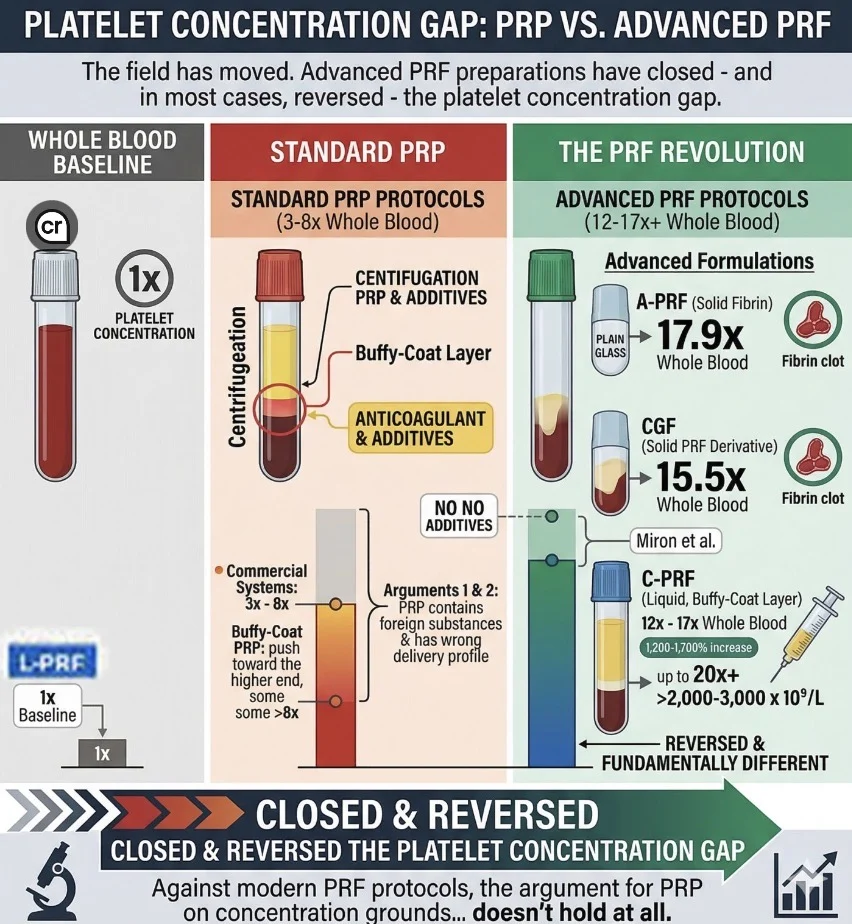
Standard PRP across most commercial systems:
3-8x whole blood concentration.
Buffy-coat PRP systems tend to be on the higher end.
Some reach slightly above 8x.
Now PRF:
- A-PRF (solid fibrin): 17.9x whole blood
- CGF (solid PRF derivative): 15.5x
- C-PRF (liquid): 12-17x – with some preparations exceeding 20x
Miron et al. quantified C-PRF from the buffy-coat fraction and reported increases of 1,200-1,700% over whole blood.
Concentrations routinely above 2,000-3,000 x 10⁹/L.
At those levels, we’re no longer talking about a marginal difference from PRP.
We’re looking at a fundamentally different concentration range.
To be precise: these are advanced PRF formulations – A-PRF, CGF, C-PRF – not standard low-speed PRF. Technique and protocol matter. But that’s exactly the point.
The field has moved.
Advanced PRF preparations have closed – and in most cases, reversed – the platelet concentration gap that once gave PRP its primary quantitative advantage.
The argument for PRP on concentration grounds was never rock-solid.
Against modern PRF protocols, it doesn’t hold at all.
Three arguments for PRP orthodoxy. Three answers from the evidence.”
Stay updated with Hemostasis Today.
-
Nov 8, 2026, 17:27Danny Gaskin: Applications Open for the BBTS Specialist Certificate in Clinical Transfusion Practice
-
Nov 8, 2026, 16:54James P. Crowley: DOAC Testing Under 50 ng/mL Safely Expedites Urgent Hip Fracture Surgery
-
Nov 8, 2026, 16:21Alessandra Bosch: Women and Girls With Bleeding Disorders and the DACH Registries at HHS 2026
-
Nov 8, 2026, 15:0310 Posts Not to Miss This Week
-
Nov 8, 2026, 14:55Andra T.: Antiphospholipid Syndrome and Its Thrombotic Risks
-
Nov 8, 2026, 14:06Shayan Mohammadmoradi: ZEUS Trial-Inflammation Reduction Without Fewer Cardiovascular Events
-
Nov 8, 2026, 14:05Kausik Ray: Plaque-Guided Care for Better Coronary Outcomes
-
Nov 8, 2026, 14:05Athira Elssa Johnson: Understanding Coronary Thrombosis and Its Risks
-
Nov 8, 2026, 14:04Sanjiv Beri: Blood Type Compatibility and the Balance of Giving and Receiving