


Seth Masters: Blocking the Effect of Pyrin by Targeting IL-1
Seth Masters, Center Head at Hudson Institute of Medical Research, shared a post on LinkedIn about a recent article he and his colleagues co-authored, published in Science Immunology, adding:
“For three generations, an Australian family suffered an inflammatory disease that took them to the hospital many times, but the cause could not be found.
It was not familial Mediterranean fever (FMF), but similarities to that condition connected them to our Australian Autoinflammatory Disease Registry, www.aadry.org
Together with Hudson Institute of Medical Research, Monash Health, Hallym University, South Korea, and The National Institutes of Health, researchers Shouya Feng, Wonyong Lee and clinicians Samar Ojaimi , William Renton, we finally found something.
It turns out that there was a genetic variant, never seen before, leading to a change in the protein CDC42, causing it to interact more tightly with the protein Pyrin, which causes FMF.
This research suggested that blocking the effect of Pyrin by targeting IL-1 would work, and it turned out to have a great therapeutic effect.
Remarkably, this family wasn’t alone. Colleagues in France and Japan publish alongside us in this issue of Science Immunology that other patients have the same condition from a slightly different genetic change right next door in CDC42.
Moreover, the laboratories in Japan found that FMF variants bind more tightly to CDC42, explaining how they work.
We still have a lot to learn about the innate immune system, but every small scientific step forwards is a big deal for the patients we are trying to help here in Australia, and it turns out, around the world.”
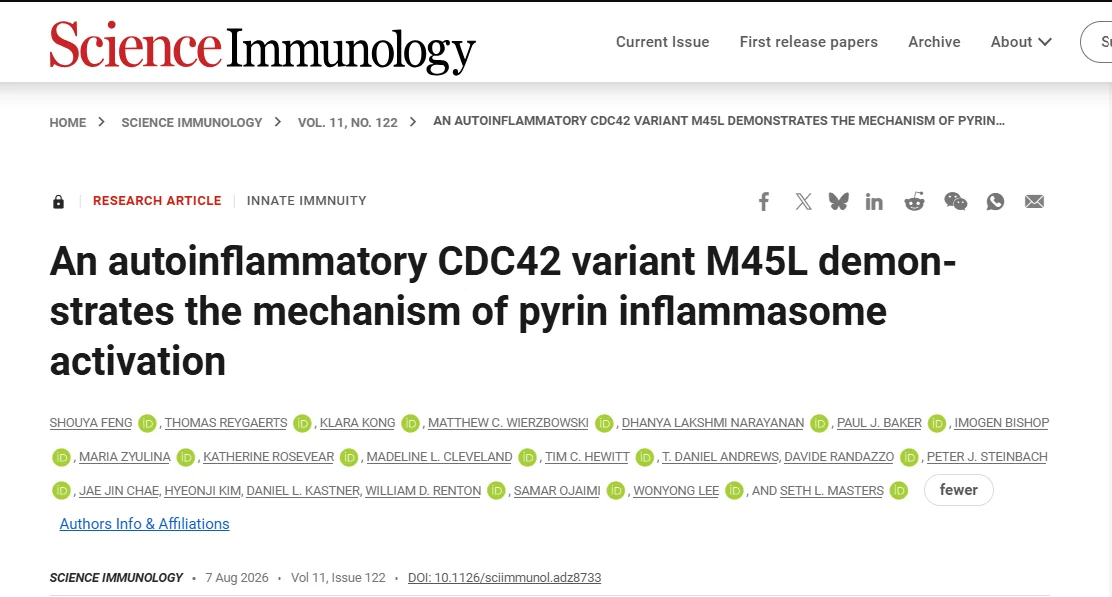
Title: An autoinflammatory CDC42 variant M45L demonstrates the mechanism of pyrin inflammasome activation
Authors: Shouya Feng, Thomas Reygaerts, Klara Kong, Matthew C. Wierzbowski, Dhanya Lakshmi Narayanan, Paul J. Baker, Imogen Bishop, Maria Zyulina, Katherine Rosevear, Madeline L. Cleveland, Tim C. Hewitt, T. Daniel Andrews, Davide Randazzo, Peter J. Steinbach, Jae Jin Chae, Hyeonji Kim, Daniel L. Kastner, William D. Renton, Samar Ojaimi, Wonyong Lee, Seth L. Masters
Stay updated on all scientific advances with Hemostasis Today.
-
Nov 8, 2026, 17:57Dhiren Patel: PLD1-Derived Phospholipids Regulate NAD Kinase and ROS Production in Neutrophils
-
Nov 8, 2026, 17:48Andra T.: What Causes Antiphospholipid Syndrome? – Four Steps, not One Cause
-
Nov 8, 2026, 17:38Nasrin Samadi: Can a Normal Clotting Test Be Misleading?
-
Nov 8, 2026, 17:36Paschalis Evangelidis: The Multifactorial Nature of Cardiovascular Risk in People With Hemophilia
-
Nov 8, 2026, 17:32Evangelos Panagiotopoulos: Apixaban Reduces Stroke and Major Bleeding Risk in Secondary Stroke Prevention
-
Nov 8, 2026, 17:27Danny Gaskin: Applications Open for the BBTS Specialist Certificate in Clinical Transfusion Practice
-
Nov 8, 2026, 16:54James P. Crowley: DOAC Testing Under 50 ng/mL Safely Expedites Urgent Hip Fracture Surgery
-
Nov 8, 2026, 16:21Alessandra Bosch: Women and Girls With Bleeding Disorders and the DACH Registries at HHS 2026
-
Nov 8, 2026, 15:0310 Posts Not to Miss This Week