


Simon Senanu: Understanding the Extrinsic Coagulation Pathway
Simon Senanu, Medical Laboratory Scientist at Perkins Medical Centre, shared a post on LinkedIn:
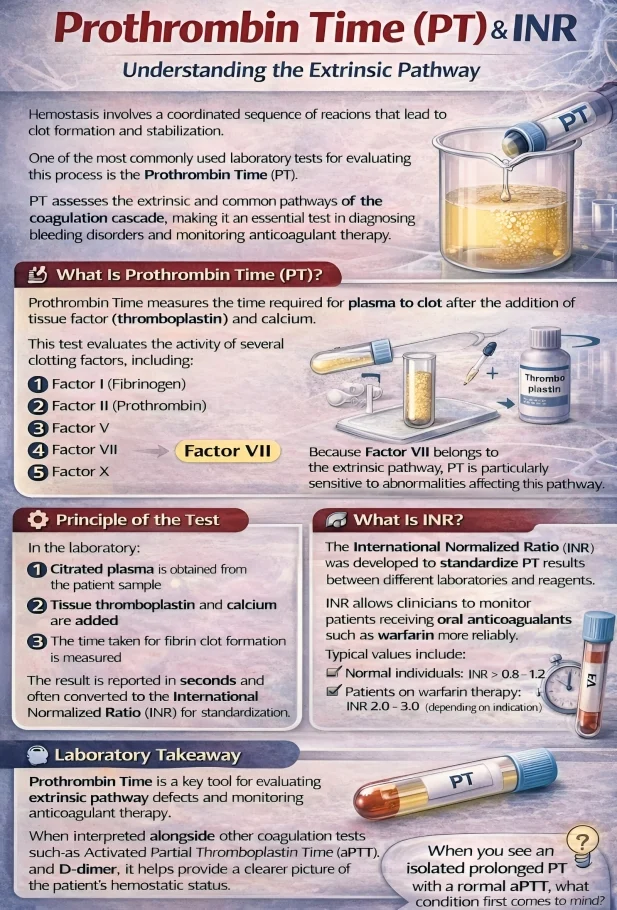
”Prothrombin Time (PT) and INR – Understanding the Extrinsic Pathway
Hemostasis involves a coordinated sequence of reactions that lead to clot formation and stabilization.
One of the most commonly used laboratory tests for evaluating this process is the Prothrombin Time (PT).
PT assesses the extrinsic and common pathways of the coagulation cascade, making it an essential test in diagnosing bleeding disorders and monitoring anticoagulant therapy.
What Is Prothrombin Time (PT)?
Prothrombin Time measures the time required for plasma to clot after the addition of tissue factor (thromboplastin) and calcium.
This test evaluates the activity of several clotting factors, including:
- Factor I (Fibrinogen)
- Factor II (Prothrombin)
- Factor V
- Factor VII
- Factor X
Because Factor VII belongs to the extrinsic pathway, PT is particularly sensitive to abnormalities affecting this pathway.
Principle of the Test In the laboratory:
- Citrated plasma is obtained from the patient sample
- Tissue thromboplastin and calcium are added
- The time taken for fibrin clot formation is measured
The result is reported in seconds and often converted to the International Normalized Ratio (INR) for standardization.
What Is INR?
The International Normalized Ratio (INR) was developed to standardize PT results between different laboratories and reagents.
INR allows clinicians to monitor patients receiving oral anticoagulants such as warfarin more reliably.
Typical values include:
- Normal individuals: INR ≈ 0.8 – 1.2
- Patients on warfarin therapy: INR 2.0 – 3.0 (depending on indication)
Causes of Prolonged PT
Prolonged PT may occur in conditions affecting the extrinsic or common coagulation pathways, including:
- Vitamin K deficiency
- Liver disease
- Warfarin therapy
- Disseminated intravascular coagulation (DIC)
- Factor VII deficiency
- Severe clotting factor depletion
Because many clotting factors are synthesized in the liver, PT is often used as a marker of hepatic synthetic function.
Pre-Analytical Considerations
Accurate PT results depend on proper sample handling. Important factors include:
- Correct blood-to-anticoagulant ratio (9:1)
- Proper mixing of citrated blood
- Avoiding hemolysis or clot formation in the tube
- Prompt plasma separation
Errors during collection or processing may lead to falsely prolonged results.
Laboratory Takeaway
Prothrombin Time is a key tool for evaluating extrinsic pathway defects and monitoring anticoagulant therapy.
When interpreted alongside other coagulation tests such as Activated Partial Thromboplastin Time (aPTT) and D-dimer, it helps provide a clearer picture of the patient’s hemostatic status.”
Other posts featuring Simon Senanu on Hemostasis Today.
-
Sep 16, 2026, 16:06Katrina Louise Manalaysay: In Your 20s, You Might be Given the Opportunity to Donate Blood for the First Time
-
Sep 16, 2026, 15:45Matthew Hazell: A Brilliant Explanation of Phenotype vs Genotype Using a LEGO House
-
Sep 16, 2026, 15:23Ahmad Al-Ramahi: Presenting the Military Pharmacists Blood Training Course at the FIP World Congress
-
Sep 16, 2026, 15:21HIT Reimagined: Can 12-Lipoxygenase Inhibition Stop Immune Thrombosis?
-
Sep 16, 2026, 14:42Ruchi Punamia: Beyond the Blood Bank and The Clinical Impact of Apheresis
-
Sep 16, 2026, 14:06Kalyan Roy: Celebrating Apheresis, Advancing Care, Saving Lives
-
Sep 16, 2026, 13:38Andrew Zapfel: Advancing Sickle Cell Disease Care and Research
-
Sep 16, 2026, 13:30Thirunavukkarasu Angappan: Why Plasma-Derived Factor VIII Still Matters for Inhibitor Patients
-
Sep 16, 2026, 13:22Matthew Hazell: New BSH Guidance for Fetal, Neonatal and Paediatric Transfusion