

Tagreed Alkaltham: In Transfusion Medicine, Every Reaction Deserves An Answer
Tagreed Alkaltham, Transfusion Medicine Lab Supervisor at KSMC, shared a post on LinkedIn:
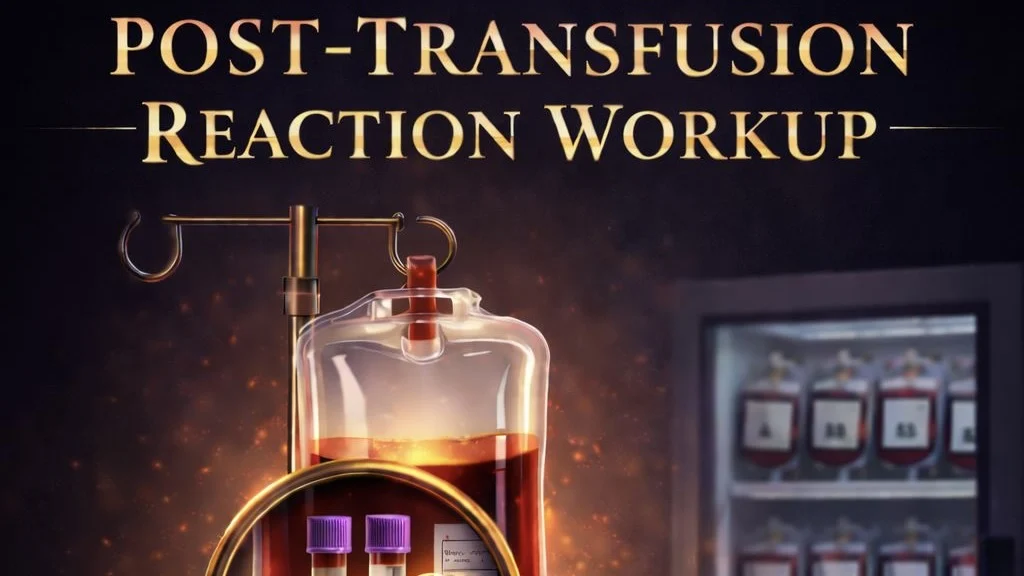
”Post-Transfusion Reaction Work-Up
What happens the moment a transfusion reaction is suspected?
The transfusion stops. But the investigation begins.
When a patient develops symptoms during or after a transfusion, the response is not assumption.
It is a structured safety protocol.
A post-transfusion reaction work-up is initiated to:
- Determine whether the reaction is transfusion related.
- Identify the type of reaction.
- Prevent recurrence.
- Protect future patients.
Post-transfusion work-up is multidisciplinary.
Post Transfusion Work-up at the bedside:
Step 1: Clerical Check
Before any lab testing, identity verification:
- Patient ID
- Unit number
- Compatibility records
Because the most severe reactions often begin with a preventable error.
Step 2: Return the blood bag and administration set to the Blood Bank.
Step 3: Send a new patient sample in EDTA for testing.
Step 4: Send a urine sample to Microbiology Laboratory to check for hemolysis (Hb. in urine).
Step 5: Blood cultures should be sent if fever or septic reaction is suspected to Microbiology Laboratory.
Proper specimen handling and clinical correlation are essential for accurate investigation.
Post Transfusion Work-up at Microbiology Laboratory:
- Hb. in urine: for hemoglobinuria, indicates hemolytic transfusion reaction.
- Blood culture from patient for bacterial infections.
Post Transfusion Work-up at Transfusion Medicine Laboratory:
Check for Clerical errors:
Re-verify patient identification and unit information for clerical discrepancies.
Visual inspection of pre and post transfusion samples plasma and comparing them:
Pink/red plasma may suggest hemolysis
Direct Antiglobulin Test (DAT) for pre and post transfusion samples:
Detects antibody/complement coating RBCs
ABO and Rh typing for pre and post transfusion samples and blood bag:
Rules out grouping error
Antibody screen and identification pre and post transfusion samples.
Crossmatch for pre and post transfusion samples:
Detects incompatibility.
Take sample from the blood unit for blood culture and gram stain and send it to Microbiology in case the patient has fever:
Blood cultures (rule out septic reaction).
All results must be integrated and interpreted in correlation with the clinical presentation.
Why It Matters
Because in transfusion medicine, every reaction deserves an answer
It is about clarity.
It protects:
- The patient in front of us
- The next transfusion
- The system as a whole
In transfusion medicine investigation is patient safety in action.”
Stay updated with Hemostasis Today.
-
Oct 21, 2026, 07:15Mahmoud Saad: Successful Mechanical Thrombectomy for Right Atrial Thrombosis
-
Oct 21, 2026, 06:55Hunain Shahbaz: Extended Dual Antiplatelet Therapy Beyond 12 Months After Drug-Eluting Stent Implantation
-
Oct 21, 2026, 06:19Dawood Findakly: When Should Anticoagulation Be Held or Resumed?
-
Oct 21, 2026, 03:36Steve Watson: Ligand Epitope Ratios Influence Antagonist Inhibition
-
Oct 21, 2026, 03:18Stephen D. Coombs: Superficial Venous Thrombosis in Athletes and Importance of Early Recognition and Referral
-
Oct 21, 2026, 02:52Aymar Akilimali: Bleeding During Anticoagulation as a Potential Signal of Occult Cancer
-
Oct 21, 2026, 00:58Anees Ur Rahman: Completing a Two-Week Clinical Rotation at Haemophilia Treatment Centre Rawalpindi
-
Oct 21, 2026, 00:56Caitlyn Mooney: Pulmonary Embolism in Athletes, Recognition and Return to Sport
-
Oct 21, 2026, 00:54Hani Karrar: Pleased to Share Our Review on Emicizumab in Hemophilia A Management